
Beyond Silver Bullets: How We Solve Canada’s Wicked Problems Matters
A call for collaborative, evidence-driven approaches to tackle Canada’s complex and interconnected climate, infrastructure, and sustainability challenges.

Canada is at a crossroads. Climate disasters strain our infrastructure, food insecurity is on the rise, and our construction sector creates waste where it could be creating resources.
These crises aren’t separate issues. They’re interconnected symptoms of wicked problems—problems that are so complex and entangled that traditional, siloed approaches not only fail to solve them but often make them worse.
Over the past year, through the Wicked Solutions Series with TheFutureEconomy.ca, we’ve convened problem-solvers across sectors in an effort to untangle some of Canada’s most wicked problems.
Throughout the series, it became clear that while each problem demands its own unique approach, there are a few common elements that have the power to propel a wicked solution forward, no matter what the problem may be. While what follows is not a fulsome analysis of what is required to drive systems change, it’s valuable to shine a light on some of the most consistent ideas that surfaced as part of the Wicked Solutions Series.
Collaboration Needs to Be Irresistible, Not Optional
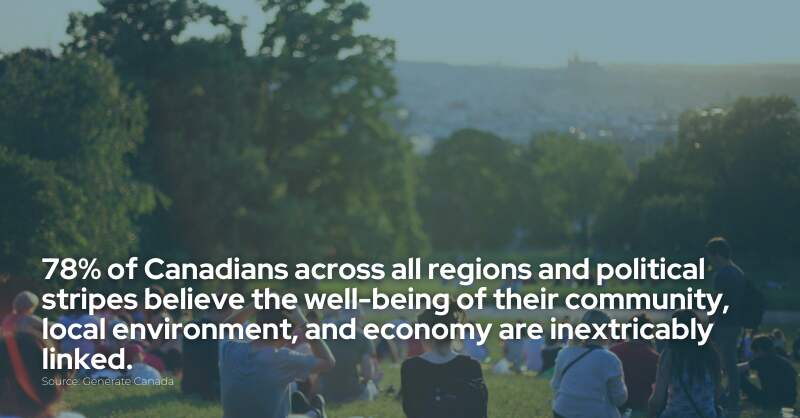
The wicked problems we face are increasingly interconnected, and so must be our approach. There simply isn’t one group—government, industry, academic, or non-profit—that can tackle these issues on their own.
And while we know collaboration is essential, how do we convince stakeholders to work together in ways that leverage our collective knowledge and power?
“While most groups want to contribute to the common good, they need to understand how collaboration can benefit their own personal interests, too.”
In our first episode of the Wicked Solution series, Chad Park of Co-operators reminded us that the “fear of missing out” can be a powerful tool to motivate folks to join their peers in solving an issue. As Park said, “If enough of the right actors are convened—if there’s a critical mass saying, ‘We’re going to solve this issue, would you like to join us?’—that can be very compelling.”
Folks don’t want to be left out—they want to be part of the next big solution. And as leaders, it’s our job to show them who else is in the room and why they should be there too.
Another way to incentivize collaboration is to demonstrate how solving a problem together benefits each participant. While most groups want to contribute to the common good, they need to understand how collaboration can benefit their own personal interests, too. This not only helps them pitch an idea within their own organization, but it also provides them with a valuable network that can help them achieve their own goals.
For example, when we can prove that taking part in regenerative farming not only raises productivity and increases ecosystem performance, but also increases farmers’ gross margin per hectare by 20%, all of a sudden, regenerative farming sparks the interest of those who may have been hesitant to participate otherwise.
When you can see the individual and shared benefit in solving systemic issues, it’s a win-win for every part of the value chain.
Wicked Solutions Require Investment of Capital, and Not Just the Financial Kind
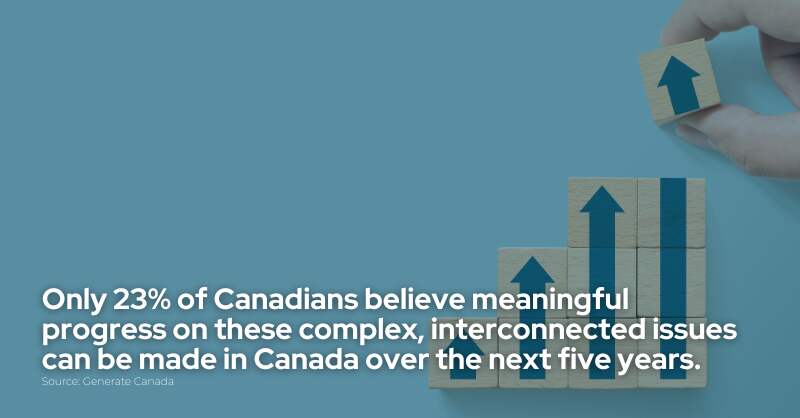
Tackling wicked problems requires substantial investment of financial capital, but we can’t forget the other forms of capital that are necessary to scale the solutions we need. Natural, human, and social capital will play a huge role in our ability to catalyze change.
“Those who are able to recognize the power of social capital will be the ones to successfully chart new pathways through complexity.”
Social capital—the relationships we cultivate, the trust we build, and the networks we nurture—can sometimes be viewed as a ‘nice to have’ in comparison to financial capital, but through the conversations had as part of the Wicked Solutions Series and in my daily work at Generate Canada, it is clear that social capital is an incredibly powerful resource that cannot be ignored. When unlocked, it can underpin much of the change we wish to create.
Hillary Thatcher from Canada Infrastructure Bank provided a great example of this in our episode exploring the need to invest in climate-resilient infrastructure. She discussed how good relationships built between the private sector and Indigenous communities have resulted in the development of critical infrastructure projects—projects that simply could not be done without established trust between groups. Thatcher said, “These partnerships foster more positive community engagement, increased openness to collaboration, and ultimately lead to more resilient infrastructure.”
Those who are able to recognize the power of social capital will be the ones to successfully chart new pathways through complexity.
Learning by Doing
“Good data, research and monitoring of processes and results are essential to ensure we build on evidence already available.”
Instead of pursuing perfection on paper, we need evidence to drive innovations that are tested and scaled in the real world. That’s how we learn what works.
In the episode exploring regenerative agriculture with Craig Klemmer from Farm Credit Canada and Nick Betts from CANZA, our experts made it clear that the path to greater productivity involves farmers testing practices on their land, gathering data, sharing results, and iterating. Literally digging in and trying new practices is what’s needed to spur the work forward. No amount of research can have the same impact as putting that research to work in the field.
Good data, research and monitoring of processes and results are essential to ensure we build on evidence already available.
The circular construction discussion with Paul Shorthouse from Circular Economy Leadership Canada and Meredith Moore from Ouroboros Construction revealed similar patterns. Rather than waiting for perfect policy frameworks, they discussed how, by demonstrating deconstruction and material reuse at scale, you can generate evidence that informs better regulations while proving commercial viability.
This iterative approach places focus on progress over perfection. And while it can be challenging to build the plane as it’s flying, if we are able to test ideas, we can then scale what works and pivot quickly from what doesn’t.
Meeting Canada’s Moment
It is going to take a concerted effort of many to address the ever-growing and evolving challenges facing us in Canada.
As much as we’d like them, there are no silver bullets to solve the interconnected challenges we are up against. But, by focusing on how we do the work, we are creating a foundation that will allow us to better innovate, test, and scale future-fit and made-in-Canada solutions, together.
About the Expert
-

David Hughes is President & CEO of Generate Canada (formerly The Natural Step Canada), overseeing initiatives like the Canada Plastics Pact, CANZA, and Circular Economy Leadership Canada. He has led NGOs, including Habitat for Humanity Canada and Pathways to Education, held senior roles at global nonprofits, and holds degrees in economics and social policy.
See more
-
 Wicked Problems, Wicked Solutions: How to Tackle Canada’s Toughest Challenges
 Chad Park
VP, Sustainability & Citizenship
Co-operators
Chad Park
VP, Sustainability & Citizenship
Co-operators
 Tima Bansal
Founder & Lab Leader
Innovation North
Tima Bansal
Founder & Lab Leader
Innovation North
 David Hughes
President & CEO
Generate Canada
David Hughes
President & CEO
Generate Canada
-
 From Waste to Wealth: Building Canada’s Circular Food Economy
 Dr. Tammara Soma
Director
Research Food Systems Lab
Dr. Tammara Soma
Director
Research Food Systems Lab
 Amr Addas
Senior Director, Sustainable Finance and Insights
Farm Credit Canada
Amr Addas
Senior Director, Sustainable Finance and Insights
Farm Credit Canada
 Barbara Swartzentruber
Senior Advisor
Canadian Alliance for Net-Zero Agri-food
David Hughes
President & CEO
Generate Canada
Barbara Swartzentruber
Senior Advisor
Canadian Alliance for Net-Zero Agri-food
David Hughes
President & CEO
Generate Canada
-
 Climate-Driven Financial Vulnerability is a Vicious Cycle. How Do We Reverse It?
Chad Park
VP, Sustainability & Citizenship
Co-operators
Climate-Driven Financial Vulnerability is a Vicious Cycle. How Do We Reverse It?
Chad Park
VP, Sustainability & Citizenship
Co-operators
 Eloise Duncan
Founder and CEO
Financial Resilience Institute
David Hughes
President & CEO
Generate Canada
Eloise Duncan
Founder and CEO
Financial Resilience Institute
David Hughes
President & CEO
Generate Canada