
Getting Sustainable Finance for Agri-food Right is How Canada Feeds the World
Canada is one of the world’s top food exporters, but to maintain this role in the face of climate change, it must channel greater investment into regenerative agriculture and sustainable finance to strengthen farmers’ resilience and secure global food security.

Eating the Cost of Climate Change
Over the past few years, the world has experienced unprecedented spikes in the cost of basic foods. Potato prices in the UK shot up 22%. Olive oil across Europe costs 50% more. In the US, vegetable prices nearly doubled. And across the globe, the cost of cocoa tripled. Was it inflation? War? Supply chain disruption? Tariffs? In these cases, the clear driver was climate change.
Droughts, heatwaves, floods—the increasing and escalating impacts of a warming global climate—are decimating crops in every continent, hurting the wallets of the people who buy food as well as those who grow it. Food prices are complicated; there is never one single factor at play. But what’s absolutely clear is that, whatever else is going on in the world that impacts the cost of your groceries, climate change makes it worse, limiting food supplies and making them unpredictable.
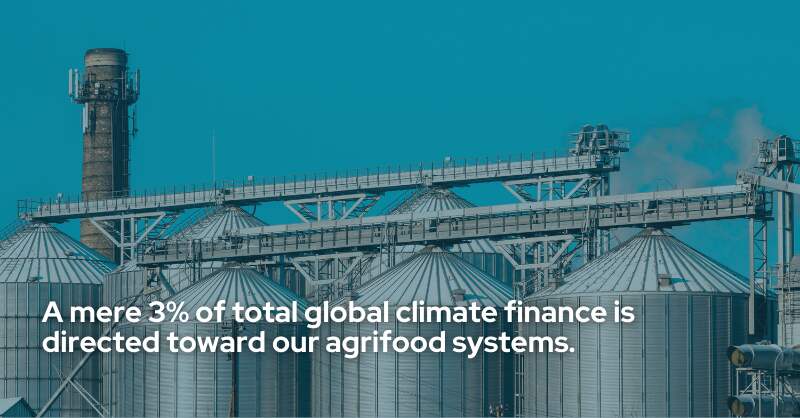
Yet, a mere 3% of total global climate finance is directed toward our agrifood systems. This is particularly surprising not only because of what is at stake—the world’s food supply—but also because agriculture is both a contributor to the problem of climate change and a key to its solution. If there is one place in the world where we need to get sustainable finance right for agrifood, it’s Canada.
Canada’s Risk and Global Opportunity
For Canadians, many of whom live far away or disconnected from the places where our food is grown, the relationship between food and climate change may feel abstract. Canada’s farmers, on the other hand, are living it.
Across the Canadian prairies, persistent droughts have plagued crops, in some cases, for as long as nine growing seasons. This impacts both yield and quality. Wheat, barley, and peas that would have been used to feed people are being sold as animal feed. Losses are so devastating that third and fourth-generation farmers in places like Saskatchewan and Alberta are considering throwing in the towel. These costs impact the security of our farmers and the resiliency of our food system. According to the Canadian Agri-Food Policy Institute, “the cost of [crop] insurance payouts has surged alongside extreme weather,” placing a significant strain on Canada’s farm support programs.
“Canada remains one of the world’s best hopes for global food production and security.”
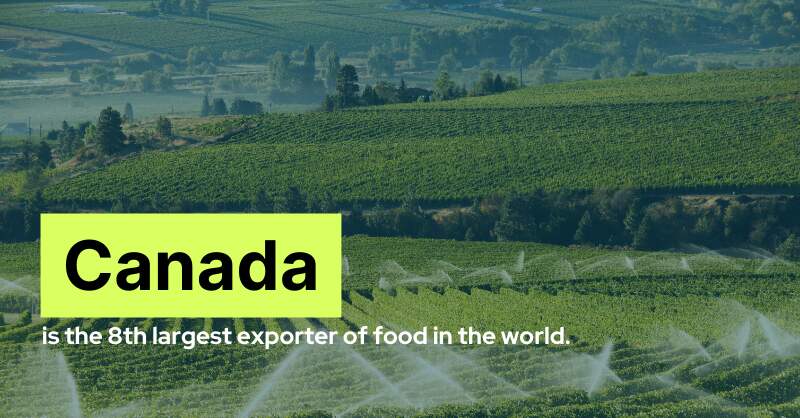
Even in the face of these worsening challenges, Canada remains one of the world’s best hopes for global food production and security. Our advantage rests on “strengths across our entire food value chain”: the stability of our democracy, our natural wealth (an abundance of arable land and water), world-class farming knowledge, reliable and safe production practices, robust ag-education ecosystem, and ability to meet global demand for traditional as well as emerging food trends. Today, Canada is the 8th largest exporter of food in the world. Experts predict that Canada can, and must, punch well-above that weight in the years to come—to serve the world’s interests and our own.
Regenerative Ag Opens a Trove of Value
But how do we increase food production in the face of increased climate risk? How do we bolster the resilience of our crops, and protect them from flood, drought and soil erosion? The answers may be found in the uptake of regenerative agriculture practices. While the term still lacks a single definition, broadly agreed-upon principles of regenerative agriculture focus on maximizing soil health. These include the broad adoption of practices that minimize soil disturbance, keep soil covered year-round and that enhance biodiversity above and below the ground.
“The recently reported results of a 3-year European study of regenerative farms found they delivered 33% higher productivity (with yield parity) and increased ecosystem performance while reducing pesticide use.”
This shift offers a trove of integrated economic, ecological, and community values. It enables farmland to trap and store carbon in the ground, makes farmlands more productive and resilient to climate impacts, supports pollinator populations and healthier watersheds, and even reduces agricultural emissions that contribute to climate change. The recently reported results of a 3-year European study of regenerative farms found they delivered 33% higher productivity (with yield parity) and increased ecosystem performance while reducing pesticide use (which impacts biodiversity and human health) by 75% and nitrogen fertilizer (which impacts climate) by 61%. Moreover, farmers earned a 20% higher gross margin per hectare.
The Need for Sustainable Investment
Increasing the uptake of regenerative agriculture practices could be the key to securing the long-term appreciative value of Canada’s agricultural wealth as we rise to feed the world. That’s because regenerative agriculture is vital for enhancing productivity, improving profitability, and fostering long-term competitiveness. It epitomizes Generate Canada’s definition of a “wicked solution” to a “wicked problem.”
But it won’t happen without significant investment. Farmers (who carry the slimmest profit margins in the supply chain) shoulder the lion’s share of the transition risk. Shifting to regenerative practices requires out-of-pocket spending on resources, equipment, and upskilling that do not pay for themselves overnight. Short-term yield drops are not uncommon. We need patient capital to help share that risk with farmers as they undertake these new approaches.
Further, environmental outcomes markets—which create the carbon and biodiversity offsetting and insetting opportunities that could compensate and reward farmers for undertaking these risks–are not yet mature. They lack the credible standards, including measurement and verification systems, necessary to attract buyers.
“In 2024, we captured less than 2% of the global venture capital invested in ag tech deals (compared to the US, which attracted more than 45%).”
Finally, the promises of regenerative agriculture can be significantly boosted through technological innovation. According to a recent FCC study, “significant agricultural productivity gains in past decades can be largely attributed to technological advancements and improved management practices that resulted from investments in agricultural innovations, their commercialization and their adoption.” But Canada is falling behind. As FCC’s report notes, agricultural knowledge generation has been in steady decline for decades. Further, Canada is failing to invest in the leap from research to commercialization. This, in turn, dampens global investment in our ag sector. In 2024, we captured less than 2% of the global venture capital invested in ag tech deals (compared to the US, which attracted more than 45%).
Crowding in Innovation
These barriers can be overcome, not by a single sector or actor, but by the full agrifood supply chain (and beyond) working collaboratively to develop, test, and scale innovative solutions. The World Economic Forum’s 100 Million Farmers report offers the case, model, and a number of specific examples for how collaborative approaches, including blended finance models, can unlock the barriers to scaling regenerative agriculture. “A coordinated system of actors can drive a step-change in sustainable food production by financing and delivering services for farmers that reduce their adoption risk,” the report explains.
These approaches are new in Canada, but they are gaining momentum. One breakthrough example, led by CANZA and supported by Nutrien, Maple Leaf Foods, and the Government of Canada, is developing new tools for farmers to measure the impacts of regenerative farming practices on their land. Built on the success of two pilot projects, the initiative is advancing the technology, tools, and processes needed to measure, report, and verify the amount of carbon sequestered in soil. The project, which brings together academic, technology, and farming partners, aims to unlock economic incentives for regenerative agriculture by establishing the data framework of a credible environmental outcomes marketplace.
Another effort, led by FCC, seeks to measure and track the change in the risk profile of producers that choose to adopt a transition to regenerative agricultural practices. The objective is to test the hypothesis that the adoption of regenerative agriculture practices reduces risk. FCC is also advancing solutions to boost investment and innovation in ag tech. That includes a commitment to invest $2 billion by 2030 to advance innovation in Canada’s agriculture and food industry. This will direct more investment into innovative devices, instrumentation, research, and methodologies designed to improve efficiency, productivity, and sustainability.
“Unleashing the power of regenerative agriculture in Canada and, in turn, Canada’s ability to meet global food demand will require much more.”
These are important steps, but unleashing the power of regenerative agriculture in Canada and, in turn, Canada’s ability to meet global food demand will require much more. As we collectively answer the question of what Canada’s role will be in a new emerging world, we must embrace this opportunity and align our energy and resources behind it. Because if Canada doesn’t rise to feed the world sustainably, who will?
About the Experts
-

Amr Addas is the Senior Director, Sustainable Finance and Insights of Farm Credit Canada. Prior to that, Amr was the Strategic Advisor for Sustainability and a lecturer at the John Molson School of Business, Concordia University, director of the Van Berkom Investment Management Program, and was the director of Concordia’s Sustainability Ecosystem.
See more -

Barbara Swartzentruber is the Senior Advisor of the Canadian Alliance for Net-Zero Agri-food. She is a strategist, catalyst, and connector, working with government and communities to respond to urgent social, economic, and environmental challenges through civic innovation, regenerative practices, and circular economy strategies.
See more -

David Hughes is President & CEO of Generate Canada (formerly The Natural Step Canada), overseeing initiatives like the Canada Plastics Pact, CANZA, and Circular Economy Leadership Canada. He has led NGOs, including Habitat for Humanity Canada and Pathways to Education, held senior roles at global nonprofits, and holds degrees in economics and social policy.
See more
-
 Wicked Problems, Wicked Solutions: How to Tackle Canada’s Toughest Challenges
 Chad Park
VP, Sustainability & Citizenship
Co-operators
Chad Park
VP, Sustainability & Citizenship
Co-operators
 Tima Bansal
Founder & Lab Leader
Innovation North
Tima Bansal
Founder & Lab Leader
Innovation North
 David Hughes
President & CEO
Generate Canada
David Hughes
President & CEO
Generate Canada
-
 From Waste to Wealth: Building Canada’s Circular Food Economy
 Dr. Tammara Soma
Director
Research Food Systems Lab
Dr. Tammara Soma
Director
Research Food Systems Lab
 Amr Addas
Senior Director, Sustainable Finance and Insights
Farm Credit Canada
Amr Addas
Senior Director, Sustainable Finance and Insights
Farm Credit Canada
 Barbara Swartzentruber
Senior Advisor
Canadian Alliance for Net-Zero Agri-food
David Hughes
President & CEO
Generate Canada
Barbara Swartzentruber
Senior Advisor
Canadian Alliance for Net-Zero Agri-food
David Hughes
President & CEO
Generate Canada
-
 Climate-Driven Financial Vulnerability is a Vicious Cycle. How Do We Reverse It?
Chad Park
VP, Sustainability & Citizenship
Co-operators
Climate-Driven Financial Vulnerability is a Vicious Cycle. How Do We Reverse It?
Chad Park
VP, Sustainability & Citizenship
Co-operators
 Eloise Duncan
Founder and CEO
Financial Resilience Institute
David Hughes
President & CEO
Generate Canada
Eloise Duncan
Founder and CEO
Financial Resilience Institute
David Hughes
President & CEO
Generate Canada