
Marine Renewables: The Key to Unlocking Canada’s Blue Economy Potential
Marine renewables are a key driver of Canada’s blue economy, connecting clean energy with innovation and sustainable ocean growth.

The phrase “blue economy” has become a fixture in policy discussions around the world. Governments, investors, and industry leaders increasingly view the ocean not only as an environmental asset but as a source of long-term economic growth.
At its simplest, the blue economy is the sustainable use of ocean resources to create jobs, generate prosperity, and support healthy marine ecosystems. It is built on a deceptively simple idea: economic growth and environmental stewardship should reinforce one another, not compete.
For Canada, that opportunity is enormous.
Why Marine Renewables Are Critical to Canada’s Future
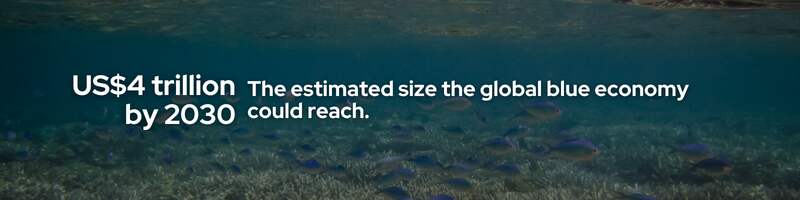
With the world’s longest coastline, access to three oceans, and the fourth-largest ocean territory on the planet, Canada possesses natural advantages that few countries can match. Yet despite these assets, we have only begun to unlock our potential as an ocean nation. The OECD estimates the global blue economy could reach US$4 trillion by 2030, while Canada’s Ocean Supercluster has set a goal of growing Canada’s ocean economy from $39 billion in GDP in 2019 to $220 billion by 2035.
Reaching that ambition will require growth across multiple sectors, including fisheries, aquaculture, marine transportation, ocean technology, and clean energy. But if the objective is to build an economy that generates value while protecting the ocean itself, one sector stands out for its ability to deliver both: marine renewable energy.
In fact, marine renewables—offshore wind, tidal, and wave energy—may be one of the most important innovation opportunities the blue economy has ever seen.
More Than Clean Energy

Marine renewable energy is often discussed through the lens of electricity generation. Offshore wind, tidal energy, and wave energy technologies can produce large amounts of low-carbon power while reducing dependence on fossil fuels.
That alone would make them important.
The ocean absorbs roughly 30% of global carbon dioxide emissions and more than 90% of excess heat caused by greenhouse gases. Climate change is already affecting ocean health through warming waters, acidification, biodiversity loss, and increasingly severe storms. Reducing emissions is no longer just a climate objective—it is an ocean protection strategy.
But focusing solely on electricity misses the larger story.
The real value of marine renewables lies in the innovations they make possible.
Marine renewable energy projects operate in some of the most complex environments on Earth. Engineers must design systems that can withstand powerful tides, corrosive saltwater, extreme weather, and challenging offshore conditions. Developers must monitor ecosystems, collect vast amounts of ocean data, and manage operations far from shore.
Meeting those challenges drives innovation.
Every offshore wind farm, tidal turbine deployment, and demonstration project becomes a testbed for new technologies, new skills, and new ways of working in the ocean.
Marine Renewables Are An Innovation Multiplier
“Marine renewables do not simply produce electricity. They create knowledge.”
Marine renewables are often described as energy projects. In reality, they are innovation projects.
Developing these technologies accelerates advances in robotics, autonomous vessels, artificial intelligence, digital twins, advanced manufacturing, subsea engineering, environmental monitoring systems, and ocean data analytics.
The benefits extend well beyond energy.
The same autonomous systems developed to inspect offshore energy infrastructure can support ocean science and maritime safety. Environmental monitoring technologies created for marine energy projects can improve fisheries management and ecosystem protection. Advanced manufacturing capabilities developed for offshore structures can strengthen domestic supply chains and create export opportunities in global markets.
In other words, marine renewables do not simply produce electricity. They create knowledge.
And knowledge is one of the most valuable economic resources a country can possess.
Around the world, jurisdictions leading in offshore renewable energy are increasingly becoming leaders in ocean technology, marine services, engineering, and advanced manufacturing. The innovation ecosystems built around these industries often generate economic activity far beyond the value of the electricity itself.
Canada has every reason to compete in that space.
Canada Is Not Starting From Scratch
“Innovation is rarely the result of a single breakthrough. More often, it is the product of sustained investment, experimentation, learning, and adaptation over time.”
One of the most common misconceptions about marine renewables is that they are entirely new.
In reality, Canada has been innovating in this sector for decades. Since the 1980s, tens of tidal energy deployments in Canadian waters have helped establish expertise in marine energy development through research, data collection, engagement with local and Indigenous communities, collaboration with governments and utilities, and technology development.
That experience matters.
Innovation is rarely the result of a single breakthrough. More often, it is the product of sustained investment, experimentation, learning, and adaptation over time.
Canada has already built much of the foundation. What comes next is scaling it.
That means creating the conditions for investment, supporting research and demonstration projects, modernizing regulatory processes, strengthening supply chains, and ensuring communities and Indigenous partners are positioned to benefit from development.
Turning Potential into Prosperity
“The countries that lead the blue economy in the coming decades will not be those that merely possess ocean resources. They will be the ones who develop the technologies, expertise, and industrial capacity to use those resources sustainably and competitively.”
Canada has the coastline. We have the wind, the tides, the waves, the engineering expertise, and the ocean technology capabilities. What we now need are concrete steps to connect them.
If Canada is to be part of a globally competitive blue economy, three priorities should rise to the top.
- Canada needs a clear long-term vision for marine renewable energy development, including regional energy planning, electricity transmission investments, and predictable procurement targets that provide investors and innovators with confidence to build here.
- We must make Canada a destination for marine renewable energy innovation. That means supporting research, development, demonstration, and commercialization activities that allow new technologies to be tested, refined, and deployed in Canadian waters before they are exported to the world.
- We need to build the conditions for success around projects themselves: modernized regulatory processes, strategic investments in ports and supply chains, meaningful Indigenous partnerships, stronger collaboration with international markets and technology leaders, and proactive planning that enables coexistence with fisheries, marine transportation, and other ocean users.
The countries that lead the blue economy in the coming decades will not be those that merely possess ocean resources. They will be the ones who develop the technologies, expertise, and industrial capacity to use those resources sustainably and competitively.
Marine renewables offer Canada an opportunity to do exactly that.
About the Expert
-

Elisa Obermann has been involved in the development of the marine renewable energy sector for over a decade. As Executive Director of Marine Renewables Canada, she champions offshore wind, tidal, wave, and river current energy through policy advocacy, innovation support, international partnerships, and supply-chain growth. Elisa holds a Masters in Public Administration from Dalhousie University.
Marine Renewables Canada is Canada’s national association for offshore wind, tidal, wave, and river-current energy development. The organization supports industry growth through policy advocacy, market development, collaboration, education, and supply-chain advancement.
See more
-
 The Ocean Is Not a Sector. It Is the System. Let’s Treat it that Way
 Jennie Moushos
Interim CEO & COO
Ocean Wise
Jennie Moushos
Interim CEO & COO
Ocean Wise
-
 Canada’s Ocean Future: Building Prosperity Through Sustainable Marine Protection
 Jason Goldsworthy
Executive Director
COAST Centre for Ocean Applied Sustainable Technologies
Jason Goldsworthy
Executive Director
COAST Centre for Ocean Applied Sustainable Technologies
-
 No More Delays: Efficiency and Integrity Should Guide Canada’s Fisheries Policies
 Daniel Pauly
Principal Investigator
Sea Around Us
Daniel Pauly
Principal Investigator
Sea Around Us
 Valentina Ruiz-Leotaud
Communications Lead
Sea Around Us
Valentina Ruiz-Leotaud
Communications Lead
Sea Around Us