
Marine Renewables: The Hidden Gem in Canada’s Energy-Superpower Future
Canada is sitting on a goldmine of untapped energy, from the world’s longest coastline to some of the highest tides on Earth, yet marine renewables remain the missing piece of our net-zero puzzle.

Canada is an ocean nation with a clean energy ambition worthy of its geography. We have the world’s longest coastlines, some of the highest tides on the planet, powerful waves, vast rivers, and world-class offshore wind resources. In a world racing to secure affordable, reliable, clean power, few countries are as naturally equipped as ours.
Yet marine renewable energy—tidal, offshore wind, wave, and river current—remains an underused pillar of Canada’s energy transition. The irony is stark: at the very moment Canada needs two to three times more clean electricity to meet net-zero goals by 2050, we are leaving enormous, predictable, energy-dense resources largely untapped. These resources aren’t speculative. Tides, winds, and river flows are measurable, local, and dependable. They can power homes and industries, produce green fuels, and keep energy flowing when other renewables are less available.
Proof of Capability, Not Potential
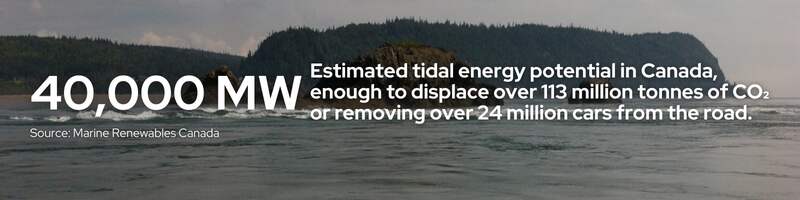
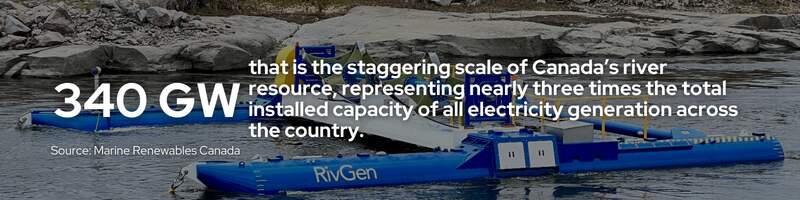
Canada has already shown what we can do. Tidal demonstrations in the Bay of Fundy, wave-energy innovation on British Columbia’s coast, river-current testing in Manitoba, and accelerating offshore wind momentum in Atlantic Canada prove we have the expertise, early supply-chain capability, and community partnerships to build a globally competitive sector.
But pilots and promises won’t win the future. Clear and sustained market signals and coordinated national action will.
This winter, Marine Renewables Canada will release our Sector Vision 2050 with partners and industry. It will outline actionable recommendations for federal, provincial, and territorial governments, utilities, investors, and developers to unlock Canada’s marine renewable potential and grow our economy. Drawing on industry experience, stakeholder engagement, and global best practices, we have identified the steps that must be taken now.
Where Canada Stands Today: Strong Potential, Uneven Progress
Around the world, marine renewables are scaling quickly. Countries with similar resource advantages are moving decisively: the UK and EU have built thriving offshore wind and tidal industries through targeted policy and procurement, and Asian markets have shown how rapidly large-scale offshore wind can be deployed when governments set clear rules for leasing, permitting, and grid connections.
Canada has comparable resources, but our progress remains fragmented across jurisdictions and technologies. In Atlantic Canada, offshore wind is finally moving from concept to market because federal-provincial Accord Act amendments and regulations are being implemented. Nova Scotia is advancing toward its first offshore wind call for bids in 2026, anchored by a 5-gigawatt leasing target by 2030. That market clarity is vital: it signals to developers, manufacturers, ports, and training institutions that Canada intends to compete seriously.
In Nova Scotia’s Bay of Fundy, renewed tidal procurement is opening the door to the next phase of sustainable tidal development—development that can build on Canada’s world-leading tidal resource and the experience gained from earlier pilots.
On the Pacific coast and in northern regions, community-scale tidal, wave, and river-current projects are emerging as credible diesel-displacement solutions—especially when paired with storage and other renewables. These projects are not just about electrons; they are about energy security, affordability, and quality of life for communities that have carried the burden of diesel dependence for too long.
This mosaic of activity is encouraging. But without a predictable path to market, stable investment frameworks, aligned regulation, and infrastructure readiness, Canada will remain a follower in a sector we should be defining.
The Challenge—and the Opportunity Canada Can’t Afford to Miss
Three realities should shape Canada’s approach.
1. Electricity demand is rising fast.
Electrified transport, industrial decarbonization, and new loads like AI data centres mean every province needs more clean power. Marine renewables can deliver reliable, complementary generation when solar and onshore wind are low, helping stabilize grids, reduce system costs, and lessen reliance on long-duration storage.
2. Remote and Indigenous communities need durable diesel alternatives.
Hundreds of communities still rely on costly, vulnerable diesel systems. Coastal, riverine, and island communities are often ideally situated for hybrid marine-renewable microgrids that advance energy sovereignty, cut emissions, and support reconciliation through Indigenous participation and ownership.
3. Canada’s industrial and blue-economy future depends on clean power.
Offshore wind, tidal, and wave resources can drive green hydrogen production, electrify ocean industries such as ports and shipping, and unlock export opportunities for Canadian technology and services. In other words, marine renewables aren’t only an environmental solution; they are an industrial strategy.
If we act now, marine renewables can be a central engine of a stronger, cleaner Canadian economy. If we delay, other countries will capture supply-chain dominance, investment, and talent—and Canada will end up importing solutions we could have built and exported ourselves.
What Must Be Done Now to Lead and Win
Canada’s pathway can be clear. Our Sector Vision 2050 highlights four immediate national priorities.
1) Extend Clean Economy Investment Tax Credits through 2040.
Marine renewable projects take time—often seven to ten years from feasibility to operation. If Canada wants to compete for investment in offshore wind, tidal arrays, and wave demonstrations, tax credits must match real development timelines. Extending these credits through 2040 provides the certainty investors need to commit, and the stability suppliers need to build domestic capacity.
2) Support a pan-Canadian electricity market through system planning and transmission.
Marine renewables can’t scale in isolation. Federal leadership is needed to coordinate regional energy planning, harmonize market rules where possible, and prioritize transmission investments that connect coastal supply with inland demand. A truly pan-Canadian approach will lower costs for consumers, accelerate clean power build-out, and help provinces share resources more efficiently.
3) Expand federal, provincial, and territorial efforts to reduce diesel reliance in northern, Indigenous, rural, and remote communities.
Marine renewables offer a high-impact clean-energy option for many remote communities—especially where strong tides, waves, or river currents coincide with high diesel costs. Governments should partner with Indigenous nations and communities to advance marine microgrids, support early feasibility and permitting, and enable long-term community ownership.
4) Invest in research, development, and demonstration.
Cost reductions in offshore wind, solar, and onshore wind came from sustained RD&D paired with steady deployment. Marine renewables need that same policy discipline. Canada should expand testing infrastructure, fund device arrays to generate bankable performance data, and create a dedicated marine renewables innovation stream with criteria suited to emerging technologies—not shoehorned into programs designed for mature renewables.
These aren’t abstract aspirations. They are practical, actionable steps that align with global best practice and Canada’s own resource advantage.
A Canadian Choice, Right Now
The question is not whether marine renewables will be part of Canada’s future. The question is whether we will lead in building that future—or watch others lead while we fall behind.
Marine renewable energy is not a niche set of technologies. It is a scalable answer to Canada’s clean electricity gap, industrial transition, and blue economy opportunity. We have the resources. We have the expertise. And we have communities eager for reliable, affordable, locally controlled power.
What we need now is alignment: coherent federal leadership, provincial targets and procurement, utility integration, finance that meets the moment, Indigenous partnership as a foundation, and workforce preparation for decades of growth.
If Canada wants to lead and win in marine renewables, the time for cautious experimentation has passed. The world is moving. With decisive action today, we can ensure that by 2050 Canada is not just importing solutions, but exporting technology, talent, and clean power from the tides, waves, winds, and rivers that have always defined us.
About the Expert
-

Elisa Obermann has been involved in the development of the marine renewable energy sector for over a decade. As Executive Director of Marine Renewables Canada, she champions offshore wind, tidal, wave, and river current energy through policy advocacy, innovation support, international partnerships, and supply-chain growth. Elisa holds a Masters in Public Administration from Dalhousie University.
Marine Renewables Canada is Canada’s national association for offshore wind, tidal, wave, and river-current energy development. The organization supports industry growth through policy advocacy, market development, collaboration, education, and supply-chain advancement.
See more
-
 Canada’s Economic Future Runs on Electricity
 Vittoria Bellissimo
President & CEO
CanREA
Vittoria Bellissimo
President & CEO
CanREA
 Imran Noorani
Vice President of Policy
CanREA
Imran Noorani
Vice President of Policy
CanREA
-
 CCS Deployment: Don’t Take the “S” for Granted
 Neil Wildgust
President & CEO
Carbon Management Canada
Neil Wildgust
President & CEO
Carbon Management Canada
-
 Canada Excels at Climate Technology Innovation, but Struggles to Adopt It
 Tyler Hamilton
Senior Director of Climate
MaRS
Tyler Hamilton
Senior Director of Climate
MaRS