
Why Steven Guilbeault’s Resignation Must Reignite National Climate Action
A sudden shift in federal political alignments has thrust the issue of environmental policy back into the national spotlight at a critical moment for the country.


By resigning first as a cabinet minister and subsequently from the Liberal caucus, Steven Guilbeault has singlehandedly forced fighting climate change back into Canada’s political conversation. Let’s hope he is not too late.
Why Canada Must Take Climate Action Seriously
Climate change is primarily caused by the carbon dioxide and methane gas produced by the burning of fossil fuels, like oil, gasoline, coal and “natural” gas (which is methane). Unfortunately, this pollution accumulates, which means that everything we burn to run our cars, heat and cool our homes, generate our electricity, and more remains in the atmosphere, accelerating the likelihood of climate breakdown.
Science says that we need to roughly halve global emissions within five years to stabilize the climate. As a global problem, it requires a global solution, which means that every country needs to do its part, including Canada. In fact, Canada, in particular, is a major producer of oil, gas and coal.
There is a global solution known as the Paris Accord. Many countries are living up to their obligations under this international agreement, like China, Great Britain, and most of Europe. But not Canada.
The Growing Cost of Climate Change for Canadian Communities
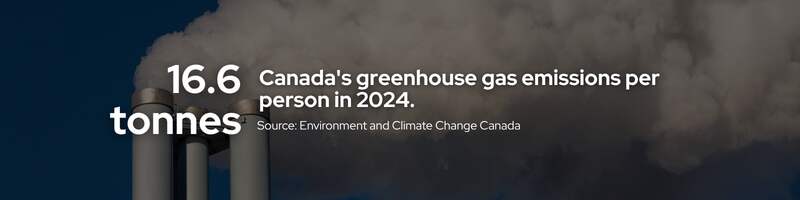
Steven Guilbeault’s resignation forces us to confront that reality as well as another one, which is that climate change is already having a massive impact on this country, as Mayors and Councillors from coast to coast to coast know all too well.
Lytton, Jasper, Fort McMurray, Lac Dubonnet, Yellowknife, Flin Flon, and numerous others have suffered from climate-related wildfires or been evacuated, at a massive cost to residents and the public purse. Nova Scotia and Newfoundland were on fire in 2024. That year, wildfire smoke from Canada became a public health hazard in the United States. Cities and towns across this country have been flooded at a scale and pace made far worse by climate change, and significant health impacts are happening from extreme heat and more.
Climate Action Is an Economic Necessity
Not only do we have an obligation, moral and legal, to act, but we also have a clear self-interest. The financial damages to our communities are in the billions, not to mention the emotional cost of seeing your home burn or the fact that a flooded home will be unlikely to get flood insurance ever again.
“To state the obvious, allowing our cities and towns to be burnt to the ground, flooded and repeatedly evacuated is clearly not in the interest of their residents or of their local economies.”
We are told that we must abandon our commitments in the interest of our economy. To state the obvious, allowing our cities and towns to be burnt to the ground, flooded and repeatedly evacuated is clearly not in the interest of their residents or of their local economies.
Who Benefits from Expanding Oil and Gas?
Sacrificing them to exploit even more oil and gas, thereby making the problem worse, isn’t rational. It raises the question, “In whose interest is the oil and gas sector operated?”
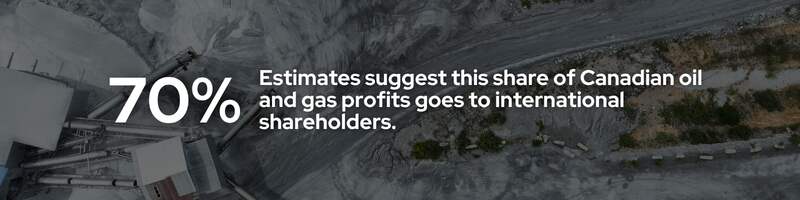
Estimates suggest that over 70% of the profits from oil and gas go to international shareholders, the vast majority to the United States. Due to technological changes, the industry has shed up to 40,000 jobs despite record levels of production. Since the attack on Iran by the USA and Israel, the industry in Canada has had excess profits of $90 billion dollars, with more than $50 billion going to the United States. Is this truly Elbows Up?
Building a Clean Energy Economy
The good news is that we can do our part to fight climate, protect our communities and create good local jobs.
Transportation can be electrified, and delivery fleets and public transit are an easy and cost-effective place to start, as is increased support for public transport and fast rail.
Our homes and workplaces can be built or retrofitted to be highly energy-efficient, ending reliance on the use of gas for heating and cooling.
We can access our vast amounts of clean energy grid, solar, wind, hydro, and geothermal, by building a national clean energy electricity grid from east to west to the north.
And we can support affected communities with a national resilience and recovery strategy, paid for by the polluters themselves through an excess profits tax.
We know how to do these things. In fact, almost all of this is being done somewhere in Canada today. And all of these initiatives create good jobs, often good union jobs with strong wages and benefits, right here at home in Canada, with economic gains staying at home.
Political Leadership Can Drive Climate Action Across Canada
What’s more, polling consistently shows that the vast majority of Canadians want climate action. But unfortunately, the same Canadians overestimate the opposition, perhaps because even though they are a small minority, they are very loud.
That’s a recipe for inaction. But all it would take to choose the best things that are happening somewhere in Canada and do them everywhere, to make addressing climate change a national economic strategy, is political leadership. We can have our Elbows Up for Climate too.
Steven Guilbeault has shown that it is possible to talk about climate change in Canada, and even more importantly, to act.
Calls to Action for the Federal Government
- Build a national East-West-North clean electric grid, powered by renewable energy, not fossil gas, to make Canada a clean energy superpower and secure our energy sovereignty
- Build at least two million non-market homes that are zero-polluting, efficient and built to the highest standards, creating more affordable, transit-linked communities, and a national retrofit strategy to ensure all buildings are highly energy efficient
- Develop a national resilience, response and recovery strategy to rebuild from the disasters already baked in, funded by a tax on excess oil and gas profits from the war in Iran. This follows the lead of our European Union allies and ensures polluters pay for the damages caused by their activities and could generate up to $46 billion in revenue
About the Experts
-
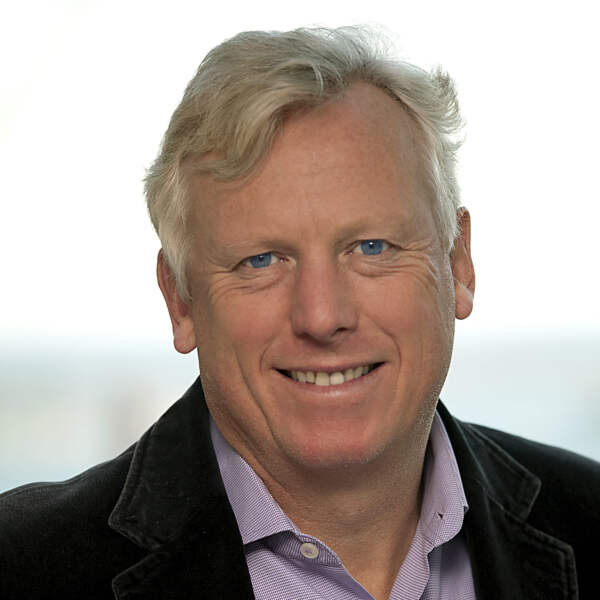
David Miller is the Managing Director of C40 Cities, the author of two books, “Solved: How the Great Cities of the World are Fixing the Climate Crisis” and “Witness to a City.” Professionally a lawyer, Miller was the Mayor of Toronto from 2003-2010, known for progressive leadership on issues of environment, social justice and jobs. His academic background includes law and economics from the University of Toronto and Harvard, respectively, and he is the recipient of honorary doctorates from York University and the University of Waterloo. He has sat on a variety of public and private boards and is currently the Chair of British Columbia Investment Benefits.
C40 Cities is a global network of 96 cities representing 920 million people and approximately 23% of the world economy. Founded in 2005, the organization helps mayors accelerate science-based, equitable climate action through policy support, research, peer collaboration, finance initiatives and global advocacy. Its C40 Centre for City Climate Policy and Economy focuses on aligning urban economic development with climate goals, advancing practical approaches that create good jobs, reduce emissions and build healthier, more resilient communities.
See more -

Valérie Plante served as mayor of Montréal from 2017 to 2025, becoming the first woman elected to lead the city. Previously a city councillor and community-sector leader, she focused her administration on sustainable mobility, climate action, housing and public space, while advancing Montréal’s international role in urban policy.
The Ville de Montréal is the municipal government of Québec’s largest city. It delivers local services and leads policy on housing, mobility, climate resilience and urban development.
See more
-
 Future-Proofing Canada: SMEs, Skills, and Capital for Tomorrow’s Economy
 Kookai Chaimahawong
Executive Director
Centre for Climate and Business Solutions, UBC Sauder
Kookai Chaimahawong
Executive Director
Centre for Climate and Business Solutions, UBC Sauder
-
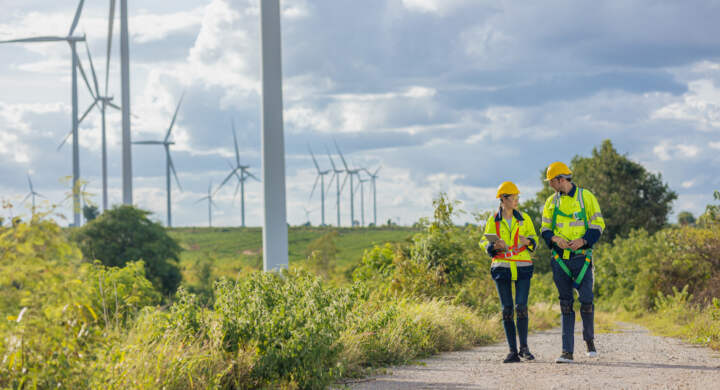 Powering the Global Energy Future: Anticipating the Next Great Energy Transformation
 David Rutherford
AVP, Sustainability Research & Insights
Mackenzie Investments
David Rutherford
AVP, Sustainability Research & Insights
Mackenzie Investments
-
 How the Canadian Construction Sector Can Lead the Low-Carbon Transition
 Jolene McLaughlin
VP, Climate & Sustainability
EllisDon
Jolene McLaughlin
VP, Climate & Sustainability
EllisDon