
Future-Proofing Canada: SMEs, Skills, and Capital for Tomorrow’s Economy
Canada’s competitiveness depends on more than cutting emissions – it’s about equipping people, SMEs, and institutions with the skills to thrive in the climate economy.
The future won’t wait – it’s time to turn ambition into action.

Canada at a Turning Point
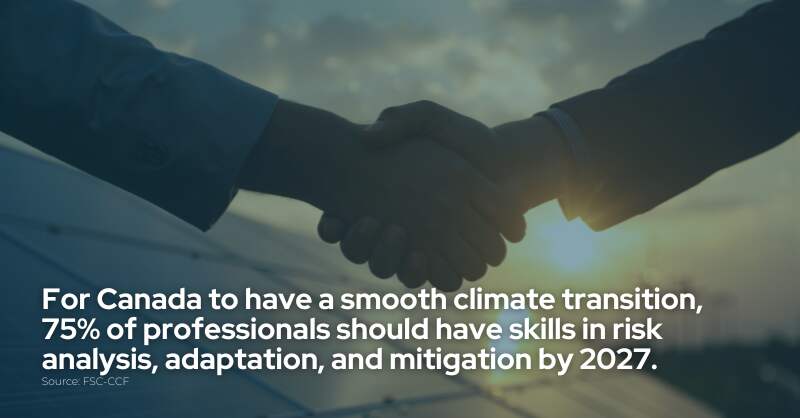
The climate risks facing Canada are no longer in the future—they are here, reshaping markets, communities and the cost of doing business. This isn’t just an environmental challenge; it’s an economic race already underway. Yet much of Canada’s conversation remains stuck on aspirations rather than action, while global investment is moving ahead into innovation, resilience, and the industries of tomorrow.
Securing our future means building the skills, businesses, and capital to compete and win in a rapidly changing global economy. Climate action is no longer only about cutting emissions. It’s about future-proofing our workforce, equipping businesses —especially small and medium-sized enterprises (SMEs)—with the skills and resources to thrive, and ensuring our competitiveness.
That means shifting from aspiration to execution – by empowering people, supporting businesses with the tools, and investing in the future we want to build.
Policymakers: Make Climate Skills a National Priority
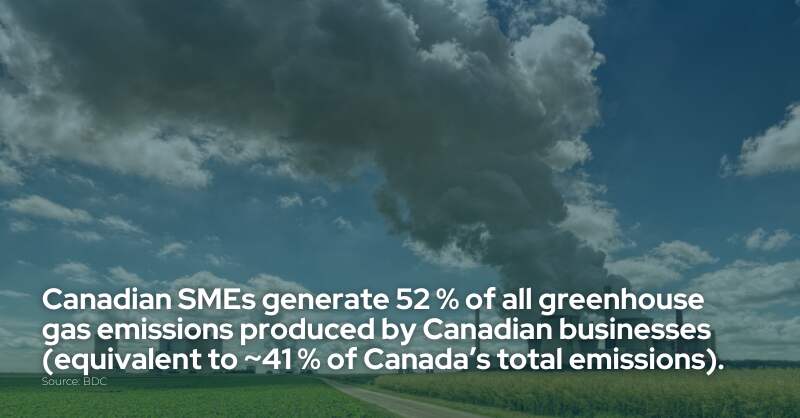
Canada’s workforce development strategy must put climate skills at its core. The ability to measure impact, manage risk, and build resilience is no longer niche—it’s essential across industries, from finance to manufacturing to agriculture and retail. Climate capability must be built into everything we teach, train, and do—because every job now requires decisions made in a changing climate.
What must be done now:
- Embed climate skills into education and training programs. Federal and provincial governments should tie post-secondary funding to the integration of climate literacy, such as carbon accounting, across business, engineering, and policy curricula.
- Incentivize workforce transition. Tax credits and training subsidies should support employers—particularly SMEs—in retraining and upskilling their employees for the climate economy.
- Mandate transparency. Clear reporting requirements for climate risk and carbon disclosures will accelerate demand for a climate-ready workforce.
Without a coordinated national push on skills, Canada risks falling behind countries already investing heavily in climate talent pipelines.
Business Leaders: Support and Scale SMEs in Your Supply Chains
“Large corporations must do more than set climate targets. They must actively support their suppliers—SMEs—through tools, funding, and partnerships to reduce emissions.”
SMEs make up 97% of Canadian businesses and employ the majority of Canadians. They are the backbone of our economy and, crucially, they represent the majority of scope 3 emissions for large corporations. Yet most SMEs lack the resources or expertise to measure, manage, and reduce their climate impact.
What must be done now:
- Integrate SMEs into climate strategies. Large corporations must do more than set climate targets. They must actively support their suppliers—SMEs—through tools, funding, and partnerships to reduce emissions.
- Invest in collaborations. Partner with universities, accelerators, and industry associations to provide SMEs with access to talent and practical expertise. At UBC Sauder, our BMO SME Climate Clinic pairs students trained in carbon accounting with small businesses—closing resource gaps while giving students hands-on skills.
- Signal demand. By embedding climate criteria into procurement and financing decisions, corporations can create the market pull SMEs need to act.
Supporting SMEs isn’t charity. It’s a business imperative: without them, Canada cannot achieve its climate goals.
Educators & Institutions: Bridge Academia and Industry
“Business students must learn carbon accounting, engineers must understand risk, and policy students must engage with markets and finance.”
Canada’s universities and colleges are uniquely positioned to drive progress—but only if they break down silos between academia and industry. Students must leave campus equipped with practical climate skills that are relevant to employers and society and prepare them to manage climate risks and opportunities across every field.
What must be done now:
- Expand experiential programs. Universities should scale initiatives that pair students with businesses to solve real climate challenges, from carbon accounting to supply chain resilience.
- Mainstream climate education. Climate literacy should not be limited to environmental studies. Business students must learn carbon accounting, engineers must understand risk, and policy students must engage with markets and finance.
- Co-develop solutions with industry. By partnering with businesses and governments, universities can ensure that research and teaching align with urgent climate needs.
Education is Canada’s strongest lever for long-term competitiveness. If we do not act now, we risk sending graduates into a world for which they—and our country—are unprepared.
Why This Matters for Canada
“We cannot delay. Every year of inaction raises the cost of transition and narrows our options.”
The stakes could not be higher.
- Economic competitiveness. Global investors are looking for climate-ready markets. Without the right skills and business support, Canada risks losing jobs and investment to other countries.
- Workforce transition. Millions of Canadians work in SMEs. Supporting them through this shift is not only about emissions—it’s about protecting livelihoods.
- Global leadership. Canada has the potential to lead not only in natural resources but in climate talent, innovative business models, and solutions that can be exported worldwide.
We cannot delay. Every year of inaction raises the cost of transition and narrows our options.
A Call to Action
Canada has already taken meaningful steps: from clean investment tax credits to support for green infrastructure. But more is needed, and urgently.
- Policymakers must put climate skills at the heart of national strategy.
- Business leaders must scale support for SMEs, especially across supply chains.
- Educators must mainstream climate literacy and embed students in real-world climate problem-solving.
These steps are not optional. They are the foundation for Canada’s competitiveness, resilience, and leadership in tomorrow’s economy.
The world will not wait for us. The time for Canadian leadership is now.
About the Expert
-

Kookai Chaimahawong is Executive Director of the Centre for Climate and Business Solutions at UBC Sauder School of Business. She bridges academia, industry, and policy to accelerate climate action through business innovation, experiential learning, and workforce development, supporting businesses and students to drive Canada’s transition to a low-carbon economy.
See more
-
 Why Steven Guilbeault’s Resignation Must Reignite National Climate Action
 David Miller
Managing Director
C40 Cities
David Miller
Managing Director
C40 Cities
 Valerie Plante
Former Mayor
City of Montreal
Valerie Plante
Former Mayor
City of Montreal
-
 Powering the Global Energy Future: Anticipating the Next Great Energy Transformation
 David Rutherford
AVP, Sustainability Research & Insights
Mackenzie Investments
David Rutherford
AVP, Sustainability Research & Insights
Mackenzie Investments
-
 How the Canadian Construction Sector Can Lead the Low-Carbon Transition
 Jolene McLaughlin
VP, Climate & Sustainability
EllisDon
Jolene McLaughlin
VP, Climate & Sustainability
EllisDon