
How the Canadian Construction Sector Can Lead the Low-Carbon Transition
As Canada commits billions to a new era of infrastructure, the construction industry faces a high-stakes ultimatum: break from ‘business as usual’ or lose its seat at the table of national progress.

Canada’s 2025 fall budget release makes it clear: our growth and prosperity as a nation rely on construction, buildings and infrastructure. More than $200 billion has been committed to national defence development and infrastructure, as well as projects designed to support Canada’s shift to a low-carbon economy.
There is significant demand on the Canadian construction industry to grow, but equally to do so in a way that recognizes business as usual is not in line with the demands of our climate. This places the construction sector at a pivotal crossroads: growth is essential, but how we build will determine whether Canada can meet its climate commitments.
Construction Emissions: An Overlooked Challenge
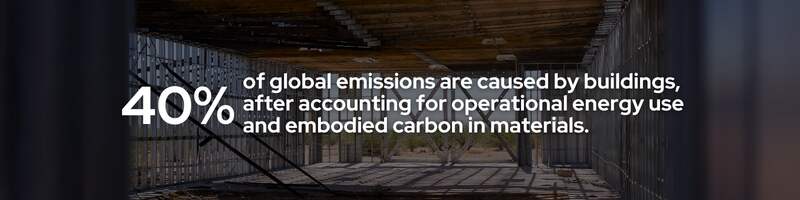
Construction sits at the intersection of some of the largest sources of emissions in the economy, from the energy buildings consume over their lifetime to the materials and processes required to put them in place. In fact, buildings alone account for nearly 40% of global emissions when operational energy use and embodied carbon in materials are considered. Yet the emissions generated on construction sites themselves are often overlooked and poorly measured. That is about to change.
In 2024, nine of the largest general contractors in Canada came together to form the Canadian Construction Sustainability Alliance (CCSA). The Alliance broke down silos in the industry and set out on a clear mission: build a better understanding of emissions from the construction phase and lead the industry towards greener jobsites.
Following the Data
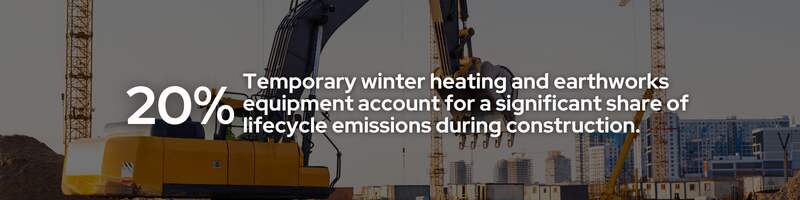
Working with Transition Accelerator, we analyzed data from over 600 active construction projects in Canada. This data provided insight into the main contributors to emissions during the construction process: temporary heating during winter and equipment used in earthworks are the most emissions-intensive activities. The combined impact of these activities is estimated to represent as much as 20% of lifecycle emissions for a given asset, exceeding the current assumptions of 5% or less for the entire construction phase.
“Getting to zero-emissions sites requires a strategic, long-term approach to finding low-carbon options across the construction site. “
Using less fuel saves both costs and emissions. Initial actions undertaken by CCSA members have focused on reducing idling in fleet vehicles and equipment, as well as optimizing fuel used for temporary heating. Advanced heating control technologies now provide effective solutions for temporary heating systems. Functioning like a programmable thermostat in your home, these systems regulate heat output, reducing fuel consumption by as much as 50%. This approach not only reduces operational costs and emissions but also improves working conditions within temporary spaces.
These are great first steps, but getting to zero-emissions sites requires a strategic, long-term approach to finding low-carbon options across the construction site. Our report, Growing and Greening Canadian Construction, provides a long-term outlook on key actions that support the construction industry’s transition to a low-carbon future.
1. Electrify what is available now, including Light Duty Vehicles (LDV) and smaller equipment options.
LDVs are commercially available with accessible solutions to recharge. Cold weather and range impacts of towing remain barriers to full-scale adoption, but these can be addressed with upfront planning.
Electric mini excavators, wheel loaders, smaller forklifts and telehandlers have been tested on Canadian construction sites. They are particularly advantageous for indoor conditions as they operate more quietly with no particulate emissions affecting workers or the general public; indoor use also limits the consequences of cold weather degradation on the battery. From practical experience, there can still be limitations to operational use time, sometimes requiring redundant equipment to maintain schedules, but operators also see the benefits of easier operation, lower noise thresholds and the elimination of tailpipe emissions.
“Renewable diesel, a low-carbon fuel alternative which is made from cooking oils and fats, is chemically identical to, and therefore a drop-in replacement for, sulphur-based diesel.”
2. Finding hybrid options and using renewable diesel as interim solutions.
Hybrid solutions, those using batteries and combustion engines in combination, provide opportunities to reduce the carbon impact of construction activities, particularly for mid-sized equipment. One successful example of this is for on-site power generation, where EllisDon is realizing as much as 70% reduction in fuel consumption on projects in the GTHA. In addition to lowering emissions, this approach enhances site safety and reduces environmental implications such as spill hazards.
Renewable diesel, a low-carbon fuel alternative which is made from cooking oils and fats, is chemically identical to, and therefore a drop-in replacement for, sulphur-based diesel. Where available, it’s a great transitional solution to reduce environmental impact. EllisDon alone has been able to utilize this fuel on more than 8 projects across Canada, leading to more than 250 tonnes of avoided emissions.
3. Bringing awareness and reducing barriers to the long-term solutions.
Low-carbon options for small- and medium-sized equipment are becoming more accessible and versatile on construction sites. However, there are still significant construction operations that don’t yet have decarbonized options on the market, and particularly not in Canada. While renewable diesel helps bridge the gap, long-term decarbonization will require a more holistic approach to heavy equipment. Within the CCSA, we are aligning with rental partners, equipment manufactures and our sub trades to identify gaps in existing solutions and advocate for widespread accessibility of decarbonized heavy equipment across all Canadian markets.
Collaboration for the Low-Carbon Transition
The low-carbon transition requires innovative approaches for all sectors of the economy, and particularly construction. Much of the work being done on active construction sites requires tremendous amounts of power, yet decarbonized solutions for large-scale equipment have not been fully developed. Europe and Scandinavia are seeing increased uptake in all-electric construction sites; however, the remote nature and cold climates across Canada provide different realities that need to be considered. The best approach to incorporate low-carbon solutions while managing all other risks tied to a construction project is a collaborative one.
Engaging contractors early in the process enables upfront logistical and operational planning alongside architects and engineers. This approach helps control costs and schedules while allowing project teams to evaluate the most effective alternatives to achieve the client’s overall objectives. The nature of construction requires a multi-stakeholder approach to achieving desired project outcomes. No single entity can deliver outcomes alone, without the support of all other stakeholders within the chain. The same is true for decarbonization: only through coordinated action across the full project ecosystem can Canada meet its infrastructure needs while advancing its climate objectives.
About the Expert
-

Jolene McLaughlin is EllisDon’s Vice President of Climate and Sustainability, bringing 14 years of experience in the construction industry. She leads carbon accounting and decarbonization strategies, partnering across teams and the industry to embed practical, forward‑thinking sustainability into major ICI projects; strengthening performance, resilience, and measurable outcomes.
See more
-
 The Future of Sustainable Business: Turning Risk into Resilience
 Marena Winstanley
Managing Director
Smart Prosperity Institute
Marena Winstanley
Managing Director
Smart Prosperity Institute
 Aaron Pardy
Senior Research Associate, Energy and Materials
Smart Prosperity Institute
Aaron Pardy
Senior Research Associate, Energy and Materials
Smart Prosperity Institute
-
 Canada’s Decarbonization Challenge: An Economic Path Forward
 Alex Todorovic
CEO and Co-founder
Arbor
Alex Todorovic
CEO and Co-founder
Arbor
-
 Why Steven Guilbeault’s Resignation Must Reignite National Climate Action
 David Miller
Managing Director
C40 Cities
David Miller
Managing Director
C40 Cities
 Valerie Plante
Former Mayor
City of Montreal
Valerie Plante
Former Mayor
City of Montreal