
Why Ethical Trade Is Central to Canada’s Global Competitiveness
As Canada shifts from aid to trade, the real challenge will be ensuring global business is built on ethical supply chains, fair wages and human rights.

Trade, not aid.
I lead Equifruit, a Montreal-based Fairtrade banana company. I have used the phrase “trade, not aid” many times to set people straight on what Fairtrade is and is not. Fairtrade is not charity, it’s business, I’ll say. It’s business within an ethical framework, which includes an element of community investment.
It makes for strange bedfellows then, when, in a post-USAID world, “trade over aid” becomes the new mantra of the Trump administration. “The idea that trade and free market capitalism is the surest path to prosperity has been proven by the facts and by history,” a US State Department spokesperson commented on a pro-business proposal which was presented to United Nations member states, including Canada, at the UN General Assembly in April 2026.
The Human Cost of Global Trade
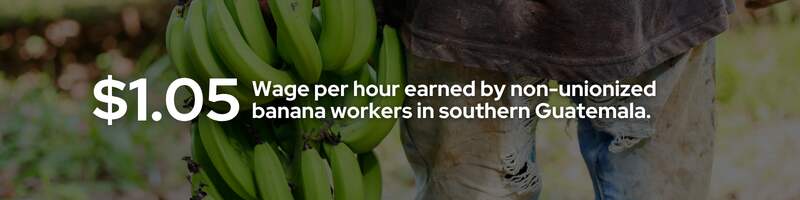
The catch is that “trade and free market capitalism” have not been a path to prosperity for all trading parties. Take the banana industry. Bananas have created lopsided wealth for a small handful of large multinationals, distributors and supermarkets. We have all enjoyed this sweet treat for rock bottom prices for over a century, blissfully ignorant of the heavy price paid by smallholder banana growers and farm workers on the other side of this trading seesaw. 40% of the bananas we eat here in North America start out their lives in Guatemala, where, according to a 2021 study, workers, on average, put in 68 hours a week and earn a meagre 1.05 USD per hour, under difficult, sometimes abusive working conditions. Yikes. I’m pretty sure they’re not living their best lives.
“Much of what we buy is traded without all “externalities” priced in, where the price of the good does not reflect its true social cost.”
Much of what we buy is traded without all “externalities” priced in, where the price of the good does not reflect its true social cost. These go from the basic: formalized labour and social security payments, fair wages, good working conditions and environmental protections, to the egregious: goods benefitting from modern slavery, in the form of child or forced labour.
Traditionally, aid organizations have come in to pick up the pieces when private businesses have abdicated their responsibilities to workers and communities in jurisdictions outside our own.
Canada’s Shift From Aid to Ethical Trade

We here in Canada can’t just pooh-pooh the gutting of USAID: the Carney government announced in its November 2025 budget a reduction of $2.7 billion in foreign aid (International Assistance Envelope) over the next four years. If we are going to get on the “trade not aid” train, then we have to ensure that our trade is truly fair. Equifruit is one of just a handful of Canadian companies that have made a commitment to source 100% of its products on Fairtrade terms. Beyond that, we have two mechanisms in Canada to protect all supply chain actors.
How Canada’s Supply Chains Act Supports Ethical Trade
The first is the Fighting Against Forced Labour and Child Labour in Supply Chains Act, often shortened to the Supply Chains Act, formerly Bill S-211, which came into force on January 1, 2024. It is a reporting law designed to increase transparency and combat forced labour and child labour in global supply chains connected to Canada. The law applies to government institutions at the federal level and private-sector entities that are either listed on a Canadian stock exchange or have a presence in Canada and meet certain thresholds based on assets, revenue, or number of employees.
“A small group of companies has complied with both the letter and the spirit of the law, while the majority have filed reports which are long on generalities, short on specifics and couched in language to limit legal liability.”
The first two years of reports have been hit and miss. A small group of companies has complied with both the letter and the spirit of the law, while the majority have filed reports which are long on generalities, short on specifics and couched in language to limit legal liability. No fines have yet been levied for not reporting, let alone investigations into admissions of supply chain misconduct.
The Bloc Québécois has also introduced Bill C-251, An Act To Amend the Customs Act and the Customs Tariff, which takes supply chain legislation up a notch by placing the burden of proof on the importers themselves through mandatory due diligence. The bill has passed first reading; whilst still early in the legislative process, Bill S-211was also introduced as a private member’s bill and still gained wide multi-partisan support.
Strengthening CORE for Responsible Enterprise
The second mechanism is CORE, which stands for the Canadian Ombudsperson for Responsible Enterprise. This is an independent office of the Government of Canada created in 2019 to address human rights concerns linked to Canadian companies operating abroad. However, the office has been without leadership for over a year, and cases are stalled.
Researchers at the International Justice and Human Rights Clinic at the Peter A. Allard School of Law at UBC recommend filling the position and strengthening the office’s independence and investigative powers, as well as creating an effective compliance body to give victims of human rights abuses access to both judicial and non-judicial remedies.
The Business Benefits of Ethical Trade
And then there’s the business case for responsible trading. A group of doctoral researchers anchored at the DeGroote School of Business at McMaster University argues that there are four upsides to Canadian companies for going all in on combating modern slavery in their supply chains, including investor and market pressure, legal liability, reputational cost, competitiveness and regulatory arbitrage.
“If Canadian companies can’t demonstrate clean supply chains, they may lose access to some of their largest trading partners.”
Perhaps most pressing is trade access and import bans. The US is already leveraging areas where Canada’s policies are weaker—including labour and supply chain enforcement—as part of broader trade pressure.If Canadian companies can’t demonstrate clean supply chains, they may lose access to some of their largest trading partners, such as through the EU Forced Labour Regulations, set to become law in 2027, and the United States’ Uyghur Forced Labor Prevention Act (2022) which already blocks imports of good made in whole or in part in China’s Xinjiang region, presumably made with Uyghur forced labour.
Reducing federal spending on international aid is not an outright savings: it is a shift of responsibility to businesses to behave well. Trade over aid, yes, but within an ethical framework.
About the Expert
-

Jennie Coleman has been the owner and president of Equifruit since 2013. She has been widely recognized as an outstanding leader in the produce industry. In 2024, Jennie was honoured with the prestigious RBC Canadian Women Entrepreneur Award. That same year, she was named one of Canada’s Most Admired CEOs by Waterstone Human Capital. Under Jennie’s leadership, Equifruit has been recognized as one of Canada’s Top Growing Companies for four consecutive years, showcasing its remarkable growth and dedication to ethical business practices.
Equifruit is a Canadian produce company specializing in Fairtrade bananas sourced from certified farming cooperatives in Latin America. Founded in 2006, the company works to advance ethical trade practices, environmental sustainability, and fair compensation for growers. Equifruit partners with major retailers and distributors across Canada while supporting initiatives focused on farmer livelihoods, gender equity, climate resilience, and responsible agricultural production.
See more
-
 Canada Has What the World Wants. The Question is Whether We Can Act On It.
 Terence Smith
Senior Director, Centre for Canada’s Future
Boston Consulting Group
Terence Smith
Senior Director, Centre for Canada’s Future
Boston Consulting Group
 Keith Halliday
Partner & Associate Director, Global Trade & Investment
Boston Consulting Group
Keith Halliday
Partner & Associate Director, Global Trade & Investment
Boston Consulting Group
-
 The Global Economy is Being Rewired. Canada Can’t Run Yesterday’s Playbook
 Shane Dunn
Canada EY-Parthenon Leader
EY Canada
Shane Dunn
Canada EY-Parthenon Leader
EY Canada
-
 CUSMA at a Crossroads: What the Annual Review Means for Canada’s Trade Future
 Jimmy Jean
Vice-President, Chief Economist & Strategist
Desjardins Group
Jimmy Jean
Vice-President, Chief Economist & Strategist
Desjardins Group
 Randall Bartlett
Deputy Chief Economist
Desjardins Group
Randall Bartlett
Deputy Chief Economist
Desjardins Group