
Canada Has What the World Wants. The Question is Whether We Can Act On It.
Canada has exactly what a changing world is desperate to buy, but almost all of it goes to just one customer. As trade rules shift, can Canadian exporters finally break their U.S. dependency and seize a massive global opportunity?


Canada sends nearly 70% of its exports to a single market: the United States.
That concentration was defensible when the rules were stable, but now, and especially as CUSMA negotiations draw nearer, it’s time to diversify.
The terms will ultimately be negotiated between Ottawa and Washington. What exporters can control is something more important: expanding beyond the market they know best.
The Canadian government’s goal of doubling non-US exports by 2035 puts that challenge into focus. It names the problem, sets a measurable bar, and signals that Canada’s economic future cannot be built on a single relationship. The harder question is, can exporters act on it?
Diversification does not mean stepping back from one of the world’s most integrated economic and trading relationships. For exporters, expanding into other regions can be incremental to continued trade with the US. But the first imperative is simply to stop waiting.
Where Canada’s Export Diversification Opportunity Lives
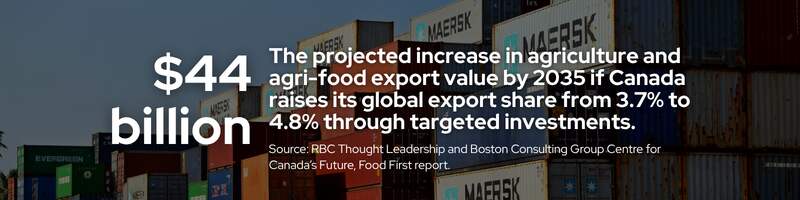
Canada is not starting from scratch. More than 90% of its exports are concentrated in sectors tied to powerful global demand drivers: energy, metals and mining, agribusiness, forestry, manufacturing, and services. Electrification, rising protein consumption, and surging demand for critical minerals all reinforce areas where Canada already competes. Geopolitical disruptions are increasing the appetite for a secure, reliable supply, and Canada is well-positioned as a trusted source.
The challenge is translating those strengths into sustained global growth. Rather than expanding evenly across export categories, a focused approach could concentrate growth where Canada already has a competitive edge.
Three distinct opportunity pools stand out.
Three High-Potential Areas for Export Growth

1. Wherever Canada dominates one market but has yet to expand globally.
More than 90% of Canadian crude oil exports currently go to the US, even as demand for stable energy supply grows across Asia and Europe, meaning Canadian producers are selling to one customer in a world full of eager buyers.
2. Wherever Canada already competes globally but has lost ground.
Canada accounts for roughly 20% of global dried legume exports, but has ceded share to Australia and Brazil, which have moved aggressively into fast-growing markets across Southeast Asia, Africa, and the Middle East. Canada has rested on its historical success while hungrier competitors have claimed the ground, but it is not too late to win back share.
3. Wherever services potential remains untapped.
Canada imports 1.5 times more professional and technical services than it exports, despite a highly educated workforce and growing global demand for engineering and technical expertise. Canadian service firms have every reason to compete globally and need to start thinking of themselves as export businesses.
Taken together, these opportunities narrow the target to roughly 50 goods and services with a credible runway to reach the doubling goal. But identifying the opportunity is the easy part. Follow-through is harder.
“Canada has what the world wants: secure energy, trusted food supply, critical minerals and professional expertise.”
Major Barriers to Canada’s Export Growth
The first is production capacity. Major projects such as building new aluminum smelters or mines often face higher costs, longer approval timelines, and more regulatory complexity than in peer economies. The recently established Major Projects Office is a step in the right direction, but economic feasibility and delivery at pace will be the real test.
The second is infrastructure. Canada’s ports, pipelines, rail, and shipping networks are heavily oriented toward the US market. Less than 20% of Canada’s pipeline capacity can reach ports serving global markets. Gaining even 1% of the global crude oil market share could require an additional Trans Mountain-scale pipeline. The projects are largely understood; again, it will come down to execution.
The third constraint is market penetration. Breaking into new markets is harder than scaling existing ones. For example, Canada produces world-class building materials but not to the specifications required by Japanese building codes. Europe’s Carbon Border Adjustment Mechanism could favour Canadian low-carbon producers, but only for those who navigate compliance correctly. Multiply these barriers across dozens of jurisdictions and the frictions add up quickly.
Business Investment as the Foundation for Long-Term Competitiveness
Underlying all three is a structural issue Canada has deferred for far too long. Business investment per worker continues to lag behind the United States, limiting the economy’s capacity to scale. The 2035 target should serve as a catalyst to address that gap directly, not just a headline aspiration.
“Favourable conditions do not guarantee growth. Execution does.”
The Next Move Belongs to Canadian Exporters
Canada has what the world wants: secure energy, a trusted food supply, critical minerals and professional expertise, all of which are in rising global demand. The geopolitical tailwinds are shifting in Canada’s favour, but favourable conditions do not guarantee growth. Execution does. This moment calls for decisiveness, sustained investment, and collaboration that matches the scale of the opportunity.
About the Experts
-

Terence Smith leads Boston Consulting Group’s Centre for Canada’s Future (CCF). Working with Canadian and global BCG experts, Terence guides the Centre’s efforts to catalyze action on Canada’s biggest challenges and opportunities.
Boston Consulting Group’s Centre for Canada’s Future is a Canadian public-policy and thought-leadership initiative established in 2016. It applies BCG’s analytical capabilities, collaborates with public- and private-sector organizations, and convenes leaders to address national priorities, including prosperity, cities, foreign investment, digital innovation, infrastructure and broader economic and social challenges.
See more -

Keith Halliday is a Partner at Boston Consulting Group and a core member of the firm’s Global Trade & Investment, Climate & Sustainability, and Public Sector practices. For over 25 years, he has advised corporate and government leaders on trade, finance, and diplomacy across the Americas, Asia, and Europe.
Boston Consulting Group’s Centre for Canada’s Future is a Canadian public-policy and thought-leadership initiative established in 2016. It applies BCG’s analytical capabilities, collaborates with public- and private-sector organizations, and convenes leaders to address national priorities, including prosperity, cities, foreign investment, digital innovation, infrastructure and broader economic and social challenges.
See more
-
 The Global Economy is Being Rewired. Canada Can’t Run Yesterday’s Playbook
 Shane Dunn
Canada EY-Parthenon Leader
EY Canada
Shane Dunn
Canada EY-Parthenon Leader
EY Canada
-
 CUSMA at a Crossroads: What the Annual Review Means for Canada’s Trade Future
 Jimmy Jean
Vice-President, Chief Economist & Strategist
Desjardins Group
Jimmy Jean
Vice-President, Chief Economist & Strategist
Desjardins Group
 Randall Bartlett
Deputy Chief Economist
Desjardins Group
Randall Bartlett
Deputy Chief Economist
Desjardins Group
-
 Why Ethical Trade Is Central to Canada’s Global Competitiveness
 Jennie Coleman
Co-Owner & President
Equifruit
Jennie Coleman
Co-Owner & President
Equifruit