
Beyond Submarines: Why Canada’s German Submarine Deal Matters for Hydrogen
Canada’s submarine decision highlights hydrogen’s strategic role in defence and industrial growth.



Canada’s decision to select Germany’s TKMS over the competing offer from South Korea’s Hanwha Ocean for its next submarine fleet is first and foremost a defence procurement choice.
But it is also a signal about where Canada sees industrial value, allied cooperation, and long-term strategic capability, and that has direct implications for Canadian industry, including the country’s hydrogen sector.
The Lost Hydrogen Investment Opportunity from South Korea

For Canada, the most immediate lesson is that major procurement can shape industrial development well beyond the original contract.
The South Korean bid included “Project Beaver”, which would have tied the submarine package to investments in hydrogen liquefaction in British Columbia, hydrogen truck manufacturing in Ontario, and a national network of refuelling stations. With Germany selected, those associated South Korean hydrogen projects in Canada will now be cancelled, which is a real loss for Canadian jobs, infrastructure, and clean industrial momentum.
How Canada’s German Submarine Deal Highlights Hydrogen’s Strategic Value
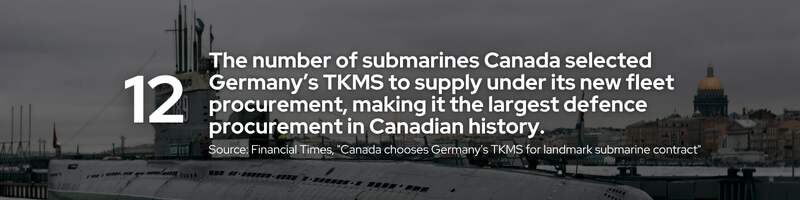
Still, the German decision is not a setback for the hydrogen sector. In fact, it underscores hydrogen’s strategic relevance.
TKMS’s 212CD submarines use diesel engines and hydrogen fuel cell-based air-independent propulsion systems, which is a powerful reminder that hydrogen is not just a climate solution; it is a proven technology in mission-critical, low-signature environments. That matters for Canada because the same reliability that supports submarine endurance and operations can support ports, logistics, remote operations, and broader domestic defence applications.
Hydrogen’s Emerging Role in Canada’s Defence Strategy
Emerging synergies between hydrogen and defence are especially important. As part of a Canadian-led NATO initiative, the Department of National Defence is already exploring hydrogen through initiatives such as its “Powering the Future” challenge for solid-state hydrogen storage, which signals that hydrogen belongs in Canada’s defence industrial strategy, not on the margins of it.
That is now becoming more concrete with the Government of Canada’s tender for a solid-state hydrogen-powered Light Armoured Vehicle feasibility study. Over time, Canada can apply hydrogen technologies to strengthen military platforms, ports, Arctic operations, logistics fleets, and isolated communities, which are all areas where sovereignty and operational reach rely on dependable energy and infrastructure.
To be clear, Canada’s hydrogen sector is already engaging directly with defence needs. Hydrogen In Motion (H2M), for example, responded to the Government of Canada’s submarine sustainment RFI to outline how solid‑state hydrogen storage could support future sustainment requirements.
Other Canadian hydrogen companies may also contribute expertise related to air‑independent propulsion concepts. Together, these inputs demonstrate that hydrogen is becoming an increasingly relevant technology across naval and defence applications, and that Canadian industry is ready to support the evolving energy needs of the Canadian Armed Forces.
Five Priorities for Scaling Canada’s Hydrogen Sector
“If Canada wants hydrogen to serve national priorities, it has to support production, demand, innovation, manufacturing, and infrastructure at the same time.”
Our view is that Canada should use this moment to scale hydrogen at home so it can capture opportunities in defence and other strategic sectors.
To do so, the Canadian Hydrogen Association (CHA) argues that five priorities are essential to accelerating sector growth:
- Optimizing the Clean Hydrogen Investment Tax Credit
- Building demand for hydrogen and hydrogen-enabled transportation (and corresponding infrastructure)
- Creating a hydrogen innovation, demonstration, and scale-up fund
- Strengthening domestic manufacturing
- Enabling export infrastructure and logistics
These measures are not abstract sector supports; they are the practical tools Canada needs to convert hydrogen into industrial capability, defence resilience, and export growth. If Canada wants hydrogen to serve national priorities, it has to support production, demand, innovation, manufacturing, and infrastructure at the same time.
Building a Domestic Hydrogen Industrial Ecosystem
Canada should also recognize that the submarine decision comes at a time when hydrogen is increasingly important to broader industrial strategy.
Across the country, hydrogen is moving from concept to execution, with projects in production, mobility, storage, export logistics, and manufacturing all beginning to converge. That makes this the right moment for Canada to ensure hydrogen policy supports not just individual projects, but the ecosystem around them, including supply chains, skilled labour, port infrastructure, and domestic equipment manufacturing.
In that sense, the submarine deal is less an isolated procurement event than a reminder that major federal decisions can shape the direction of emerging strategic industries.
And on that, our point is simple: this submarine deal has opened the door to deeper hydrogen synergies in defence. Moreover, it is a sign of things to come, not only for hydrogen sector scaling but for the continued integration of hydrogen into Canada’s defence industrial strategy, Arctic posture, logistics networks, and other key areas of national focus.
If the South Korean proposal showed how hydrogen can be used as a procurement sweetener, the German submarine deal and Germany’s broader investments in hydrogen show that hydrogen is already being treated as a serious strategic technology. Canada should take that signal seriously and use it to accelerate the infrastructure, manufacturing capacity, and policy tools needed to make hydrogen a durable part of the country’s defence, export, and industrial strategies.
About the Experts
-

David Billedeau is President and CEO of the Canadian Hydrogen Association and holds a PhD from the University of Waterloo’s Faculty of Environment. He has extensive experience in government relations, sustainability, and clean energy advocacy.
The Canadian Hydrogen Association is Canada’s national industry association representing organizations across the hydrogen value chain, including producers, technology developers, infrastructure providers, researchers, and end users. The association advances policies, collaboration, market development, and knowledge sharing to support hydrogen and fuel cell technologies as part of Canada’s clean energy transition.
See more -

Maike Althaus is the Vice President of Government Relations & Public Affairs at the Canadian Hydrogen Association and has over 15 years of experience in clean technology, communications, and government relations. She has led advocacy initiatives across Canada and internationally to advance clean energy technology adoption and market growth.
The Canadian Hydrogen Association is Canada’s national industry association representing organizations across the hydrogen value chain, including producers, technology developers, infrastructure providers, researchers, and end users. The association advances policies, collaboration, market development, and knowledge sharing to support hydrogen and fuel cell technologies as part of Canada’s clean energy transition.
See more -

Grace Quan is President & CEO of Hydrogen In Motion (H2M), a NATO DIANA Innovator advancing solid‑state hydrogen storage. A CPA and MBA, she brings disciplined, scalable clean‑tech leadership and serves on six boards, including as Chairperson of CHA, shaping Canada’s hydrogen, energy, and defence innovation ecosystem.
Hydrogen In Motion (H2M) is a Canadian clean technology company based in Burnaby, British Columbia, developing solid-state hydrogen storage materials and systems. Founded in 2014, the company focuses on safer, lower-pressure, scalable hydrogen storage solutions for mobility, energy storage, and industrial applications, helping advance practical hydrogen deployment.
See more
-
 Building Canada’s Future Hydrogen Economy
 Alanna Hnatiw
Mayor
Sturgeon County
Alanna Hnatiw
Mayor
Sturgeon County
 Bob Masterson
President and CEO
Chemistry Industry Association of Canada
Bob Masterson
President and CEO
Chemistry Industry Association of Canada
-
 A Decarbonized Petrochemical Future
 Diego Ordonez
President
Dow Canada
Bob Masterson
President and CEO
Chemistry Industry Association of Canada
Diego Ordonez
President
Dow Canada
Bob Masterson
President and CEO
Chemistry Industry Association of Canada
-
 Canada’s Defence Shift: From Spending Commitments to Strategic Capability
 Kristen Leroux
VP & Regional Executive, Canada & Latin America
Lockheed Martin
Kristen Leroux
VP & Regional Executive, Canada & Latin America
Lockheed Martin
 David Perry
President & CEO
Canadian Global Affairs Institute
David Perry
President & CEO
Canadian Global Affairs Institute