
The TransCanada Power Corridor: A National Grid for a National Purpose
The TransCanada Power Corridor links the entire continent from the West to the East and represents more than an energy project; it is a nation-building enterprise that fuses climate security, energy sovereignty, infrastructure resiliency, innovation and technology development, and national prosperity into a single strategic vision.


Canada was shaped in the late 1890s as a nation, integrated by the “technology” of that era, the railroad. Like the immense impact of the railroad on Canada’s economy and capabilities in Canada’s early days, we develop here a transformational blueprint for Canada’s future economic prosperity. A transformation of Canada’s energy landscape “fit-for-purpose” for the twenty-first century rests on enabling a completely new set of technological capabilities and new opportunities for high-value-added goods, services, and exports.
In sharp contrast, oil pipelines are rooted in the economic and social dynamics of a previous era focused primarily on the extraction and export of raw materials with minimal or no added value. That is not the road to future prosperity. Additionally, any major new expansion or investment in oil pipelines constitutes a risk of being stranded assets in the face of declining global oil demand. The primary value to the economy of a basic ‘extract and sell’ the raw product is a proposition with minimal value-added.
An Alternative Pathway: Broad-Based Electrification
“Clean electricity is a high-value manufactured product that delivers measurable economic and environmental gains while providing uniquely flexible, reliable, and secure access to energy for all end uses.”
We propose an alternative pathway for new investments: “Broad-based electrification” of all end-use sectors in the economy is the cornerstone of a national strategy, linked to a continent-scale TransCanada Power Corridor as the critical enabler of improving productivity through electrification. The TransCanada Power Corridor, to be developed as a national infrastructure flagship project, is fully aligned with national priorities for sovereignty, export expansion, and clean energy development.
Establishing a national grid capable of integrating all the diverse resources of each province is a commitment to enhanced energy security and to balancing resource development across the energy landscape, while meeting Canada’s international climate obligations. The unique and unifying features of a national grid are its capacity to reliably absorb, integrate, and transfer clean energy resources from each province for overall national benefit through enhanced electricity trade.
Clean electricity is a high-value manufactured product that delivers measurable economic and environmental gains while providing uniquely flexible, reliable, and secure access to energy for all end uses. The national grid will not only serve as the backbone of Canada’s clean energy system but will also function as a unifying national force for the growth of new enterprises, products and services, investment, and employment opportunities.

A national grid, co-located with the existing railway right of ways where practical, can minimize land-use impacts and support faster permitting and approvals processes. Non-carbon electricity generation options (hydro, nuclear, geothermal, wind and solar with storage, and smart grids at the distribution level) together with a large natural resource base of critical minerals for the end-use sector are Canada’s competitive advantage that needs to be exploited fully.
Why a National Project?
“The diverse energy resources of each province constitute a significant strategic national endowment and, when integrated into a national transmission and electricity trading system, become a unifying national advantage.”
Energy security and national security are the twin pillars of national sovereignty. There is an urgency to shape a timely response to emerging geopolitical risks and threats to Canada’s sovereignty. The necessity lies in establishing a national energy economy that is resilient to the threats of climate-induced shocks and to future-proofing critical infrastructure that supports national economic growth.
The diverse energy resources of each province constitute a significant strategic national endowment and, when integrated into a national transmission and electricity trading system, become a unifying national advantage that enables enhanced trade across provincial boundaries and improves Canada’s national productivity.
The global trend towards massive electrification is clear and well established, with electricity demand projected to increase sixfold over the next decade.
Growth and Electricity Demand
Generation, transmission, and intelligent distribution of electricity emerge as the backbone of a digital economy capable of accelerating AI-enabled productivity gains for business enterprises, industry, and services. The primary source of new economic value rests on the creation of an intangible economy enabled by access to clean, affordable electricity. The figure below shows the potential for final energy demand in diverse sectors of the economy that can be electrified economically.

Accelerated expansion of the electricity sector with minimal dependence on the use of fossil fuels (<20% share in final energy consumption) is achievable in the 2050–2060 period. Timely investments in the transmission infrastructure for improvements to interconnection capabilities across provinces (2025-2035), rapid deployment of existing commercially proven technologies (2025-2040) and development of new transformative technologies in the 2035–2050 period will be necessary. Achieving a dramatic reduction in annual carbon emissions, greater than 70%, from the current levels of 700 Mt to 200 Mt, is feasible, and it is compliant with Canada’s international obligations.
Why Electricity? The Economic Value of Electrification is High
Electricity’s contribution to GDP growth is greater by a large margin in comparison to fossil fuel resources. Electricity is a higher-quality form of energy—more efficient and versatile—and those sectors relying heavily on electricity (for example, technology, services, manufacturing) tend to have higher productivity per unit of energy. Electricity intensity (electricity consumed per dollar of GDP) is lower than total energy intensity, indicating greater economic output per unit of electricity. Electricity delivers the highest GDP per gigajoule (GJ).
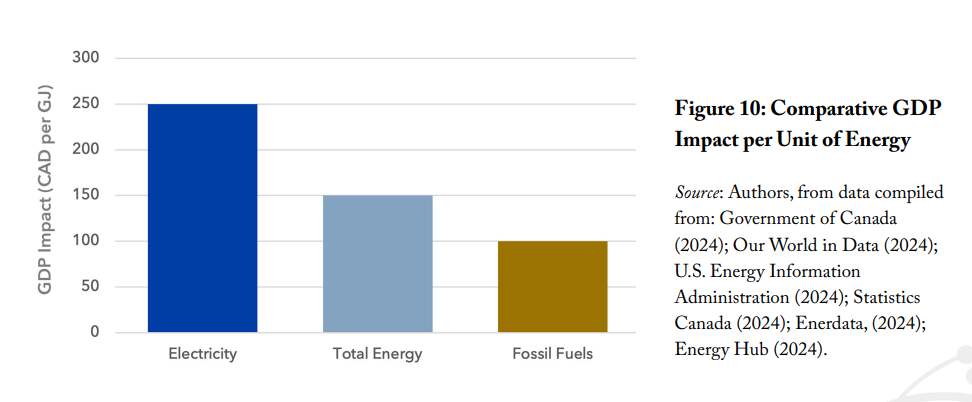
The national narrative must necessarily shift away from future investments in oil and gas pipelines to investment in the creation of a national grid that facilitates the seamless transfer of energy from each province into a national grid: a unifying force that combines social, economic and environmental benefits for all of Canada.
Reimaging the Future of Energy
“If substantial social, economic, and political benefits of a unified country are to be realized, Canada must treat the TransCanada Power Corridor as a project of national urgency, akin to the construction of the transcontinental railway in the nineteenth century.”
Reimagining the basic architecture of Canada’s energy landscape enabled through development of an east–west power corridor—a national grid—can only be accomplished by reducing fragmentation across provincial jurisdictions as part of a whole-of-government, whole-of-society approach.
If substantial social, economic, and political benefits of a unified country are to be realized, Canada must treat the TransCanada Power Corridor as a project of national urgency, akin to the construction of the transcontinental railway in the nineteenth century.
The TransCanada Power Corridor links the entire continent from the West to the East and represents more than an energy project; it is a nation-building enterprise that fuses climate security, energy sovereignty, infrastructure resiliency, innovation and technology development, and national prosperity into a single strategic vision. Its success depends not only on technical feasibility but on urgent and collaborative governance, the recognition of electricity as a strategic trade asset, and the establishment of a robust financial architecture aligned with national purpose.
About the Experts
-

Jatin Nathwani is Professor Emeritus, Department of Management Science and Engineering at the University of Waterloo, as well as BSIA Fellow, Technology Governance Initiative Fellow, and Founding Executive Director of Waterloo Institute for Sustainable Energy (WISE). Professor Nathwani is one of Canada’s foremost experts and thought leaders on sustainable energy policy and technology governance. He has held leadership positions at the University of Waterloo and advised government, business, academic and civil society organizations. He has made significant contributions to the development of science in support of sustainable energy policy, capacity building, and community-building, all in support of transitioning global and national energy systems toward more just and sustainable outcomes.
The University of Waterloo is a leading Canadian institution known for research and innovation. The Department of Management Science and Engineering integrates engineering, business, and policy to address complex societal challenges.
See more -

Kam Mofid is a Balsillie School of International Affairs Fellow. He has been a senior executive and a thought leader in solar energy and energy electrification since 2010 and has led multiple large solar energy and technology companies both in the United States and globally through periods of rapid growth and substantial market changes. Prior to his tenure in clean energy, he held senior leadership positions in the automotive and aerospace sectors at General Motors, Teleflex, and Pratt & Whitney. Kam holds engineering degrees from the University of Waterloo, Canada and the Georgia Institute of Technology in Atlanta, Georgia, USA.
See more
-
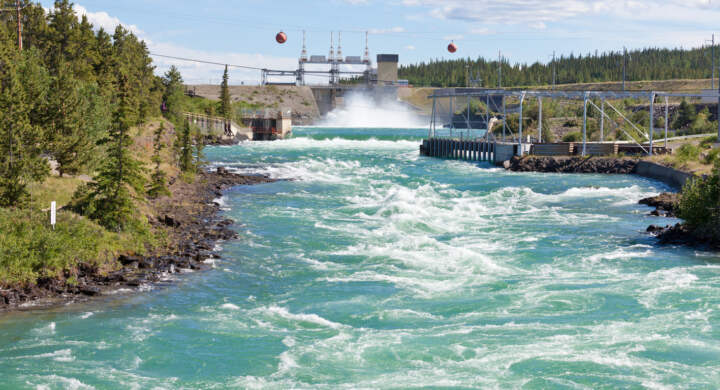 Canada’s Water Advantage: A Strategic Economic Strength in a Volatile World
 Lorena Patterson
President & CEO
WaterPower Canada
Lorena Patterson
President & CEO
WaterPower Canada
-
 Fusion’s Decisive Decade and Why Canada Is Positioned to Lead
 Amitava Bhattacharjee
President & Chief Science Officer
Stellarex
Amitava Bhattacharjee
President & Chief Science Officer
Stellarex
-
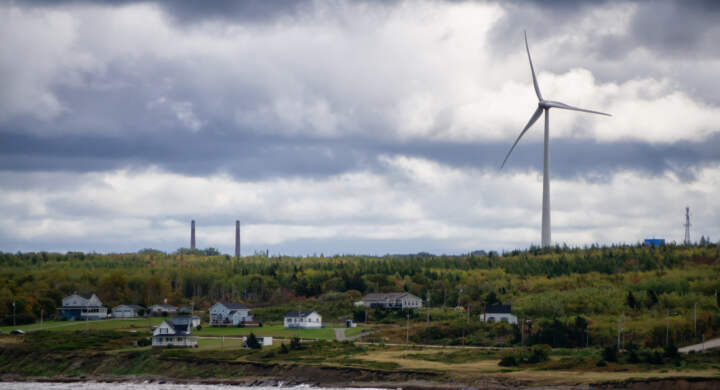 Canada’s Economic Future Runs on Electricity
 Vittoria Bellissimo
President & CEO
CanREA
Vittoria Bellissimo
President & CEO
CanREA
 Imran Noorani
Vice President of Policy
CanREA
Imran Noorani
Vice President of Policy
CanREA