
Fusion’s Decisive Decade and Why Canada Is Positioned to Lead
Canada is winning the fusion game by mastering the specialized engineering and tritium fuel supply that other nations lack.

Fusion, the process that powers the sun and the stars, is the long-promised source of virtually limitless, clean energy. After years of scientific progress, it is entering a decisive decade. The central question is no longer whether the process works. It does. The real challenge is whether fusion reactors can operate continuously, economically, and safely to power modern society.
That shift reshapes the global landscape and places Canada, especially Ontario, in a position few expected, at the center of fusion’s next chapter.
On November 28, 2025, the federal and Ontario governments stood side by side to announce the creation of the Centre for Fusion Energy (CFE), a new public-private partnership. In a typically Canadian way, this moonshot moment was marked by quiet pragmatism, yet it nonetheless represented a strategic pivot aligning Canada’s strengths with one of the most urgent challenges facing the world today: abundant clean energy.
Engineering, Not Physics, is Now the Barrier

As the fusion race enters its decisive and most competitive phase, the barriers that now dominate are engineering and systems challenges, like how reactor walls can withstand years of operation, how the fusion fuel, tritium, can be produced, handled, and safely regulated, and how operations can be predicted through advanced simulations rather than relying on billion-dollar experimental prototypes.
These are not questions of physics alone but of engineering integration—where materials science, nuclear operations, tritium management, the nuclear supply chain, robotics, and high-performance computing converge. This is precisely where Canada has an edge.
Unlike countries that invested heavily in large flagship fusion devices, Canada, by design and circumstance, built expertise in the interfaces where fusion succeeds or fails. Ontario’s nuclear legacy has produced world-leading capabilities in nuclear operations, tritium management, robotics, and the regulatory foundations of a fusion-ready ecosystem.
Tritium as a Strategic Advantage
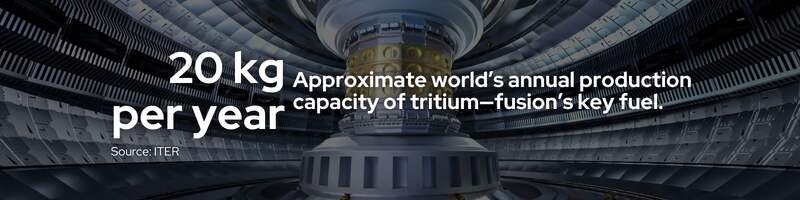
Nowhere is this clearer than at Ontario Power Generation (OPG). Through the Darlington Tritium Removal Facility, OPG operates, by far, the world’s largest tritium-processing and storage facility, in close partnership with the province’s prized CANDU reactors. As fusion moves toward deployment, tritium is becoming a strategic resource, technically, economically, and geopolitically. Countries with experience handling it safely will have a decisive advantage.
This matters even more for advanced fusion energy devices, including the stellarator approach pursued by Toronto-based Stellarex Group Ltd. and several other international fusion programs. Stellarators, first proposed by Princeton’s Lyman Spitzer in 1958, avoid many of the problems that plague other fusion energy approaches. However, their advantages shift the technical burden toward engineering integration, where Canada’s existing nuclear expertise is strongest.
Computation and the Stellarator Opportunity
“Fusion is not a near-term replacement for existing energy sources, but it is a long-term strategy to build a new industry, create high-value jobs, and position Canada as a leader in clean-energy innovation.”
Modern stellarators are designed and optimized through computer simulations. Increasingly, these simulations rely on machine learning and artificial intelligence, fields in which Canada has been a global leader, thanks in part to pioneering work by Nobel laureate Geoffrey Hinton at the University of Toronto.
The CFE will bring together the capabilities needed to launch Canada’s fusion sector. Properly empowered, it can serve as the integration hub where physics, engineering, tritium infrastructure, robotics, and computation converge, anchored in Ontario’s tritium strengths and supported by fusion-grade computing.
This approach leverages Canada’s technical strengths and collaborative culture across government, industry, and academia, and aligns with national economic and climate goals. Fusion is not a near-term replacement for existing energy sources, but it is a long-term strategy to build a new industry, create high-value jobs, and position Canada as a leader in clean-energy innovation.
The Race Will Be Won on Integration
The race to harness fusion will not be won by the country with the biggest device or the largest budget. It will be won by those who solve the hardest remaining problems early and predictably, while engaging the public with transparency and ambition.
On that terrain, including tritium fuel, materials, and trusted nuclear operations, Canada is not catching up. It is already ahead. The question now is whether Canada turns that advantage into lasting leadership.
Calls to Action
“Fast-track clear, predictable risk-based tritium governance and regulatory pathways to enable the safe and timely development and deployment of fusion energy.”
Federal and provincial governments: Commit to a national fusion strategy and a staged funding roadmap that empowers the Centre for Fusion Energy as a domestic and international integration hub.
Regulators and policy makers: Fast-track clear, predictable risk-based tritium governance and regulatory pathways to enable the safe and timely development and deployment of fusion energy.
About the Expert
-

Amitava Bhattacharjee is Professor of Astrophysical Sciences at Princeton University and President and Chief Science Officer of Stellarex Group, a Toronto-based fusion energy company that partners with the Centre for Fusion Energy.
See more
-
 Canada’s Water Advantage: A Strategic Economic Strength in a Volatile World
 Lorena Patterson
President & CEO
WaterPower Canada
Lorena Patterson
President & CEO
WaterPower Canada
-
 Canada’s Economic Future Runs on Electricity
 Vittoria Bellissimo
President & CEO
CanREA
Vittoria Bellissimo
President & CEO
CanREA
 Imran Noorani
Vice President of Policy
CanREA
Imran Noorani
Vice President of Policy
CanREA
-
 Canada’s Clean Energy Opportunity: Powering Shared Prosperity
 Kwatuuma Cole Sayers
Executive Director
Clean Energy BC
Kwatuuma Cole Sayers
Executive Director
Clean Energy BC