
Rethinking Sustainability and Affordability Through Digital Bartering
Firat Eren explores how digital bartering can complement today’s money system — building affordability, sustainability, and stronger local economies.

Fire, the wheel, and money. No wonder they shaped humanity. Fire taught us how to survive. The wheel let us reach distances we never thought possible. Money made our most basic instinct, trading, smoother.
Thousands of years later, we still have fire, but now it’s lasers, induction ovens, plasma cutters, and even nuclear reactors. We still have wheels, but they’ve become rockets, maglev trains, drones, and self-driving cars. For money, we piled on the upgrades there too, like credit cards, crypto, and one-click checkout. But changing how something looks doesn’t change what it is, does it? Painting the Pink Panther blue doesn’t make him the Blue Panther. He’s still the Pink Panther, just blue.
That, to me, is a good starting point for a deeper question.
The Cost of Money
“Money often costs too much,” said Ralph Waldo Emerson. He said this in the 19th century. Today, the cost is even steeper.
What does money cost us now? I am not talking about inflation, interest rates, or taxes, but something deeper. It costs time with your loved ones. Your health. Your freedom. Your creativity. Even who you could’ve become. On the other hand, making a living will always have its fair share of costs. There’s nothing wrong with that.
“What does money cost us now? I am not talking about inflation, interest rates, or taxes, but something deeper. It costs time with your loved ones. Your health. Your freedom. Your creativity. Even who you could’ve become.”
But here is the part that doesn’t sit right: if we’re all paying similar prices, why are the returns so unequal?
Economists call it “unfair income distribution.” That is the polite label. The truth is, it’s not a glitch; it’s by design. Economist Daron Acemoglu, a Nobel Prize laureate for his work on how institutions affect prosperity, said: “Inequality often rises when the benefits of innovation are channelled by existing power structures, rather than broadly distributed by fair institutions, usually to those already in power.”
In other words, there are some who are a little “more equal” than others.
The Architecture of Inequality
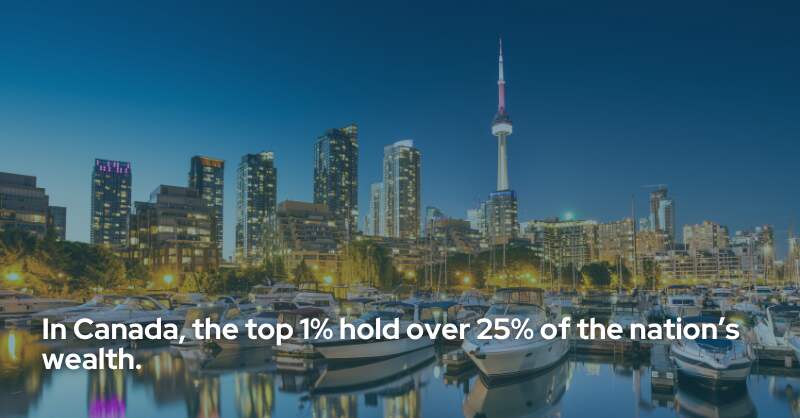
In Canada alone, the top 1% hold over 25% of the nation’s wealth. And despite being one of the richest countries, over a million households spend more than 30% of their income just to keep a roof over their heads. In the US, billionaires gained $1.3 trillion during the pandemic while 20 million people lost their jobs. That’s not accidental. It’s architectural.
“The scale of it—wealth, attention, responsibility—starts distorting judgment, not because they are reckless but because the system turns everyone into an instrument of its momentum.”
Here’s my diagnosis in one line: the trade system has a bottleneck. Every trade, for everyone everywhere, in principle depends on money. Anything that is dependent gets tired, spoiled, and starts losing its survival reflexes. It’s not a coincidence that we see even the boldest minds—the ones building brain chips, planning Mars colonies—start to shift under that kind of pressure. The scale of it—wealth, attention, responsibility—starts distorting judgment, not because they are reckless but because the system turns everyone into an instrument of its momentum.
The system is clearly signalling it is time we start actively seeking creative, out-of-the-box improvements. In other words, it seems like we have reached the limit of repainting the Pink Panther. What we need now isn’t just a new colour, but a new character entirely.
A New Trade Model
This diagnosis comes from a decade spent building and testing a new trading model—one already moving thousands of dollars’ worth of goods and services every month in Toronto. I’ve been working on developing a trading model where emotion, need, values, context, even personality are part of every exchange—like a personalized version of traditional trade.
“By utilizing recent technologies like the internet, AI, very fast computing power, digital currencies, and wide network infrastructures, new modern bartering platforms can be built.”
Simply put, it’s a new-generation bartering system and platform. Is this about going back to the Stone Age? No. What’s new is the digital infrastructure we can now offer in conjunction with it. Bartering itself is a timeless, universal instinct and not something we invented. It’s an instinct even beyond humans, such as when chimpanzees exchange grooming services for food or protection, or even when hermit crabs form a “vacancy chain” to trade shells.
By utilizing recent technologies like the internet, AI, very fast computing power, digital currencies, and wide network infrastructures, new modern bartering platforms can be built. What makes bartering doable now, more than before, is the new era of digital social networking and online platforms and the ability to match supply and demand instantly, which bartering requires. Thanks to AI or other web tools, this is not a problem in today’s technology.
The Outcome
Here’s the outcome: a healthier trade system with multiple instruments, reduced waste and a cleaner planet, reduced excess consumerization, more united communities, more social activity, more decluttered homes, and improved financial status.
The good news is that many Canadians are already living it through BUNZ—short for “Bunz Trading Zone”—a thriving bartering culture hiding in plain sight. Imagine an anti-marketplace where value emerges from stories, not spreadsheets. And it’s working: over 1,500 Torontonians use the app monthly, trading thousands of dollars’ worth of goods and services without cash. There are also tens of thousands of people using different online platforms like Bunz.
“I’ve seen a bottle of Château Mouton Rothschild (1999) traded via the app for things not wanted anymore.”
Bunz is much more than an app: it’s an act, a culture, and a lifestyle. You can Bunz anywhere. It’s an anti-marketplace that transforms exchanges to a level where even Bill Gates is just Bill there. No status, no price tags, no buyer side, no seller side. Just your presence, what you have, what you need, or even what you’d like to have. In fact, I’ve seen a bottle of Château Mouton Rothschild (1999) traded via the app for things not wanted anymore.
Starting the Shift
This doesn’t need permission, funding, or a grand rollout. It starts as a habit: swapping in your kitchen, sharing in a school class, or running a one-week coffee-for-art trade in your café.
Individuals can trade at least 3% of what they acquire without cash. They can join or create a small barter circle and make it normal. Businesses can offer a small slice of inventory or services for trade and accept trade credits alongside cash. Communities and nonprofits can redistribute idle goods and skills before spending budgets.
“This doesn’t need permission, funding, or a grand rollout. It starts as a habit: swapping in your kitchen, sharing in a school class, or running a one-week coffee-for-art trade in your café.”
As to how to grow the bartering culture in Canada, tech builders can create the infrastructure, matching tools, APIs, and trust systems that allow barter networks to interconnect. Governments can pilot barters in public programs and modernize regulations so these systems can operate securely.
Three percent is small enough to try, big enough to matter—and just the start of a shift that could scale from local kitchens to entire cities.
It’s clearly time we take these kinds of radical experiments seriously.
Why?
“Because it’s there.” – George Mallory
About the Expert
-

Firat Eren is a Canadian civil engineer and the CEO of Bunz Inc. Prior to Bunz, he founded and led the web-hosting firm Softcom. He is also an avid mountaineer who has summited Everest, Aconcagua, and Cho Oyu, and attempted other major climbs such as K2, Denali, and Peak Lenin.
See more
-
 From Waste to Wealth: Building Canada’s Circular Food Economy
 Dr. Tammara Soma
Director
Research Food Systems Lab
Dr. Tammara Soma
Director
Research Food Systems Lab
 Amr Addas
Senior Director, Sustainable Finance and Insights
Farm Credit Canada
Amr Addas
Senior Director, Sustainable Finance and Insights
Farm Credit Canada
 Barbara Swartzentruber
Senior Advisor
Canadian Alliance for Net-Zero Agri-food
Barbara Swartzentruber
Senior Advisor
Canadian Alliance for Net-Zero Agri-food
 David Hughes
President & CEO
Generate Canada
David Hughes
President & CEO
Generate Canada
-
 Canada’s Circular Economy: A Path to Zero Waste and Carbon Neutrality
 Craig Hodge
Chair
National Zero Waste Council
Craig Hodge
Chair
National Zero Waste Council
-
 Eco-Effectiveness: Canada’s Path to Genuine Sustainable Growth
 Jury Gualandris
Associate Professor of Operations Management & Sustainability
Ivey Business School
Jury Gualandris
Associate Professor of Operations Management & Sustainability
Ivey Business School