
Building a Strong Canada: Identifying Infrastructure Investments that Deliver More for Canadians

In the current political climate, there is understandably a significant national focus on building a stronger Canada. Not many would argue against the fact that this is a key need. But what does a “stronger” Canada look like in terms of infrastructure?
As well as performing in traditional economic terms (like GDP), a strong Canada needs to be more resilient, not only to geopolitical influences, but also to accelerating climate change and extreme weather impacts. A stronger Canada also requires investment in infrastructure that improves prosperity and service delivery to Canadians. Again, these statements are not controversial. But there are many different ideas on how we get there – some more innovative than others.
The Need for Infrastructure Investment
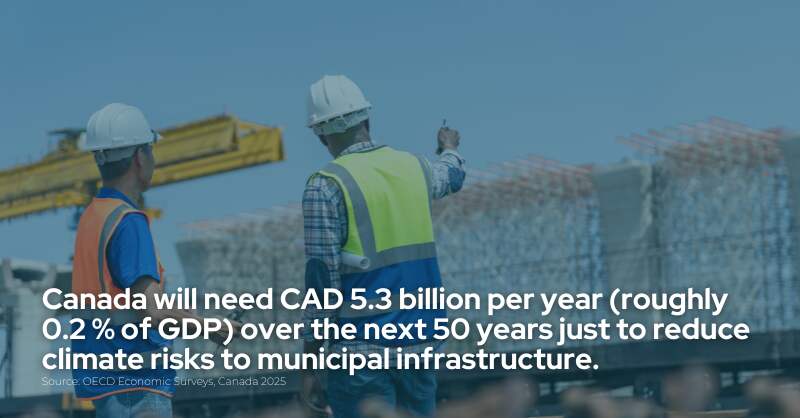
Following the passing of the Building Canada Act in June 2025, the new Major Projects Office (MPO) has been launched to fast-track nation-building projects by streamlining regulatory assessment and approvals and helping to structure financing.
Canada definitely needs to invest heavily in infrastructure. But this means more than new built infrastructure.
The recently published “What We Heard” report from the Canadian Infrastructure Council, summarized engagement on planning the National Infrastructure Assessment. Participants identified that existing infrastructure systems face substantial pressure from aging assets, shifting economic conditions and regional disparities, and there was widespread agreement that Canada’s current infrastructure systems are not ready to withstand increasing climate-related risks.
In addition to major projects, ongoing, long-term and significant investment is required, just to maintain the level of services that infrastructure provides to Canadians in a changing climate.
Natural Infrastructure is Critical Infrastructure
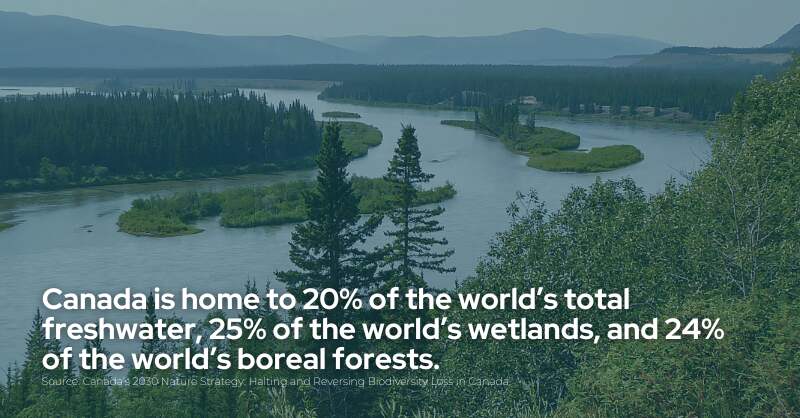
The need for infrastructure investment is not limited to built infrastructure.
Natural infrastructure underpins Canada’s economy, and we are lucky to have a wealth of natural assets. Natural assets, like forests and wetlands, are increasingly recognized as infrastructure that provide financially valuable ecosystem services to Canadians. Services include absorbing and storing water to limit floods and droughts, reducing temperatures to shelter communities from heat waves, and storing carbon to slow climate change.
The Federal Government is making good progress through the Census of Environment in understanding these services, as they compile Canada’s natural capital accounts. Over 150 local governments are also leading the way towards including natural assets in asset management planning activities as well as financial reporting.
However, despite knowing that the services provided by natural infrastructure are valuable, they are currently largely omitted from decision-making. The assets that King Charles described as “core to Canada’s identify” in his Speech from the Throne, are virtually nowhere to be found in our measures of economic strength, infrastructure investment business cases, accounting systems, or financial reports.
An alternative approach is required to ensure that, while we are streamlining regulatory requirements, we are not turning a blind eye to the very real economic losses incurred when critical ecosystem services to people are degraded (and that potentially result in costs for yet more built infrastructure when we realize those services were needed).
Reforming How We Define Value
“If even a small proportion of the natural infrastructure assets in Canada were ultimately recognized by federal, provincial and territorial, municipal and Indigenous governments, it could add billions to our government balance sheets.”
A key underlying issue is that “natural resources and Crown lands that have not been purchased” are currently excluded from Canadian public sector financial statements, including the statements of all levels of government and Crown Corporations. Consequently, natural assets and the services they provide are not appropriately considered in public sector decision-making.
This may all change soon. The International Public Sector Accounting Standards Board are currently preparing the Draft final pronouncement for a new standard on “Tangible Natural Resources Held for Conservation,” which would pave the way for including certain natural infrastructure assets in financial statements, in dollars, if the standard is adopted in Canada.
This is not a far-future pipe dream. The final international standard is anticipated to be published in December 2025.
If even a small proportion of the natural infrastructure assets in Canada were ultimately recognized by federal, provincial and territorial, municipal and Indigenous governments, it could add billions to our government balance sheets. And once assets are on the balance sheet, their value would be reported on annually and presumably taken more fully into account in economic decision-making. This would be an effective way of ensuring that valuable services from natural infrastructure, that are the foundation of the economy, are not lost as we strive to build a “stronger” Canada.
Rethinking How We Make Infrastructure Investment Decisions Now
“Where option appraisal is undertaken in Canada, it is often not robust or transparent, and there is currently no nationally standardized approach.”
What can we do until we have updated accounting standards in hand? One solution is to embed ecological and social outcomes, as well as climate resilience, within mainstream infrastructure planning and design processes and financing structures.
Options appraisal is the comparison of different infrastructure options against set criteria to help decision makers select an approach that delivers the most desirable overall outcomes. Where option appraisal is undertaken in Canada, it is often not robust or transparent, and there is currently no nationally standardized approach. Economic aspects of appraisal are frequently limited to the consideration of direct costs or single outcomes. Key issues include undervaluation of long-term costs and benefits, bias towards traditional “grey” infrastructure solutions that are more familiar to decision-makers, and failure to consider outcomes in the context of services to people. Notably, the critical services delivered by natural infrastructure, are currently not routinely considered in Canada.
Recognizing the need for more robust options appraisal to guide infrastructure investment, the Standards Council of Canada recently commissioned a new national option appraisal guide. The new guide will identify how different appraisal methods can be used to more fully assess the costs and benefits of different options (including non-infrastructure solutions). While the guide will focus on coastal options, the principles could be applied to any type of infrastructure.
Getting Nature Into Financial Reporting
“As a “natural asset-rich” country, Canada stands much to gain by recognizing and drawing on our natural, inner strength, rather than assuming that only what we build ourselves makes us strong.”
There is no need to wait for new standards to start integrating natural infrastructure into financial reporting that accompanies financial statements. By doing this, governments in Canada can plan for sustainable economic growth as we build a stronger Canada, and get ahead of the new standards that are on the horizon.
The national guide, Getting Nature into Financial Reporting, also supported by the Standards Council of Canada outlines how governments of all sizes can start integrating nature into their financial reports today using natural asset disclosures.
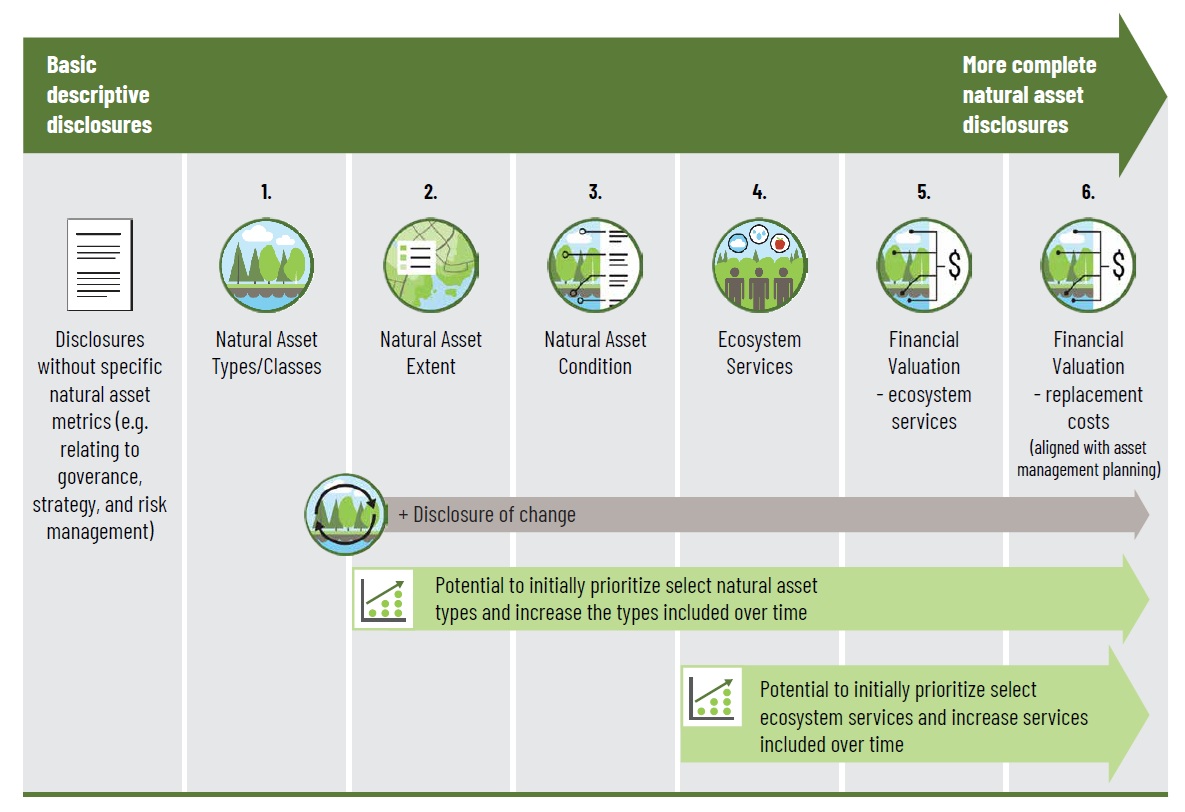
While there is significant amount of attention focused on valuation, financial values are only part of the recommended disclosures, which are:
- Natural asset types and classes: Identification of ecosystems, like forests, wetlands and coastal dunes, on which the community depends for services.
- Natural asset extent: Detailed location data and spatial extent (including maps), and ownership distinctions between government-held and external assets.
- Natural asset condition: Assessment of the ecosystem composition, structure and function.
- Ecosystem services: Metrics outlining services provided (e.g. water storage), benefits to the community, and associated dependencies.
- Financial valuation: Assignment of monetary value to services provided, as well as replacement costs.
- Disclosure of change: Changes in the above listed metrics against an established baseline
Governments do not need to make a complete set of natural asset-related disclosures covering all of the elements identified at once. The guide can be used to identify what disclosures can be made now, and incremental improvements that can be made towards more complete natural asset disclosures (illustrated in the Figure below). All governments can start somewhere.
It will take courage to transform what we value and how we value it, in terms of infrastructure (and beyond). As a “natural asset-rich” country, Canada stands much to gain by recognizing and drawing on our natural, inner strength, rather than assuming that only what we build ourselves makes us strong.
About the Expert
-

Joanna Eyquem is Vice President of Climate Risk Institute. She is an internationally recognized leader in climate adaptation and nature-based infrastructure, with 25 years of experience in North America, Europe, and Western Africa. Her work at the Climate Risk Institute focuses on managing climate risks, including flooding, erosion, and extreme heat, particularly working with nature and the financial sector.
See more
-
 Canada’s Water Future: Climate Change, Water Security, and Sustainable Management
 John Pomeroy
Director
Global Water Futures Observatories
John Pomeroy
Director
Global Water Futures Observatories
-
 From Hidden Cost to Strategic Value: Rethinking Water in the Age of AI
 Soula Chronopoulos
President
AquaAction
Soula Chronopoulos
President
AquaAction
-
 Beyond Silver Bullets: How We Solve Canada’s Wicked Problems Matters
 David Hughes
President & CEO
Generate Canada
David Hughes
President & CEO
Generate Canada