
How Aviation Powers Progress and Economies
Aviation powers economies, connects people, defends freedom, and delivers hope. From taming wildfires to driving innovation, aviation keeps life in motion.

Behind every ticket booked and every flight that takes off and lands safely lies a vast ecosystem of innovation, engineering, and people that makes it all happen. Aerospace is an essential economic and social driver that strengthens Canada’s global competitiveness.
As we look to the future of this indispensable industry, we must ask ourselves, “What do we need, in terms of people, supply chain, transformation, resources, to innovate while continuing to deliver and support flying customers?”
A Canadian Industry That Punches Above Its Weight
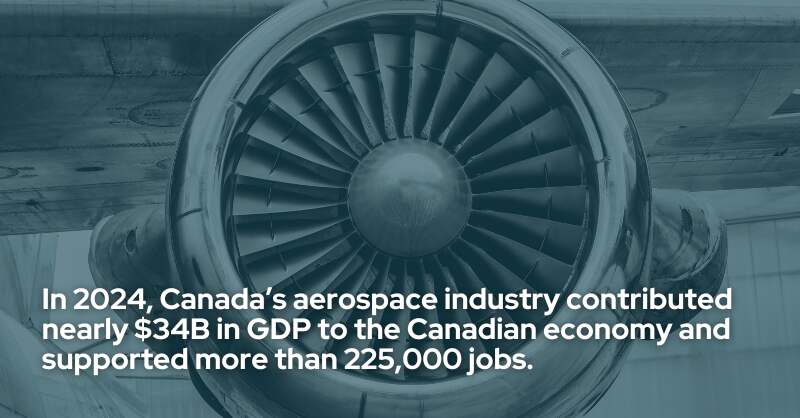
Canada is home to one of the world’s most vibrant aerospace sectors. In 2024, the industry contributed nearly $34B in GDP to the Canadian economy and supported more than 225,000 jobs. The value chain spans design, manufacturing, maintenance, training, and services.
Our industry builds airplanes and components, all the while driving innovation in artificial intelligence, advanced manufacturing, and next-generation technologies that expand into other industries.
Pratt & Whitney Canada is one contributor within this broader ecosystem, designing and manufacturing engines that power aircraft across nearly every segment of aviation. Its work sits alongside that of other major Canadian aerospace players that collectively position the country among the global industry’s leaders. Notably, the greater Montreal area is one of only three regions in the world—alongside Toulouse and Seattle—where a complete aircraft can be built from start to finish.
While these contributions are worth celebrating, we remain candid about the headwinds we face. Aviation at large is navigating a convergence of pressures: workforce shortages, supply chain uncertainty, and demand for next-generation technologies. These are collective issues for an industry and a country to address.
Powered by people: Investing in tomorrow’s talent
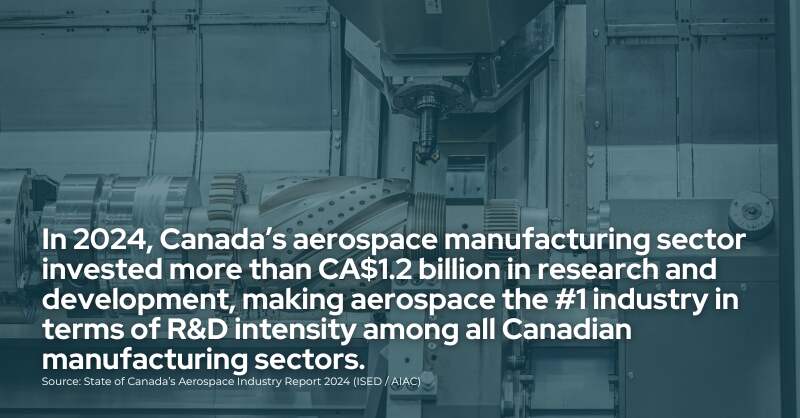
Canada’s capacity to attract, train, and retain the people behind the machines is a national competitiveness issue, an enabler to maintain our international aerospace leader status.
Aerospace is powered by the ingenuity, precision, and passion of its workforce. This is why we must rethink how we value and support aerospace careers, as well as those who surround them. We need the best welders, machinists and technicians as much as we need data scientists, AI specialists, accountants, project managers and other administrative functions. Yet too often, society shines less light on the trades and technical pathways that keep aviation moving.
To secure our future, as an industry, we must:
- Elevate awareness of aerospace careers among youth.
- Expand collaborations between industry, government, and academia to align training with real-world demand.
- Invest in apprenticeship, mentorship, and scholarship programs that make technical pathways accessible.
- Celebrate the impact of these careers.
For more than 10 years, Pratt & Whitney Canada has invested over $500M annually in research and development across Canada. Annually, we invest over $10M in academic collaboration, contribute to over 15 research projects and have more than 20 active university research agreements. We offer scholarships across all levels of education, we support STEM initiatives, and our internship programs are among the largest in the country, hiring over 600 interns every year and providing robust learning and development opportunities.
Together for Next-Generation Aerospace Technologies
Equally pressing is our shared responsibility to create a more efficient aerospace ecosystem. The reality is that no single company can shoulder this challenge alone. Beyond developing new technologies, we must also advance infrastructure, regulatory frameworks, and financing mechanisms in parallel.
Pratt & Whitney Canada’s hybrid-electric flight demonstrator is planned to deliver up to 30% fuel savings compared to today’s turboprop engines, a major step forward in energy and fuel efficiency. We constantly improve our engines to reduce fuel consumption with each iteration. Our PW127XT engine series further exemplifies this progress, improving fuel efficiency by 3%, extending time on wing by 40%, and reducing maintenance costs by 20%.
Working with global operators, we’re also accelerating the adoption of SAF with engine models such as the PW127M powering the ATR 72-600, the PT6C-67C powering the AW139 helicopter, and the PW815GA powering the G600, which has already flown in a 100% SAF configuration. All Pratt & Whitney Canada engines are certified to operate on 50% SAF, and we’re pushing toward 100% by 2030.
Strategy must extend beyond technology: it requires investing in the people who will bring these innovations to life and ensuring that emerging solutions align with future regulations while contributing to stronger global energy independence.
This approach not only addresses environmental challenges but also enhances operational efficiency and cost-effectiveness for operators, making it a sustainable and scalable solution for the future of aviation.
A Call to Action
“We must elevate and support the careers that underpin aviation and all manufacturing industries. These roles deserve recognition, resources, and respect like all other professions.”
So, what should we do?
First, we must reframe aerospace in the public eye—not as a niche industry, but as a cornerstone of Canada’s prosperity, security, and competitiveness.
Second, we must elevate and support the careers that underpin aviation and all manufacturing industries. These roles deserve recognition, resources, and respect like all other professions.
Finally, we must double down on collaborations—between government, industry, academia, and communities—to strengthen supply chains, fund research, and inspire the next generation.
When airplanes fly, they open new horizons—of commerce, of connection, of possibility. It is within our power to shape the future of aviation, and it is something we focus on every day at Pratt & Whitney Canada.
By strengthening our commitment to talent development, continuous innovation and collaboration, we will ensure that Canada’s aerospace industry remains competitive, resilient and influential. These investments extend Canada’s leadership to the world and shape the advancements that will matter most in the years ahead.
About the Expert
-

Maria Della Posta, President of Pratt & Whitney Canada, has been a driving force in the aerospace industry for 40 years. Through her visionary leadership, the company has solidified its position as a global leader in propulsion systems, introducing groundbreaking engines such as the PW800 turbofan, PT6E-Series for general aviation, and PW127XT regional turboprop, while advancing new technologies, including hybrid-electric propulsion. Her vision and collaboration with the industry continue to shape Pratt & Whitney Canada’s success.
See more
-
 Canada’s Future Is Airborne—Let’s Build It to Last
 Tracy Medve
President & CEO
KF Aerospace
Tracy Medve
President & CEO
KF Aerospace
-
 Protecting the Skies Together: Canada’s Leadership on Global Aviation Safety
 Steven MacKinnon
Minister of Transport
Government of Canada
Steven MacKinnon
Minister of Transport
Government of Canada
-
 Aerospace is Essential to Building the Strongest Economy in the G7
 Mike Mueller
President & CEO
Aerospace Industries Association of Canada
Mike Mueller
President & CEO
Aerospace Industries Association of Canada