
Building the Low-Carbon Industries of Tomorrow: Alberta’s Next Wave of Economic Growth
The world is reorganizing around low-carbon competitiveness. Alberta has the resources, expertise, and industrial foundations to lead. But leadership requires action, not catch-up, and the future economy isn’t waiting.

With contributions from Ailsa Popilian, Senior Manager of Communications and Community Engagement with the Energy Futures Lab
Canada is on the brink of a new economic era, one that redefines what it means to be a resource-rich nation. As global markets reorganize around clean growth and low-carbon competitiveness, the question becomes less about whether Canada will continue to extract its resources, but how it will empower the emerging industries capable of advancing its global economic standing.
When it comes to resource endowment, Alberta is an ideal proving ground for how this shift can unfold. A new analysis from the Energy Futures Lab identifies 16 economically viable, resource-based, low-carbon sectors across energy, agriculture, and technology. While each sector exhibits its own regional strengths, together they point to something larger: an emerging future economy grounded in value-added production, advanced processing, and the clean energy systems investors increasingly demand.
Clean Energy is the New Currency of Global Market Access
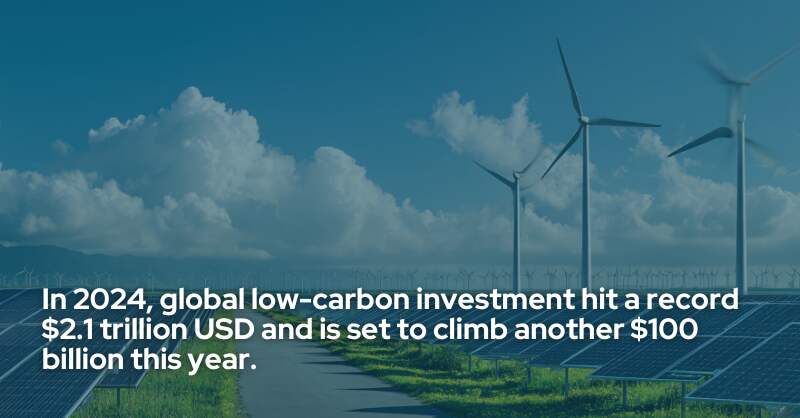
In 2024, global low-carbon investment hit a record $2.1 trillion USD and is set to climb another $100 billion this year. Amid heightened concerns over energy security, industrial costs, and shifting trade dynamics, capital is moving rapidly toward jurisdictions offering clean, reliable and affordable power alongside credible pathways to lower industrial emissions. For Alberta, this is no longer just a climate objective but a competitiveness imperative. And if investment trends hold, tomorrow’s industries will locate where consistent, low-cost electricity is assured.
The recent Ottawa-Alberta MOU underscores this reality, signalling the need for a more integrated and expanded electricity system to power the province’s industrial future. Embedded in the agreement is an understanding that Alberta’s economic future—including its ability to attract AI, data centres, and advanced manufacturing investment—relies on new generation capacity, modernized transmission and a commitment to low-emission power as a foundation for the next wave of economic growth.
When Opportunities are Clear, Strategy Must Follow
When it comes to trade, 2025 was a whirlwind. Political shocks from our neighbours to the south jolted Canada into expanding allied markets, as illustrated by the 2025 defence and trade pact with the EU. Meanwhile, other nations turned inward; China’s firm control of critical mineral exports demonstrated how quickly geopolitics can upend economic strategy. In response, Canada sharpened its focus on long-term priorities. The One Canadian Economy Act marked a shift toward national initiatives such as energy corridors, hydrogen hubs, and critical minerals development, with the latter now reinforced by the billion-dollar federal investment into domestic processing announced during the Prime Minister’s recent visit to the UAE.
National ambition now needs alignment with regional realities, particularly in the West, where Alberta’s choices will heavily influence the country’s economic trajectory. For the province, diversifying economic pathways is a no-regrets strategy—if it chooses to lean in.
Alberta’s Next Economic Wave
“Across an emerging portfolio of resource-based, low-carbon sectors, Alberta has the fundamentals to anchor itself in value chains where global momentum is already building.”
The Energy Futures Lab’s recent analysis of Alberta’s Future Competitiveness and the Next Wave of Growth highlights a set of growth pathways rooted in the same strengths that established Alberta as a global energy leader:
- Deep industrial expertise and infrastructure investment
- World-class engineering and subsurface capabilities
- Export-ready infrastructure
- Strong agricultural production
- A culture of industrial innovation
These are the ingredients of the next wave of low-carbon industries that will drive markets in the future economy. And across an emerging portfolio of resource-based, low-carbon sectors, Alberta has the fundamentals to anchor itself in value chains where global momentum is already building.
From Extraction to Value-Added Leadership
“Alberta has promise as a processing hub to capture added value instead of simply exporting raw resources. “
The next decade will reward jurisdictions that move beyond extraction into processing, manufacturing, and technology integration. 16 emerging sectors were identified in the report, with five standing out for their near-term potential, grounded in market demand and the province’s industrial DNA.
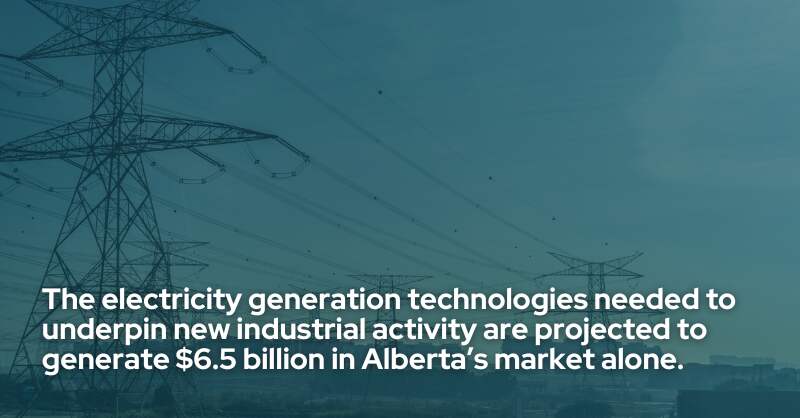
- Clean energy enablers—the electricity generation technologies needed to underpin new industrial activity; projected to generate $6.5 billion in Alberta’s market alone.
- Alternative proteins—capturing more value from Alberta’s agricultural production instead of exporting raw crops. Recent investment in the province tops more than $435 million, including in processing plants in Bowden and Strathmore, tapping into a global market expected to exceed $36 billion USD by 2034.
- Carbon capture and storage (CCS)—applying Alberta’s oil and gas expertise to decarbonize heavy industry. Alberta already hosts six of the world’s large-scale facilities, positioning it for an $18-billion global market by 2032.
- Critical minerals—the missing midstream needed for Canadian and allied supply chains, with a global market set to reach USD 290 billion by 2030. Alberta has promise as a processing hub to capture added value instead of simply exporting raw resources.
- Green chemistry and advanced materials—leveraging Alberta’s $16.8-billion petrochemicals sector to serve a $4.7-trillion global market that’s outpacing the traditional chemical industry.
Critical Minerals: A Case Study in Economic Potential
Canada’s rising role in critical minerals has long been a focus for the Energy Futures Lab, and Alberta is emerging as a key link in Canada’s ability to move up the value chain. With expertise in subsurface extraction, processing, and industrial scaling, the province has the capacity to transform raw commodities into refined, high-value products—whether through lithium extraction from brines, refining ores from neighbouring provinces, or recovering metals from tailings and waste streams.
The launch of the Western Canadian Critical Minerals Alliance signals a clear recognition: the real opportunity isn’t just in extraction, but in the midstream—turning raw minerals into refined inputs for batteries, advanced materials, and clean technologies. The Alliance brings industry and government together to accelerate the infrastructure, policy, and investment needed to build this capacity at scale, as demonstrated through a newly released Industrial Development Playbook.
From Analysis to Action: What Alberta Must Do Next
Competitiveness isn’t about picking winners—it’s about building the conditions for multiple sectors to succeed. The Energy Futures Lab’s system-level analysis identified where Alberta holds a comparative advantage and where new foundations are forming. Notably, even before the MOU was signed, the report outlined policy priorities, including strengthened carbon pricing and expanded electricity transmission, that now appear in the agreement—underscoring the system-level changes required to make structural economic shifts a reality.
To seize these opportunities, the report offers six considerations that policymakers should prioritize:
- Modernize transmission and distribution
- Reinforce carbon pricing regimes (like Alberta’s TIER program) as a competitiveness tool
- Accelerate strategic infrastructure development
- Treat water as industrial infrastructure
- Compete on supply chains, not single projects
- Expand regional industrial hubs
These aren’t merely abstract ideas; they’re the economic fundamentals Alberta must deliver to be investment-ready.
Play to Win, Not Just to Participate
“Alberta doesn’t need one big sector champion; it needs a portfolio of them. That means building optionality, resilience, and agility (think more goals in more nets). “
And just as it’s not about picking winners, building out industries is not a winner-take-all sprint.
Alberta doesn’t need one big sector champion; it needs a portfolio of them. That means building optionality, resilience, and agility (think more goals in more nets). It means moving quickly, adjusting strategy as conditions change, and staying prepared for the openings global markets present.
The world is reorganizing around low-carbon competitiveness. Alberta has the resources, expertise, and industrial foundations to lead. But leadership requires action, not catch-up, and the future economy isn’t waiting.
About the Expert
-

Keren Perla is the Director of Alberta’s Clean Competitiveness at the Energy Futures Lab, specializing in systemic design, foresight, and innovation. She is the co-founder of the Alberta CoLab and an Avenue Magazine Top 40 Under 40 recipient.
See more
-
 Canada’s Water Advantage: A Strategic Economic Strength in a Volatile World
 Lorena Patterson
President & CEO
WaterPower Canada
Lorena Patterson
President & CEO
WaterPower Canada
-
 Fusion’s Decisive Decade and Why Canada Is Positioned to Lead
 Amitava Bhattacharjee
President & Chief Science Officer
Stellarex
Amitava Bhattacharjee
President & Chief Science Officer
Stellarex
-
 Canada’s Economic Future Runs on Electricity
 Vittoria Bellissimo
President & CEO
CanREA
Vittoria Bellissimo
President & CEO
CanREA
 Imran Noorani
Vice President of Policy
CanREA
Imran Noorani
Vice President of Policy
CanREA