
Why Intelligent Mobility is Essential for Resilient, Productive Canadian Cities
Canada’s productivity crisis isn’t just about business investment – it’s about movement. Intelligent mobility can unlock billions in lost productivity by making cities safer, faster, and more efficient.

When policymakers talk about Canada’s productivity crisis, they’re usually referring to the private sector, lagging R&D, underinvestment in new technologies, and a reliance on resource exports over innovation. Public policy has long focused on addressing these gaps, from Scientific Research and Experimental Development (SR&ED) to tax reforms designed to spur business investment.
But that’s not the kind of productivity we’re talking about here.
Canada’s cities face a different, yet no less urgent, productivity challenge, rooted in how efficiently our infrastructure enables the movement of people, goods, and services. Every hour lost to traffic congestion, every delayed delivery, and every collision comes at a cost to our economy, our governments, and our quality of life.
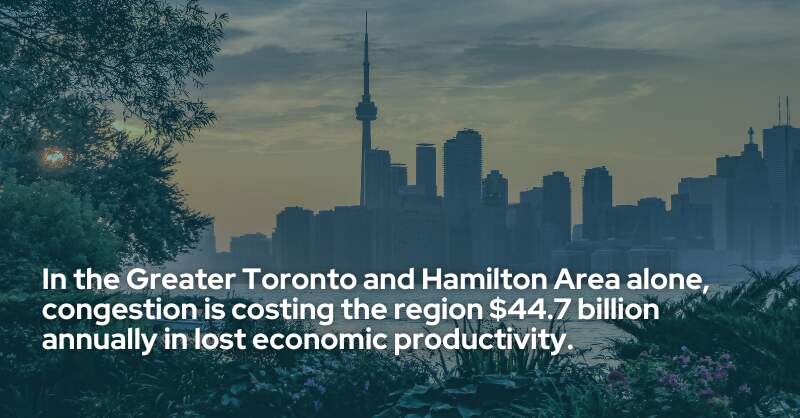
Congestion and inefficiency in our transportation networks are not just nuisances—they are massive, avoidable drags on the economy. In cities like Toronto, Vancouver, Montreal, and Ottawa, commuters lose up to 98 hours each year sitting in traffic. In the Greater Toronto and Hamilton Area (GTHA) alone, congestion is costing the region $44.7 billion annually in lost economic productivity.
This problem affects both private sector output and public service delivery. It slows down the movement of goods and hinders emergency response. It delays transit vehicles and erodes reliability, making it a less attractive option. This collective drain on economic activity and growth ultimately also impacts tax revenues, meaning that public services find themselves trying to improve urban congestion, emergency services and transit within limited budgets. These are solvable problems if we start seeing traffic infrastructure not as a municipal line item, but as a lever for national productivity.
We already have the infrastructure—we just need it to work smarter.
What is Intelligent Mobility?
At Miovision, we define intelligent mobility as the use of connected, data-driven technologies to improve how people, vehicles, goods, and services move through our cities, safely, efficiently, and sustainably. It’s about optimizing the entire transportation ecosystem by equipping infrastructure with the intelligence to respond to real-time conditions and the flexibility to serve the needs of all road users.
This isn’t just about moving cars faster. It’s about enabling more reliable transit, faster emergency response, safer pedestrian and cyclist crossings, and lower emissions. Intelligent mobility supports better decision-making, more effective public services, and ultimately, stronger economic outcomes.
The building blocks of intelligent mobility can be found at urban intersections. Serving the needs of cars, buses, cyclists, pedestrians, delivery vehicles, and emergency services, many Canadian intersections still run on outdated timers or basic sensors, unable to respond to dynamic, real-time traffic conditions.
An intelligent intersection offers advanced capabilities such as multi-use sensors, real-time analytics, cloud-based connectivity, and real-time, two-way data exchange between the intersection and its users. They can make precise adjustments, extending walk signals for seniors, giving priority to late-running buses, creating green corridors for emergency vehicles, and improving safety for vulnerable road users. This data can also be used for broader planning purposes, tracking travel patterns, monitoring emissions, and identifying near-miss collisions to prevent crashes before they happen.
Early Results from Cities
Intelligent mobility systems are already delivering results in Canadian cities:
- Peterborough applied continuous traffic count tech to help engineers optimize traffic signal timing, resulting in a 41% reduction in vehicle delays.
- Milton achieved a 20% cut in travel times along a busy corridor by using intersection-level data analytics.
- Safety analytics played a crucial role in Vancouver and Bellingham, Washington, by identifying incidents of near-miss collisions involving vehicles, cyclists, and pedestrians. In Vancouver, these insights led to significant improvements at key intersections, reducing incidents by 55% and increasing cycling volumes by 68%. In Bellingham, the city’s own changes led to a 33% increase in bicycle ridership and 87% bike lane usage, helping advance its Vision Zero goals.
- Ottawa is currently piloting real-time cyclist detection, providing riders with green-light priority, improving both mobility and safety.
- New York City implemented transit signal priority systems that enabled real-time connections between buses and intersections, reducing delays by an average of 20%.
Intelligent Mobility Systems Should Be an Economic Strategy, Not an Expense
“Upgrading Canada’s approximately 24,000 signalized intersections to smart traffic systems could be achieved within two to three years.”
These examples show how intelligent mobility can cut congestion delays, reduce collisions, and make sustainable modes like walking and cycling more attractive. In dense urban areas that are key drivers of Canada’s economy, this means moving people and goods more efficiently. Yet despite this proven potential, such upgrades remain overlooked in national economic strategy.
In an age where various levels of government are clearly willing to make necessary, big investments in transportation infrastructure—committing billions of dollars for much-needed improvements in local and intra-city transit—they shouldn’t ignore smaller investments offering comparably big impacts on reducing the costs of urban transportation in time, lost economic activity, and delivery costs.
Upgrading Canada’s approximately 24,000 signalized intersections to smart traffic systems could be achieved within two to three years. The annual productivity drain from Toronto’s congestion alone exceeds $11 billion. Optimized signals can lead to a 30% improvement in flow, which would be sufficient to offset the cost of national implementation.
Additionally, we have a once-in-a-lifetime opportunity to set standards for intelligent mobility for the world. By being the first country to implement systems nationwide, Canada can become the benchmark, opening a path to a potential $30 billion export market globally.
A Blueprint for Smarter, Scalable Mobility
“Intelligent mobility must be treated as essential infrastructure. It must be planned, maintained, and expanded like roads, broadband, or water systems.”
To make real progress, we need to move beyond pilots and one-off upgrades. Intelligent mobility must be treated as essential infrastructure. It must be planned, maintained, and expanded like roads, broadband, or water systems.
Unlike large infrastructure projects, intelligent mobility solutions can be implemented relatively quickly. In order to maximize impact, Canada could start by focusing on intersections that need it most. Consider those along emergency routes, transit corridors, school zones, and major commuter routes. Many already have the basics in place, including communication lines and sensors. This means many intersections only require upgrades and not rebuilds to increase their contribution to their communities by lowering emissions, reducing collisions, improving access to services, and strengthening emergency response.
With priority areas covered, the next step is to implement intelligent mobility solutions across the entire signal network. Data insights across a network can reveal otherwise invisible challenges—places where vehicles and pedestrians are at risk of collisions or unnecessary back-ups that ripple into other areas, for example. Network-level data provides an incredible opportunity to optimize urban transportation in a way that’s truly new.
To reach this potential, intelligent mobility must be seen as a priority. That means long-term investment, agreement on common standards, and a clear focus on results.
Better Mobility, Better Canada
“To address Canada’s productivity issues, we need to get more from the road networks we already have.”
In less than three years, we can experience a commute where all modes of travel—pedestrians, buses, cyclists, and commercial vehicles—can move more efficiently and with greater safety through intersections that dynamically adjust to real-time demands.
To address Canada’s productivity issues, we need to get more from the road networks we already have. We need to use what we have to move more people and more goods, and the only way to do that is through intelligent mobility solutions.
About the Expert
-

Kurtis McBride is the CEO and co-founder of Miovision, a Canadian company powering over 170,000 intersections in 68 countries, globally. While others see traffic lights, he sees opportunities to transform how communities move, breathe, and thrive. A recognized leader in intelligent mobility and infrastructure innovation, Miovision is dedicated to solving Canada’s most pressing transportation and productivity challenges.
See more
-
 Government Spending Needs Systemic Alignment to Deliver Projects
 Elaine Alec
Practice Partner
Coeuraj
Elaine Alec
Practice Partner
Coeuraj
 Tyl van Toorn
Co-Founder & Group CEO
Coeuraj
Tyl van Toorn
Co-Founder & Group CEO
Coeuraj
-
 Tourism in Canada: A Cornerstone of Growth and Sustainable Transformation
 Amy Butcher
Vice President of Public Affairs
Tourism Industry Association of Canada
Amy Butcher
Vice President of Public Affairs
Tourism Industry Association of Canada
-
 Laying the Digital Rails for a Prosperous Canadian Future
 Douglas Heintzman
Chief Catalyst
Blockchain Research Institute
Douglas Heintzman
Chief Catalyst
Blockchain Research Institute