
Laying the Digital Rails for a Prosperous Canadian Future
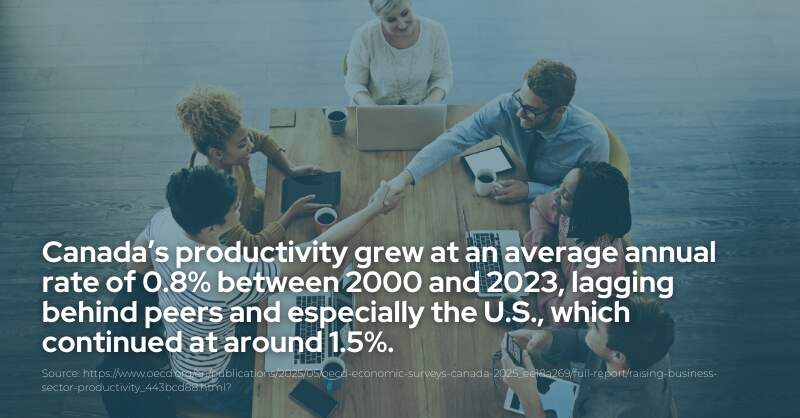
Canada’s productivity crisis is deepening, with 2023 marking the worst decline in the OECD—erasing years of progress and raising urgent questions about how to restore growth, competitiveness, and prosperity.

Margaret Thatcher once quipped, “You and I come by road or rail, but economists travel on infrastructure.” She was making the point that infrastructure is the basis of economic activity and progress, often unseen but essential for everything else to function.
Canada stands at a historic crossroads. We are buffeted by disruptions to supply chains, shifting trade patterns, and rapid technological advancements that are reshaping our infrastructure. Therefore, we must invest in the infrastructure that we want to be the basis of our society and economy going forward, one that will also define our role on the global stage.
At the most fundamental level, the raison d’être of infrastructure is to support a high level of productivity and do as much as we can with the resources we have. And we have abundant resources. We have fertile land, minerals, energy, a stable rule of law, and a highly skilled and diverse population. Yet despite all these advantages, the structure of our economy has led to a national productivity deficit compared with our peers. We’ve dropped from the 6th most productive OECD economy in 1970 to 18th in 2022, now sitting 30% behind the United States. Alarmingly, the OECD predicts Canada will be the worst-performing economy among 38 advanced countries over the next 40 years.
Canada’s future sovereignty, prosperity, and global competitiveness depend on us building a productive, efficient, and resilient economy. Unfortunately, our basic instinct is to tweak outdated industrial models rather than build on their foundations for tomorrow’s economy.
Infrastructure has always aimed to ease the movement of people, goods, and ideas. In the industrial economy, Canada flourished by investing in public infrastructure, including roads, bridges, railroads, power grids, and public health care, which gave rise to efficient factories and vibrant communities.
“To succeed in the digital age, Canada urgently needs a coordinated national effort to invest in a digital infrastructure “moon shot” for the 21st century.”
As we transition to a digital economy, new infrastructure is required. It will be built on microprocessors and software that is invisible yet fundamental. This new digital infrastructure will move ideas, secure identity, facilitate transactions, enable innovation, and build trust. To succeed in the digital age, Canada urgently needs a coordinated national effort to invest in a digital infrastructure “moon shot” for the 21st century.
Digital infrastructure is built on five pillars:
Personal Digital Identity
Identity in the digital age is not merely a card or a number in a government database. It’s a personal asset you control. Imagine seamlessly proving your age, educational background, or health information securely through your phone. Your identity shouldn’t be fragmented across various institutions and platforms; it should be portable, verifiable, and entirely yours. A secure, user-controlled identity reduces friction in interactions with government, employers, health care providers, and educators, ushering in greater trust and autonomy.
“Your identity shouldn’t be fragmented across various institutions and platforms; it should be portable, verifiable, and entirely yours.”
Trusted Digital Credentials

Beyond personal identity, organizations, businesses, and even devices need trusted digital credentials. These credentials establish authenticity, ownership, and capability, creating a secure foundation for confident digital transactions, collaboration, and innovation.
Reliable and Accessible Data
Trust is essential in a digital economy, and it begins with reliable, accessible data. All Canadians should be able to verify real-time information, and Canadian businesses should be able to transact with ease and confidence, from environmental conditions and product safety to land titles and supply chains. Rather than outdated registries or complex bureaucratic processes, we need a transparent, secure digital commons that is accessible and reliable for everyone.
“All Canadians should be able to verify real-time information, and Canadian businesses should be able to transact with ease and confidence, from environmental conditions and product safety to land titles and supply chains.”
Fast and Secure Digital Payments
Our economy needs efficient payment systems that allow people and businesses to transfer value instantly and securely without unnecessary intermediaries. Whether through a Central Bank Digital Currency or a regulated digital bank currency pegged to the Canadian dollar, modernizing our payment infrastructure will lower transaction costs, protect privacy, and expand economic participation.
Canadian AI for Canadian Values
Artificial intelligence (AI) will define our future productivity and global competitiveness. For Canadians and Canadian businesses to thrive, we need AI that understands and reflects our laws, values, and priorities. Imagine automation AI agents, trained on Canadian regulations and tax policy, or personal “identic” agents possessing local knowledge and cultural context, that can assist us in everyday decisions and tasks. However, we must ensure that these capabilities are available to everyone, not just a privileged few. Just as education and health care are public goods, AI-driven intelligence should also be universally accessible, supporting informed, ethical, and situationally relevant decision-making.
“Just as education and health care are public goods, AI-driven intelligence should also be universally accessible, supporting informed, ethical, and situationally relevant decision-making.”
Digital infrastructure will also support our physical world. Roads will become intelligent networks for electric and autonomous vehicles. Our energy grids will manage solar panels, home batteries, electric vehicles, and community microgrids. Digital tools will enable smart voting, seamless tax filing, and lifetime verifiable learning credentials. Food safety, product traceability, and carbon emissions will be digitally tracked from source to shelf.
These ideas are not futuristic; they’re within reach. We have the technology—the real challenge is political will. Just as we once united as a country to lay steel rails across the continent, we must now lay digital rails for a new economy. Canada can’t wait. To build a productive, resilient, and competitive economy that will ensure our continued sovereignty and prosperity, we must seize this moment and invest boldly in a secure, inclusive digital future.
About the Expert
-

Douglas Heintzman is the Chief Catalyst at Blockchain Research Institute, an international think tank exploring Web3 and AI technologies’ intersection with business and society. He is also CEO of Syncura, a cognitive AI software company specializing in document and business process automation.
See more
-
 Government Spending Needs Systemic Alignment to Deliver Projects
 Elaine Alec
Practice Partner
Coeuraj
Elaine Alec
Practice Partner
Coeuraj
 Tyl van Toorn
Co-Founder & Group CEO
Coeuraj
Tyl van Toorn
Co-Founder & Group CEO
Coeuraj
-
 Why Intelligent Mobility is Essential for Resilient, Productive Canadian Cities
 Kurtis McBride
CEO
Miovision
Kurtis McBride
CEO
Miovision
-
 Tourism in Canada: A Cornerstone of Growth and Sustainable Transformation
 Amy Butcher
Vice President of Public Affairs
Tourism Industry Association of Canada
Amy Butcher
Vice President of Public Affairs
Tourism Industry Association of Canada