
Leveraging Sustainable Wood Construction to Beat the Housing Crisis

Today, the intersecting challenges of climate change and housing supply stand as significant hurdles on the path toward sustainable development. How do we address the housing crisis without making the climate crisis worse?
Canada’s Housing Crisis and the Need to Build

It is widely recognized that construction, maintenance, and demolition of the built environment are responsible for nearly 40% of the world’s energy-related carbon emissions. Yet, we can’t stop building. In fact, here in Canada, we need to build much more. Over the last five years alone, population growth has significantly outpaced housing starts, and the gap continues to grow.
“Construction, maintenance, and demolition of the built environment are responsible for nearly 40% of the world’s energy-related carbon emissions.”
In 2023, Canada Mortgage and Housing Corporation reported 223,513 housing starts. This is nowhere near what is needed, considering 2023 was the second year in a row that Canada’s population grew by more than a million people, with our total population reaching 40 million in June 2023.
Of course, the need for significant development isn’t limited to Canada. Over the next 25 years, as the global population approaches 10 billion, it’s anticipated that the worldwide building inventory will double.
“If we do not change the way we build or are too slow to change, this significant construction activity will consume a large part of our remaining carbon budget.”
But the reality is that if we do not change the way we build or are too slow to change, this significant construction activity will consume a large part of our remaining carbon budget—the maximum amount of cumulative, anthropogenic CO2 emissions that would limit global warming to 1.5 °C—and put us on a fast track to catastrophic climate destabilization.
Building for the Future with Sustainable Wood Construction
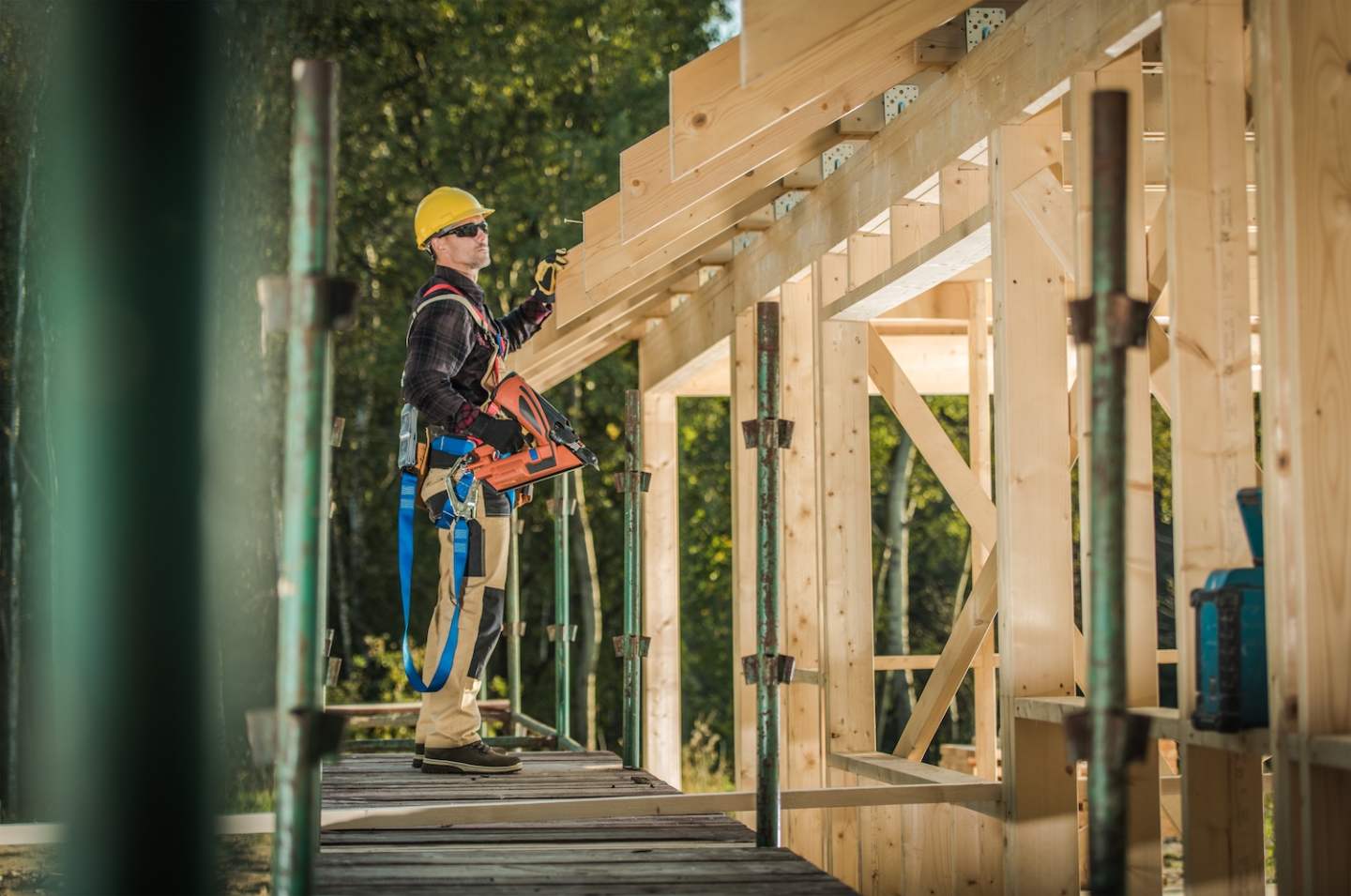
Fortunately, when it comes to construction, we know what we need to do. We already have many tools available that enable us to significantly reduce the carbon footprint of the built environment. Achieving the aggressive carbon reduction targets necessary to limit global warming to 1.5 °C is possible; we just need to make it a priority.
“As we continue to improve the operational efficiency of our buildings, upfront carbon is projected to account for half of the total carbon footprint of new construction until 2050.”
Building with wood from sustainably managed sources is an important part of the overall solution, particularly when it comes to “upfront” carbon. Carbon emissions associated with new construction that are produced before a building comes into use are called upfront or embodied carbon. According to the Bringing Embodied Carbon Upfront report from the World Green Building Council, as we continue to improve the operational efficiency of our buildings, upfront carbon is projected to account for half of the total carbon footprint of new construction until 2050.
It is here, in the embodied carbon calculation, that wood construction has a significant impact. It is the only major construction material we have that is renewable. It is a product that literally grows on trees, which use solar power to clean the air and turn atmospheric carbon into a strong but lightweight construction material.
Canada’s forest management practices are recognized among the best in the world, with more 3rd party certified lands than any other country. When we use wood instead of more carbon-intensive materials, we can dramatically reduce the carbon footprint of our buildings.
Building with sustainably sourced wood products reduces CO2 levels in the atmosphere in four important ways:
- Capturing Carbon: A sustainably managed growing forest is a significant carbon sink.
- Storing Carbon: 1m3 of wood contains approximately one metric ton of CO2 that has been extracted from the atmosphere by the tree as it grows (varies slightly +/- depending on wood species and region)
- Avoiding New Carbon Emissions: When we use wood instead of more carbon-intensive materials, we reduce the carbon footprint of our buildings
- Improving Building Performance: Wood’s natural insulating properties and precision manufacturing can significantly improve building envelope performance, reducing operational carbon emissions.
Important progress has been made in recent years that enables the increased use of wood construction. Building code updates have come into effect that ensure our codes are keeping pace with new products, systems, and engineering advancements in the market. Light frame wood construction, for example, is a safe, sustainable, cost-effective form of construction that has resulted in the delivery of tens of thousands of housing units in the “missing middle” category across Canada since 2009, when the height limit for construction was raised from four to six storeys.
“Light frame wood construction, for example, is a safe, sustainable, cost-effective form of construction that has resulted in the delivery of tens of thousands of housing units in the “missing middle” category across Canada since 2009.”
Similarly, Encapsulated Mass Timber Construction (EMTC), which is a new wood-based construction type recognized by the 2020 National Building Code of Canada, is now permitted in buildings up to 12 storeys in height and is being considered for taller buildings in the future. Mass timber construction has the potential to replace more carbon-intensive construction methods in our urban centres, where larger and taller buildings are needed to achieve increases in housing density.
Our capacity for building with wood has increased dramatically over the last decade. The industry is responding accordingly, with several major mass timber manufacturers in Canada, announcing investments in expansion projects within the last three months that will increase production volume.
“Current value-added manufacturers can take advantage of the significant long-term demand for housing solutions to expand product offerings and production capacity.”
In parallel, the offsite, prefabricated manufacturing sector is providing housing options that range from engineered components like wood trusses and wall panels to building “kits” and completed modules. There is considerable room for incremental growth here, and current value-added manufacturers can take advantage of the significant long-term demand for housing solutions (it’s going to take many years to catch up with the pent-up demand for housing) to expand product offerings and production capacity.
The Future of Sustainable Construction
Canada can build on this momentum by removing development barriers and stimulating innovation with wood products. A first step should include the sharing of strong public signals from the federal government that it supports wood-based housing solutions, such as through a federal affordable housing strategy. Clear federal support in Finland has led to the rapid expansion of mass timber construction, while the Inflation Reduction Act and Wood Innovations Grant in the US have driven their mass timber market to grow 30% annually.
“A national harmonized regulatory framework, coupled with a set of nationally-certified building typologies for wood-based building structures that meet specific standards shared across Canadian municipalities, would enable more efficient permitting processes.”
We also know that permitting processes slow down construction and create administrative burdens for developers, while municipal planners executing these permitting processes may lack experience with wood building techniques. A national harmonized regulatory framework, coupled with a set of nationally-certified building typologies for wood-based building structures that meet specific standards shared across Canadian municipalities, would enable more efficient permitting processes and accelerate housing development.
To ensure uptake by developers and to complement federal initiatives like the GST rental rebate, which removes the GST on new rental housing construction, the government should consider rewarding developers committed to the climate benefits of wood-based construction. Incentives like tax credits, grants, or unique permitting streams for pre-certified building typologies could help accelerate construction.
Canadians can look to the solutions in our own backyard to solve our housing crisis affordably and sustainably. The solutions from our forest sector should be strengthened through federal government action to help unlock the full potential of sustainable wood construction.
-
 Smart Climate Policy Will Unleash Forest-Based Energy Solutions
 Derek Nighbor
President and CEO
Forest Products Association of Canada
Derek Nighbor
President and CEO
Forest Products Association of Canada
-
 Tall Trees, Strong Roots: Untold Stories in Indigenous Forestry
 John Desjarlais
Executive Director
Indigenous Resource Network
John Desjarlais
Executive Director
Indigenous Resource Network
-
 Rebranding Canada as a Leading Sustainable Mining and Metals Economy
 Jean Simard
President & CEO
Aluminium Association of Canada
Jean Simard
President & CEO
Aluminium Association of Canada