
How Agentic AI Will Redefine Work by Automating Decisions, Not Just Tasks
Agentic AI is shifting from a passive “copilot” to a goal-oriented digital worker capable of navigating the “gray zone” of business decisions.

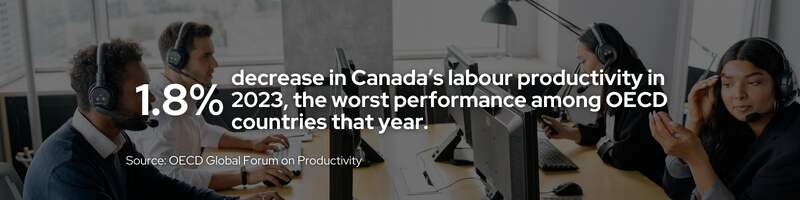
Canadian business leaders don’t need another lecture about uncertainty: we’re living it. The last five years have delivered a string of shocks, and many companies are trying to plan in a world that changes week to week. At the same time, Canada’s productivity problem isn’t abstract. It shows up in how long it takes to get decisions made and how much time smart people spend coordinating work instead of doing it.
This is where agentic artificial intelligence (AI) matters. Because it can automate decision loops, not just tasks. That difference sounds subtle. It isn’t.
Agents Are Digital Workers, Not Copilots
AI agents are different. The simplest way I explain agentic AI is this: they’re digital workers, systems that can do work on your behalf inside your tools and workflows. You give them an objective, you define constraints, and they execute a process that spans multiple steps, tools, and decisions. They can operate in what I call the “gray zone,” where you can’t pre-script every move in advance.
That’s what distinguishes an agent from many “copilot” experiences (think ChatGPT or Google Gemini). A copilot responds to prompts. An agent takes a goal and makes progress toward it, finding information, moving through systems, following up, reconciling inputs, and escalating when it hits a boundary.
The First Wave: The Steps Around Every Decision
To understand where the value comes from, it helps to look at the work that consumes most organizations. It isn’t usually one big strategic decision. It’s the thousands of small operational steps that surround every decision.
These are the tasks that nobody loves, but every organization depends on. They’re also the tasks that create delay, friction, and cost. And they’re the ones agents can take over first, such as data entry, validating against rules or reference documents, routing for approvals, and keeping work moving across email, CRM, finance, and internal portals.
“Agents don’t just “do tasks faster.” They can chain tasks together into a workflow that moves from intake to decision to action. That’s what changes productivity.”
But the most important point is this: agents don’t just “do tasks faster.” They can chain tasks together into a workflow that moves from intake to decision to action. That’s what changes productivity.
The measurable gains show up in cycle time, throughput, and quality. You remove procedural work from high-talent teams, reduce rework and close loops faster, sometimes in hours instead of weeks.
Why This Breaks Traditional Automation
“The rule of thumb is simple: start where reversibility is possible, value is measurable, and escalation rules are clear.”
Traditional automation works best when processes are deterministic. If X happens, do Y. If the input is clean and the path is predictable, it’s powerful. But the moment something unexpected happens, such as an exception, nuance in a customer reply, or a document that doesn’t match the template, traditional automation stops and hands the work back to a person.
Agents don’t have to stop at exceptions. They can interpret context and choose the next step within boundaries. That’s the “gray zone” difference. It’s the difference between a system that follows a script and a system that can carry the process forward when reality deviates from it.
This is also why the most “ready” business processes tend to be the ones that are already digital, repeat frequently, and have clear escalation paths. For example, invoice intake and matching, customer inquiry triage and follow-up, and procurement support. The rule of thumb is simple: start where reversibility is possible, value is measurable, and escalation rules are clear.
The Competitive Edge Is Adaptability
The impact isn’t just efficiency: it’s adaptability, the ability to diversify suppliers and markets faster than your competitors, without burning weeks of human time.
Think about a decision loop many Canadian firms are facing: analyzing materials or components, finding equivalences, identifying suppliers, requesting pricing, validating uncertainty, comparing offers across markets, and deciding what to buy and where to sell. That process can be done manually, slowly. Or it can be accelerated by agents that keep the loop moving, escalate when the risk is high, and deliver options at speed.
That capability is exactly why the competitive edge is real. It’s also why the risk profile changes.
Go Fast at the Pace You Can Govern
“The goal is to choose a speed that is aggressive enough to stay competitive, but controlled enough to be safe.”
When you deploy agents, you’re not just adding a tool. You’re adding a digital worker into your organization, one that can touch email, files, internal systems, portals, browsers, and data. If access is too broad or controls are too weak, you’ve created risk at speed. If instructions are vague, you’ve created ambiguity at speed. If monitoring is absent, you won’t know what happened until it’s already happened.
The right posture is not “go fast”: it’s “go fast at the pace you can govern.”
I use a Formula 1 analogy because it’s simple. The faster you go, the more dangerous it becomes. But refusing to move because it feels risky isn’t a strategy either, because competitors will move, and the learning curve will compound. The goal is to choose a speed that is aggressive enough to stay competitive, but controlled enough to be safe.
In practice, governance means treating agents like privileged identities, not just “apps.” Identity and access control, permission boundaries, logging and traceability, escalation paths, and kill switches aren’t theoretical; they’re how you scale safely.
Managing Outcomes, Not Tasks
“Managers will need clearer prioritization, stronger triage, and more disciplined objective setting: less about pushing tasks through people, more about steering a system and holding accountability when it matters.”
Agentic AI doesn’t remove the need for people. It changes where people spend their time.
As agents take over more execution steps, people move from process to decisions. Less time doing procedural steps means more time setting objectives, defining policy, reviewing exceptions, and making judgment calls. In practice, that creates roles even if companies don’t formalize them right away: roles to design workflows and constraints, to steward multiple agents, and security teams that oversee digital workers.
Managers, in particular, don’t disappear. But their tempo will increase. Agents execute quickly and report back frequently, which creates constant context switching. Managers will need clearer prioritization, stronger triage, and more disciplined objective setting: less about pushing tasks through people, more about steering a system and holding accountability when it matters.
What Canada Must Do Now
“Establish practical expectations for agents in production (controls, traceability, and accountability), then lead by example in carefully selected citizen services where workflow control is possible and value is obvious.”
Canada has real strengths in AI talent and research. The risk is that we confuse those strengths with competitiveness in implementation. Research matters, but implementation is where productivity gains show up, and where the global race is being won or lost.
The government will not out-innovate the market. But it can do something the market can’t do on its own: set baseline standards and normalize safe deployment. Establish practical expectations for agents in production (controls, traceability, and accountability), then lead by example in carefully selected citizen services where workflow control is possible and value is obvious. When Canadians experience responsible agent-driven service in a high-trust context, expectations shift across the economy. Funding helps as well, especially for SMEs, but incentives without visible examples won’t be enough. Canada needs both: standards and demonstration.
The uncomfortable truth is that we don’t fully know what the job map looks like in five years. So we need to train durable skills: communication, judgment, systems thinking, and digital literacy strong enough to steer (and challenge) agent outputs responsibly. At the same time, we can’t afford to break the pipelines that build deep expertise, because validation still matters.
The move is to start running, govern properly, and reinvest gains into scaling what works. We have the talent. We have momentum. Now we need coherent execution, and we need it quickly.
About the Expert
-

Kevin Moore is the CEO and Founder of Vooban, a Canadian leader and pioneer in applied artificial intelligence. The company specializes in supporting organizations in the development and implementation of AI projects that improve productivity. Driven by a mission to foster innovation, Vooban leverages cutting-edge technologies such as AI, data analytics, the Internet of Things (IoT), and cloud computing to deliver high-impact applications.
Vooban is a Canadian applied artificial intelligence company founded in 2011.
See more
It develops customized AI solutions that help organizations automate processes, analyze data, and accelerate digital transformation.
-
 Canada’s Insurance Industry Has A Productivity Crisis. AI Can Cure It.
 Jackson Fregeau
CEO & Co-Founder
Quandri
Jackson Fregeau
CEO & Co-Founder
Quandri
-
 Can AI Help Canada Build the Future of Life Sciences?
 Handol Kim
Co-Founder & CEO
Variational AI
Handol Kim
Co-Founder & CEO
Variational AI
 Martin Enault
Chief Entrepreneur in Residence
Centech
Martin Enault
Chief Entrepreneur in Residence
Centech
 David D. Jones
Managing Director
Merck Canada
David D. Jones
Managing Director
Merck Canada
-
 Adoption Is Not Adaptation: The Reskilling Wave Canada’s AI Strategy Leaves Out
 Tracey Taylor-O’Reilly
Founder
Promentus
Tracey Taylor-O’Reilly
Founder
Promentus