
Adoption Is Not Adaptation: The Reskilling Wave Canada’s AI Strategy Leaves Out
Canada has a plan to help workers adopt AI. What it doesn’t have is a plan to help them adapt when AI changes the jobs themselves.

Canada’s new AI strategy will teach a million students and a generation of workers to use AI in the jobs they hold today. That is the right thing to do. It is also the easy part.
The hard part is the jobs they will not hold tomorrow.
Why Adoption Is Not the Same as AI Reskilling
The impact of AI on the workforce does not arrive all at once. It arrives in waves. The first wave is adoption: putting AI to work in the role you already have. The second wave is adaptation: rebuilding a career when AI redesigns or removes the role itself, and preparing workers to move into roles that may not exist today. The strategy, “AI for All,” is built almost entirely for the first wave. It is nearly silent on the second. And the second is the one that redraws the lines of the labour market.
Adoption is not adaptation. That is the gap in the plan. We have roughly three years to close it.
Skills for the First and Second Waves

Literacy and fluency belong to the first wave.
Most of the debate so far has been about moving Canadians from AI literacy, knowing what the tools are, to AI fluency, using them well. Worth doing. But literacy and fluency answer the same question: how do you do your current job better in a world with AI? Both are adoption. Both assume the job is still there. Reskilling answers a different question: what do you do when the job is gone, or changed past recognition? That is adaptation, and a set of online modules won’t cut it.
Adaptation looks like a surprising second career.
Picture an accountant, ten years in, degree and designation. AI now handles the reconciliations, the first-pass audit, the routine filings, and her role thins. Her next move? It isn’t obvious: financial crime and fraud analyst, catching the fraud that automated systems miss, now that AI helps create it at scale. Her instinct for what clean books look like is exactly what the work needs. She gets there through a short post-secondary credential in forensic analysis, not another degree. That bridge does not exist at scale today. Someone has to build it.
The second wave is an economic event.
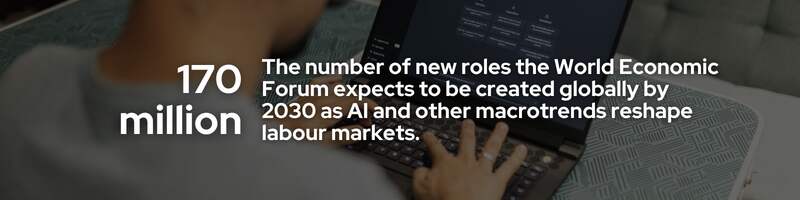
Gartner projects that from 2028, roughly 32 million jobs a year worldwide will be significantly transformed, and about 220,000 people every day will need reskilling or redeployment. The World Economic Forum expects 170 million new roles and 92 million lost by 2030, a net gain of 78 million jobs, with 39% of core skills changing.
History rhymes: the Industrial Revolution and the mechanization of agriculture each remade the labour market over a generation, and the gains arrived only once workers transitioned into the new work. The technology was never the bottleneck. Reskilling people was.
Canada’s AI Strategy Underestimates Workforce Disruption
“AI Adoption is not adaptation. That is the gap in the plan. We have roughly three years to close it.”
Canada’s AI strategy recognizes the upside yet looks past the cost. It promises up to 250,000 new AI jobs by 2031 and ignores the jobs lost and the magnitude of reskilling required during the transition.
The story of the second wave is in the disruption. The strategy’s headline 3% gain in GDP, nearly $200 billion, comes explicitly “from labour productivity,” the very reconfiguration that reshapes the jobs. The benefit and the disruption are one event. The plan counts one side of it.
The second wave is not a new-graduate problem. It is a working-adult problem, millions of people mid-career whose roles will shift beneath them. Teaching new entrants to use AI is necessary. It is nowhere near sufficient. What follows the second wave is genuinely uncertain, from a productivity boom to a slow erosion of good work. That uncertainty is the case for building flexible capacity now, while the runway is long.
Building a National AI Reskilling System
“Reskilling answers a different question about AI: what do you do when the job is gone, or changed past recognition?”
We have the institutions. We have not yet built the system. The strategy misses this. We can’t afford to ignore it.
We have the infrastructure: colleges, polytechnics, and universities with real expertise, close employer ties, and the ability to build and launch reskilling programs. What we lack is a system.
Post-secondary education was never designed for a national reskilling challenge of this magnitude. Institutions operate independently, focused on local labour markets or their own areas of strength. The expertise is national. The delivery is not.
Meeting the second wave means treating post-secondary as a true national system: institutions building specialized programs around their strengths, with employers, then scaling them nationally through consortia or shared delivery. We do this in pockets today. It needs to be funded, coordinated, and led.
Workforce Alliances and the Next Step for Government
The government has started building the table. Its new Workforce Alliances bring government, employers, unions, and post-secondary institutions together by sector. The move now is to give post-secondary institutions genuine co-design authority within them, not a seat in the back row, and to fund the system to build and deliver these programs nationally.
The demand is real. The delivery is buildable. The lead time is tight but workable.
The government read the first wave correctly and moved with intent. Credit where it is due. The second wave is the larger test, and it will arrive whether or not we are ready for it.
We have a plan for adoption. We do not yet have one for adaptation, and that is the plan that will decide how the next decade goes for Canadian workers. The institutions exist. The disruption is certain. What is missing is the decision to fund it and lead it.
Let’s do it before the wave, not after.
Key Calls to Action
- Track the net, not just the new jobs. Government should monitor and forecast the full labour-market reconfiguration, which roles are changing, which are disappearing, and which are emerging, and tune education programs and public policy to it as the data matures.
- Build national reskilling capacity on the system we already have. Fund, coordinate, and lead a shift that treats Canada’s publicly funded colleges, polytechnics, and universities as one national system, able to build programs and scale them nationwide through consortia and shared delivery.
- Build for adaptation now, while you deliver adoption. Stand up the reskilling infrastructure for the second wave before it arrives, because how Canada prepares for adaptation today will decide what the next decade looks like for Canadian workers.
About the Expert
-

Tracey Taylor-O’Reilly is the founder of Promentus, a strategy and advisory practice serving higher education and social-purpose organizations. She founded and scaled York University’s School of Continuing Studies, the largest university continuing education start-up in Canadian history, led exponential growth in continuing education at McMaster University, and served as President of the Canadian Association for University Continuing Education (CAUCE).
Promentus is a boutique consulting and interim leadership firm serving higher education, continuing and professional education, social-purpose organizations and education-technology companies. It works with leaders on strategy, institutional transformation, growth and organizational performance, drawing on experience in complex, stakeholder-rich environments and education-focused enterprises in Canada and internationally, and adjacent sectors.
See more
-
 Canada’s Insurance Industry Has A Productivity Crisis. AI Can Cure It.
 Jackson Fregeau
CEO & Co-Founder
Quandri
Jackson Fregeau
CEO & Co-Founder
Quandri
-
 Can AI Help Canada Build the Future of Life Sciences?
 Handol Kim
Co-Founder & CEO
Variational AI
Handol Kim
Co-Founder & CEO
Variational AI
 Martin Enault
Chief Entrepreneur in Residence
Centech
Martin Enault
Chief Entrepreneur in Residence
Centech
 David D. Jones
Managing Director
Merck Canada
David D. Jones
Managing Director
Merck Canada
-
 From Automation to Reinvention: Why Leaders Defining the Next Decade Are Prioritizing AI Platforms and People
 Brian Solis
Head of Global Innovation
ServiceNow
Brian Solis
Head of Global Innovation
ServiceNow