
The Future of Distributed Wind in Canada: What Must Be Done Now to Lead and Win
Unlike utility-scale projects located far from consumers, distributed wind generates power exactly where it is needed, reducing grid congestion and transmission losses, especially in rural and remote areas.

Across rural Canada, farmers and small businesses face a stark reality: energy bills climbing year after year, while solar panels sit idle through long winters and hydro projects require decades to build. Yet above our fields, industrial parks, and coastlines, one of our most abundant resources—wind—remains underutilized. Distributed wind has the potential to transform Canada’s energy landscape, but only if we act decisively and without delay.
Why Distributed Wind Is Essential
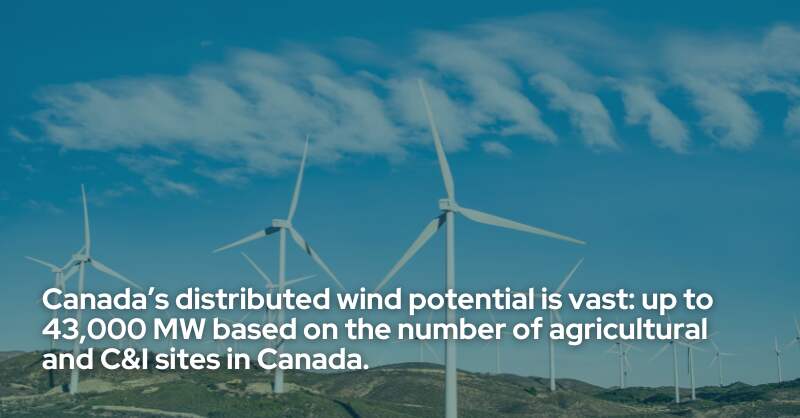
Canada’s distributed wind potential is vast: up to 43,000 MW based on the number of agricultural and C&I sites in Canada. Unlike utility-scale projects located far from consumers, distributed wind generates power exactly where it is needed, reducing grid congestion and transmission losses, especially in rural and remote areas.
It complements solar perfectly: more than two-thirds of its output is produced in winter, balancing seasonal demand. Farmers and landowners benefit from dual land use, generating renewable energy without displacing agriculture. Because distributed wind requires fifty times less space than solar, it thrives where land is scarce, such as farms, industrial parks or institutional campuses and avoids wasting high-quality farmland.
Concerns about noise, footprint, or visual impact often arise, yet modern small-scale turbines are designed to be compact and quiet, with minimal disturbance to landscapes or communities. At the same time, technological advances are driving costs down, making these systems more efficient and grid-compatible than ever.
For equipment owners, the benefits are long-term and tangible: wind is free, immune to inflation, and offers decades of predictable energy costs.
Strategic Benefits for Canada
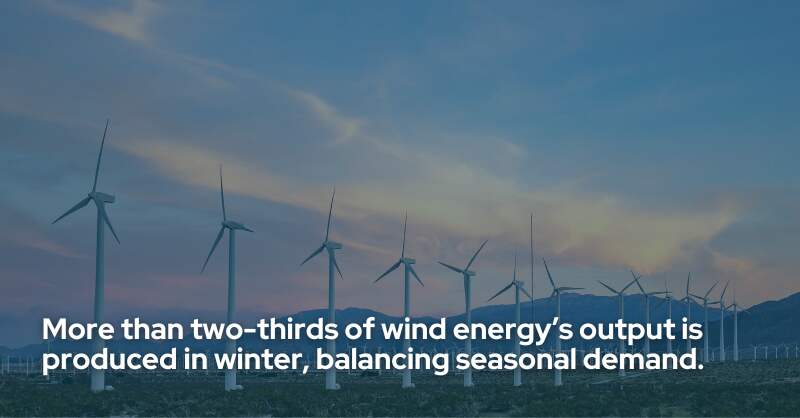
Distributed wind is not just an energy technology; it is a strategic tool for Canada’s competitiveness and resilience. By empowering farmers, businesses, and communities to control their own power, we build energy independence that shields against volatile global markets.
It also accelerates progress toward our national greenhouse gas reduction targets. Distributed projects can be deployed quickly, without the massive infrastructure demands of utility-scale wind, solar, or hydro. And when paired with solar and batteries, distributed wind creates stable, local energy systems that strengthen the grid and reduce intermittency risks.
Perhaps most importantly, distributed wind keeps energy dollars local. Instead of flowing to centralized utilities or foreign imports, revenue circulates in the very regions that need it most, driving economic growth and regional development.
What Must Be Done Now
“Introduce tailored financial instruments—tax credits, grants, low-interest loans—to level the playing field with solar.”
Despite its proven benefits, distributed wind remains on the periphery of Canada’s energy strategy. This must change. To unlock its full potential, Canada should:
- Elevate distributed wind from a niche option to a national clean energy priority.
- Ensure permitting efforts are proportional to project size, avoiding the bureaucratic weight of utility-scale developments.
- Streamline interconnection approvals, with true net metering programs across provinces.
- Introduce tailored financial instruments—tax credits, grants, low-interest loans—to level the playing field with solar.
- Invest in public awareness campaigns so policymakers, utilities, and communities understand the advantages already within reach.
Canada’s Opportunity for Global Leadership
If Canada acts now, it can set a global benchmark for rural and agricultural deployment of distributed wind. By combining climate leadership with economic inclusion, we can catalyze flourishing regional clusters of expertise, manufacturing, and service providers.
Companies like Eocycle are already proving that distributed wind is not just viable but transformative when paired with the right partnerships and community engagement.
The moment is here. By embedding distributed wind into federal and provincial energy transition strategies, Canada can lead—not follow—on the global stage.
Calls to Action
- Integrate distributed wind with defined targets into Canada’s clean energy strategies.
- Facilitate permitting and interconnection by issuing national guidelines for provinces.
- Launch tax credits, grants, and loans tailored to distributed wind.
- Fund national awareness and education programs on its benefits.
- Establish a Canada-wide Rural Energy Resilience Program with distributed wind as a cornerstone.
The Time to Lead Is Now
Distributed wind is Canada’s overlooked advantage: affordable, scalable, and ready today. By harnessing it, we can cut emissions, lower costs, and empower communities, while building a model the world will follow. The question is no longer whether we can afford to act, but whether we can afford not to.
About the Expert
-

Richard Legault is President and CEO of Eocycle Technologies, a world leader in distributed wind energy solutions. With over three decades of experience in renewable energy and business leadership, Richard is dedicated to advancing Canada’s clean energy transition through innovation, rural empowerment, and sustainable economic growth.
See more
-
 Why Steven Guilbeault’s Resignation Must Reignite National Climate Action
 David Miller
Managing Director
C40 Cities
David Miller
Managing Director
C40 Cities
 Valerie Plante
Former Mayor
City of Montreal
Valerie Plante
Former Mayor
City of Montreal
-
 The Race for Critical Minerals: Can Canada Compete?
 John Cook
Senior VP & Portfolio Manager
Mackenzie Investments
John Cook
Senior VP & Portfolio Manager
Mackenzie Investments
 Constantine Karayannopoulos
Former CEO
Neo Performance Materials
Constantine Karayannopoulos
Former CEO
Neo Performance Materials
 Onno Rutten
VP, Portfolio Manager
Mackenzie Resource Team
Onno Rutten
VP, Portfolio Manager
Mackenzie Resource Team
-
 The Future of Sustainable Business: Turning Risk into Resilience
 Marena Winstanley
Managing Director
Smart Prosperity Institute
Marena Winstanley
Managing Director
Smart Prosperity Institute
 Aaron Pardy
Senior Research Associate, Energy and Materials
Smart Prosperity Institute
Aaron Pardy
Senior Research Associate, Energy and Materials
Smart Prosperity Institute