
From Extraction to Subtraction: Carbon Removal is Canada’s Next Big Opportunity
Canada has a historic opportunity to lead the global carbon removal industry, turning climate action into an economic strategy that could create tens of thousands of jobs and add over $140 billion to the economy by mid-century.

Canada’s history was built on fur, fish, timber, and oil, centuries of generating wealth from our land and waters and shipping it to the world. But the next great boom won’t come from taking more out. It will come from putting carbon back under the ground.
Permanent carbon removal is the process of cleaning up carbon dioxide (CO₂) already in the atmosphere and storing it away for centuries or longer. Even if we cut emissions significantly, Canada cannot reach net-zero without also scaling carbon removal solutions to counterbalance any residual emissions. Beyond net-zero, carbon removal can help tackle historical emissions and turn back the clock on the worst impacts of climate change.
“By 2050, Canada could prove, scale, and export the world’s most credible permanent carbon removal solutions, helping to catalyze the industry at the gigaton scale globally.”
The global race to develop a carbon removal industry is already underway, with hundreds of billions of dollars a year expected to be in play by mid-century. Our geography, resources, and expertise give us a head start that few countries can match. The big question is whether we’ll seize it or watch others cash in, while we settle for a supporting role.
By 2050, Canada could prove, scale, and export the world’s most credible permanent carbon removal solutions, helping to catalyze the industry at the gigaton scale globally and restore a stable climate for generations to come. This could be an industrial strategy that helps define the next century of economic competitiveness.
A Natural Head Start
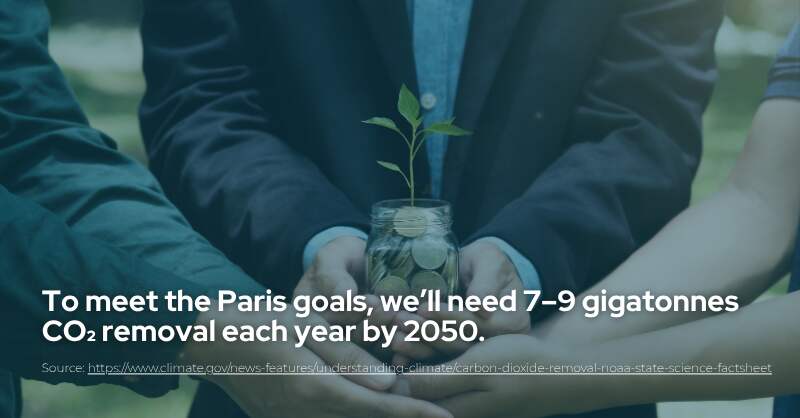
Canada’s advantages are almost unfair:
- Marine resources: the world’s longest coastline and deep ocean research capabilities.
- Clean power: abundant clean energy to power removal facilities.
- Geological storage: vast underground capacity and mineral resources for secure carbon storage.
- Policy stability: a more consistent policy environment than competitors.
- Regulatory strength: relatively strong rules for verification and environmental oversight.
- Industrial expertise: world-class skills in resource processing and large-scale project development.
- Waste biomass: thousands of hectares of forest and farmland with waste suitable for feedstock.
“Canada can have a comprehensive portfolio of carbon removal technologies deployed across Canada, from coast-to-coast-to-coast, with opportunities for every province and territory.”
These aren’t just impressive facts; they’re the building blocks of leadership. Canada can have a comprehensive portfolio of carbon removal technologies deployed across Canada, from coast-to-coast-to-coast, with opportunities for every province and territory.
Direct air capture requires clean power and geological storage, positioning British Columbia and the Prairies as natural hubs for this technology. Similarly, bioenergy with carbon capture depends on sustainable biomass and secure sequestration, making it well-suited for deployment across British Columbia, Alberta, and Ontario—all regions with thriving forestry industries. Meanwhile, enhanced weathering and carbon mineralization can leverage existing mining infrastructure in Ontario and Quebec. Finally, ocean-based removal methods are ideally matched to the Atlantic provinces, which offer extensive coastlines and established marine expertise.
We don’t just have one or two of these advantages; we have them all, with industries already capable of operating at scale.
And governments across Canada are taking notice, taking some excellent early steps, including the:
- Carbon Management Strategy
- Low-Carbon Fuel Procurement Program (LCFPP),
- CCUS and biomass tax credits, with a top-up credit in Alberta for DAC projects
- Federal DAC offset protocol, alongside CCS protocols in Alberta and BC
Prime Minister Carney even made history by being the first politician to include commitments to permanent carbon removal in a political platform during the last election.
But Head Starts Aren’t Enough
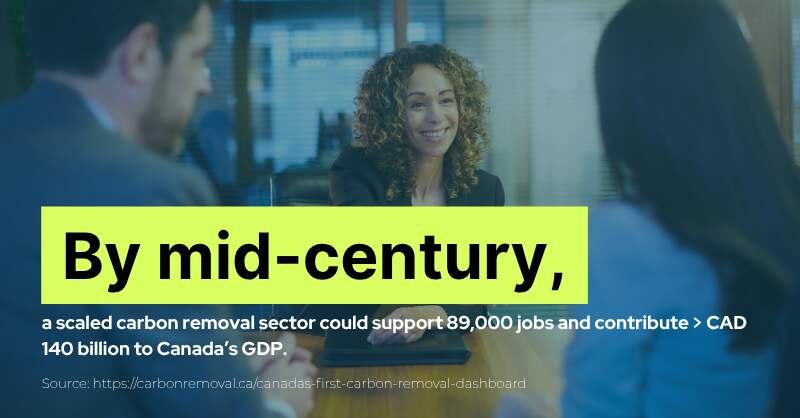
However, despite our advantages, Canada also faces serious barriers to scaling carbon removal.
Our bureaucracy can be risk-averse. Carbon removal technologies are still coming down the cost curve. Federal-provincial responsibilities and compliance markets are fragmented. Permitting can drag on for years. Power grids in some regions are maxed out, and CO₂ transport is mostly limited to Alberta.
“If we want to lead, we can’t just rely on natural advantages and wishful thinking. We need to actively dismantle these barriers while building the markets, infrastructure, and policy frameworks to compete globally.”
These bottlenecks threaten to constrain an industry where speed matters.
If we want to lead, we can’t just rely on natural advantages and wishful thinking. We need to actively dismantle these barriers while building the markets, infrastructure, and policy frameworks to compete globally.
Defining Leadership
There’s no playbook for being the global leader in carbon removal because no one has claimed that mantle yet.
True leadership means more than counting projects or tonnes removed. It’s about creating an ecosystem where companies choose to locate, investors see long-term stability, and other nations look to us for standards and expertise. It’s about becoming a training ground for the global workforce and a testing ground for breakthrough technology.
Most importantly, it’s about positioning ourselves as a credible standards-setter and technology exporter internationally. The countries that write the rules will own the markets.
“Companies won’t build at scale without buyers, and buyers won’t commit without a reason to enter the market at its earliest stages. Breaking that cycle requires bold demand signals.”
Building Durable Demand
Carbon removal faces a classic chicken-and-egg problem: companies won’t build at scale without buyers, and buyers won’t commit without a reason to enter the market at its earliest stages. Breaking that cycle requires bold demand signals.
“The federal government could commit to purchasing removals and put them towards our international climate targets, creating a predictable revenue stream for Canadian projects.”
The next move is to enhance the impact of existing carbon removal programs while committing to large, long-term purchases and integrating carbon removal into compliance markets nationwide.
- Expand the LCFPP commitment to purchase carbon removal from $10M to $50M between now and 2030. This would not require any additional operational costs as there are already sufficient funds within the program, and the program is ready to have an immediate impact on the industry, which sidesteps the lengthy setup process that larger programs typically require.
- The federal government could commit to purchasing removals and put them towards our international climate targets, creating a predictable revenue stream for Canadian projects.
- We need to fully integrate carbon removal into compliance markets like the Output-Based Pricing System, provincial carbon markets programs, and the low-carbon fuel standards that exist across the country. This would create durable, scaled demand beyond one-off pilot purchases and corporate marketing budgets, without creating new policy structures.
Every tonne purchased from Canadian projects represents revenue, jobs, and intellectual property that stay here rather than flowing abroad.
Scaling Supply, Not Just Studies
On the supply side, we have multiple levers to bring new capacity online quickly if we’re willing to invest.
- Ensure that programs demonstrating measurable return on investment by bringing new companies and technologies to commercialization, particularly in carbon removal, are adequately funded. This should include the Energy Innovation Program at Natural Resources Canada, which should be expanded to include a dedicated carbon removal stream.
“The federal Green Bond program could make carbon removal projects eligible immediately, leveraging private capital without increasing government spending.”
- Expand the CCUS ITC, as committed to during the recent federal election, to a wider swathe of carbon removal technologies.
- The federal Green Bond program could make carbon removal projects eligible immediately, leveraging private capital without increasing government spending. This funding could flow to companies through grants or low-interest loans, each competing to maximize production capacity.
- Carbon removal isn’t limited to one sector; instead, it’s a set of tools that can integrate into forestry, steel, agriculture, and mining, creating co-benefits and additional revenue streams for the industries that embrace it. That’s why it needs cross-department recognition, from Natural Resources to Agriculture to Innovation to Fisheries. These departments should be including it explicitly in their mandates and their existing programs.
- We also need to bridge federal-provincial gaps. A cross-jurisdictional cooperation framework could streamline permitting, coordinate infrastructure like CO₂ pipelines, and ensure power availability where projects want to build.
The Choice Before Us
This extends far beyond our domestic market. Carbon removal will be global, with countries and companies seeking the most credible, verifiable solutions. Canada has the opportunity to become the world’s most trusted supplier.
Our resource economy made Canada wealthy, but in tomorrow’s economy, our prosperity will be bolstered by sectors like carbon removal. The countries that act now will set the standards, own the technology, and sell the solutions.
“Carbon removal will be global, with countries and companies seeking the most credible, verifiable solutions. Canada has the opportunity to become the world’s most trusted supplier.”
We can lead that pack or stand back and buy the results from others. It’s a simple choice, and the window is closing fast.
About the Expert
-

Na’im Merchant is the Executive Director of Carbon Removal Canada. He previously founded Carbon Curve, a consulting practice focused on equitably scaling up carbon removal. He’s an advisor to Terraset and the Carbon Removal Standards Initiative, and was previously an Elemental Impact Policy Fellow. He brings 10+ years of leadership experience in non-profits that expanded access to health innovations around the world.
See more
-
 CCS Deployment: Don’t Take the “S” for Granted
 Neil Wildgust
President & CEO
Carbon Management Canada
Neil Wildgust
President & CEO
Carbon Management Canada
-
 The Voluntary Carbon Market is in Transition: Here’s What it Means for the Green Economy
 Yingzhi Tang
Senior Research Associate
Institute for Sustainable Finance (ISF) at Smith School of Business, Queen’s University
Yingzhi Tang
Senior Research Associate
Institute for Sustainable Finance (ISF) at Smith School of Business, Queen’s University
-
 Canada’s Decarbonization Challenge: An Economic Path Forward
 Alex Todorovic
CEO and Co-founder
Arbor
Alex Todorovic
CEO and Co-founder
Arbor