
Canada’s Critical Mineral Moment: From Resource Wealth to Industrial Power
Canada is transforming its vast natural reserves into a strategic industrial engine for the global energy transition.

For years, critical minerals were treated as technical inputs, essential to engineers and commodity traders, yet peripheral to national strategy. Today, they sit at the centre of industrial policy, trade relations and allied coordination, as countries race to secure access to the materials that underpin economic resilience and competitiveness.
Critical Minerals as Instruments of Power
Why do critical minerals matter? Because they are irreplaceable inputs for electrification, clean technologies and advanced manufacturing, often with few substitutes and high switching costs.
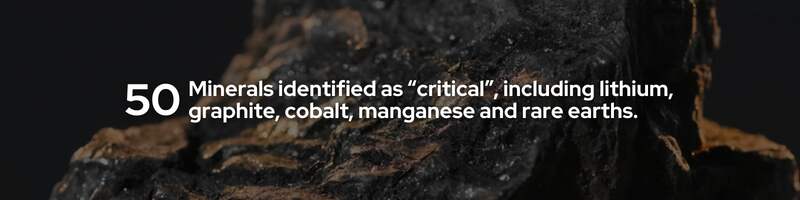
In North America and the European Union, the International Energy Agency (IEA) counts roughly 50 metals and minerals meeting “critical” criteria—including lithium, graphite, cobalt, manganese and rare earths—given their unique properties and indispensability in technologies that power our modern world.
Graphite is illustrative. It is foundational to 21st-century industry, from EV batteries and grid storage to AI-scale data centres, advanced systems and next-generation materials. It is also the single largest component in a typical lithium-ion battery.
“Power does not lie in geology alone; it also lies in the ability to transform natural endowments into high-value engineered materials.”
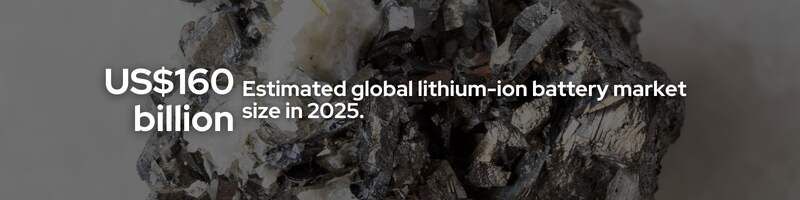
Batteries are the most visible expression of this reality: the global lithium-ion battery market exceeded US$150 billion in 2025, up more than 20% from 2024. Yet the significance of batteries extends far beyond market size, touching energy systems, transportation and digital infrastructure. Crucially, the gap between raw resources and qualified active anode material (AAM) is where another strategic leverage is created.
Power does not lie in geology alone; it also lies in the ability to transform natural endowments into high-value engineered materials. That means processing capacity, midstream refinement and the delivery of specification-compliant materials at an industrial scale. Without this, mineral abundance yields limited influence. The difference between a price taker and a strategic supplier is industrial discipline: predictable permitting, supportive financing instruments and the ability to supply downstream manufacturers today, not in theory.
Meanwhile, critical mineral supply chains are anything but diversified. The IEA has repeatedly underlined the high concentration of critical mineral supply chains, and even more their processing, while investors discount projects that cannot convert resources into qualified materials at industrial scale. Manufacturers seek diversified, trusted, traceable supply to avoid exposure to single-country disruptions. Nations that can refine and deliver midstream products consistently will hold a strategic advantage. Critical minerals are instruments of power in an increasingly volatile and competitive world.
From Geopolitics To Geoeconomics: Policy Now Shapes Minerals Markets
The accelerated dynamics of 2025 marked a decisive shift: public policy now actively shapes critical mineral markets. Governments increasingly treat supply chains not as trade flows but as strategic infrastructure to be coordinated, diversified and protected. In this landscape, Canada is positioning itself as a deliberate, aligned actor, working closely with G7 partners.
Across the allied nations, finance ministers have turned to price floors, supply partnerships and coordinated public-finance tools to pivot from “cheapest” to “safest” supply. In the United States, the decision to delay new Section 232 tariffs and engage allies on minimum import prices reflects the same intent: stabilize the market without penalizing trusted suppliers. The launch of Project Vault—a US$12 billion stockpile—reinforces this transition by smoothing supply-chain risk through structured, standards-based sourcing.
Canada’s policy architecture mirrors this evolution. Under its G7 Presidency, the country championed the Critical Minerals Action Plan, a Roadmap for standards-based markets, and the Critical Minerals Production Alliance, paired with 26 investments and partnerships unlocking C$6.4 billion in strategic projects, including a graphite offtake with Nouveau Monde Graphite (NMG). Together, these initiatives signal that Canada is a predictable, ESG-aligned partner ready to anchor allied supply.
“The creation of the Major Projects Office (MPO) further accelerates time-to-market opportunities by streamlining approvals and financing for nationally significant projects.”
Domestically, Canada’s strategic selectivity on EV tariffs underscores the challenge of staying open to trade while building advanced domestic capacity. The creation of the Major Projects Office (MPO) further accelerates time-to-market opportunities by streamlining approvals and financing for nationally significant projects.
Through these converging shifts, Canada moves from resource participant to structuring actor in allied critical-mineral supply chains—supporting investor confidence, long-term offtake agreements and strategic investment aligned with Western industrial and energy-security priorities as demand, including for graphite, intensifies.
Does Canada Hold The Key?
“Domestically, securing long-term offtake agreements, deepening the talent pool and maintaining investor confidence will be essential to reach bankable scale. “
A single-source country’s grip on critical minerals did not happen by accident; it was constructed over decades. Rebalancing will require long-term commitment, coordinated policy and credible industrial partners capable of delivering resilient alternatives.
Canada has the ingredients to be a strategic supplier for allied economies: abundant reserves (graphite, nickel, lithium and more), clean power that others cannot replicate at scale, and a recognized framework that prioritizes transparency, ESG performance and predictable permitting. In recent years, large-scale investments in critical materials, advanced components and processing facilities have begun to form an integrated ecosystem—evidence that international capital recognizes Canada’s long-term potential.
But advantages alone do not guarantee leadership. Canada must move quickly to bridge infrastructure gaps and deliver industrial-scale production. Competition is intense, with established processors abroad operating at high volume and lower cost. Domestically, securing long-term offtake agreements, deepening the talent pool and maintaining investor confidence will be essential to reach bankable scale. At the same time, Canada must remain open to global trade while applying standards that retain value creation at home, avoiding the historic pattern of exporting raw materials only to import high-value technologies.
Case in point: graphite. Within the G7, Canada is currently the only country actively producing natural graphite and is building an industrial ecosystem around it. The IEA’s 2026 Critical Minerals Review is explicit: Canada can be a major global supplier of key minerals, including graphite.
The Future of Mining
“Countries that align industrial strategy, policy stability, clean energy, and credible execution will secure economic sovereignty.”
If we maintain discipline, accelerate processing capacity, leverage pooled offtake, and deepen responsible partnerships, Canada will not just keep up with the critical minerals at the heart of tomorrow’s industries and energy transition, it will power it.
Countries that align industrial strategy, policy stability, clean energy, and credible execution will secure economic sovereignty.
NMG is one illustration. Recognized by Canada as a Major Project of National Interest, we are advancing an integrated mine-to-advanced materials value chain for graphite, backed by long-term offtake terms.
Our contribution is comprehensive: we build, compete, and deliver; we reinforce national and allied security through resilient, traceable supply; we advance clean-power competitiveness across the value chain; and we prove how strong institutions turn policy ambition into qualified tonnes.
If this resonates, we look forward to continuing the Future of Economy dialogue at PDAC 2026, March 1–4 in Toronto, and around the world as we expand our engagement.
About the Expert
-

Eric Desaulniers, MSc, P. Geo, is the Founder, President and CEO of Nouveau Monde Graphite, an ESG-driven company dedicated to developing North America’s largest graphite production to supply tomorrow’s industries with sustainably and ethically transformed advanced materials. Prior to launching the company, Eric worked for Sanders Geophysics and the Canadian Armed Forces.
See more
-
 The Race for Critical Minerals: Can Canada Compete?
 John Cook
Senior VP & Portfolio Manager
Mackenzie Investments
John Cook
Senior VP & Portfolio Manager
Mackenzie Investments
 Constantine Karayannopoulos
Former CEO
Neo Performance Materials
Constantine Karayannopoulos
Former CEO
Neo Performance Materials
 Onno Rutten
VP, Portfolio Manager
Mackenzie Resource Team
Onno Rutten
VP, Portfolio Manager
Mackenzie Resource Team
-
 Canada Must Lead the Next Era of Responsible Metals and Deep-Sea Mining
 Gerard Barron
Chairman & CEO
The Metals Company
Gerard Barron
Chairman & CEO
The Metals Company
-
 From Quiet Strength to Global Leadership: This is Canada’s Semiconductor Moment
 Gordon Harling
President and CEO
CMC Microsystems
Gordon Harling
President and CEO
CMC Microsystems