
Canada Must Lead the Next Era of Responsible Metals and Deep-Sea Mining
As global demand for critical minerals surges, Canada faces a pivotal choice in the emerging field of deep-sea mining.

For more than a century, Canada stood at the forefront of global resource development. From Sudbury’s nickel basin to the vast mineral wealth of British Columbia and Quebec, Canadian discoveries powered industries, built cities, and helped fuel the global economy.
Generations of Canadian geologists, engineers, and institutions not only developed world-class mines but also built a reputation for responsible extraction, one that balanced economic growth with environmental stewardship.
Today, as the world competes for the critical minerals needed to build energy systems, electrify transportation, and strengthen national security, Canada risks falling behind. Global demand for nickel, copper, cobalt, and manganese is projected to multiply several times over in the decades ahead. Yet ore grades are declining, and new discoveries are flatlining.
Meanwhile, operations have shifted to regions with higher grades and lower costs, often where weak governance and oversight come at the expense of local communities and fragile ecosystems.
A New Opportunity and a Challenge to Lead
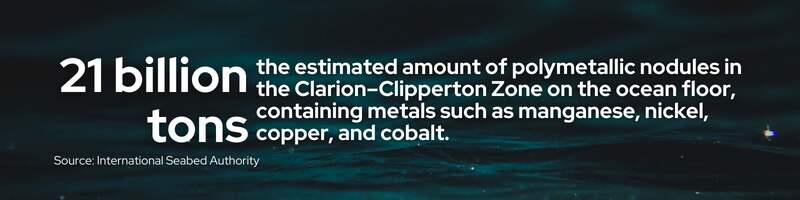
Against this backdrop, the world’s attention is turning to a new frontier. Deep-sea polymetallic nodules have emerged as one of the most promising sources of critical minerals. Sitting unattached on the seafloor, these remarkable rocks contain high grades of four base metals and can be collected without the deforestation, massive waste, or human displacement associated with land-based mining.
When undertaken responsibly, nodule collection can produce more metal from less ore, with dramatically reduced impacts on ecosystems and human communities.
Though the resource may seem novel, the field is not. More than 50 years of scientific research and mining trials, encompassing over 300 offshore campaigns and 25 cumulative years at sea, have deepened society’s understanding of the abyssal environment and the effects of various collection technologies. The data tell a clear story: when undertaken responsibly, nodule collection can produce more metal from less ore, with dramatically reduced impacts on ecosystems and human communities.
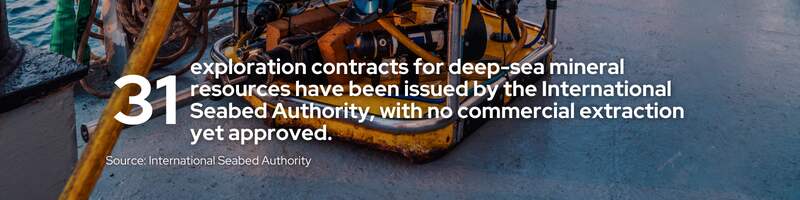
Yet, Canada’s decision to support a de facto moratorium at the International Seabed Authority (ISA) makes its stated goal of establishing a robust regulatory regime less likely, not more. This position, similar to those adopted by the UK and Germany, overlooks decades of scientific evidence and, unintentionally, strengthens activist strategies designed to delay the adoption of workable rules indefinitely. In doing so, Canada risks sidelining its scientists and companies while ceding regulatory influence at the ISA to others, most notably China.
The Data Is Clear, and Canada Should Trust It
“Policymakers must not let misinformation drive decisions.”
Critics of deep-sea mineral collection often rely on outdated assumptions. Following over two decades of pioneering research and monitoring of the first-ever mining trials, the US National Oceanic and Atmospheric Administration (NOAA) reported in the 1990s that nodules could be collected safely and responsibly. This data remains relevant but is often ignored.
Today, the evidence base is far more robust. Modern studies show that seafloor sediment plumes, once thought to travel vast distances, in fact settle within hundreds of meters rather than thousands of kilometres. As Dr Thomas Peacock of MIT cautioned in testimony to the US Congress, policymakers must not let misinformation drive decisions.
If Canada, a nation with one of the world’s strongest records of science-based resource policy, truly seeks to shape the global norms of this emerging industry, it cannot allow fear to outweigh data.
Canada’s Strength: Innovation, Clean Processing, and a Circular Future
Canada’s opportunity is immense. The country already leads in the development of clean, efficient metallurgical processing.
“The same technologies being developed to process deep-sea nodules will also enable a future where we move through society like nutrients in a living system. “
Innovative work on nodule processing is being carried out by Canadian companies and institutions with TMC’s metallurgical partners, including Kingston Process Metallurgy (KPM) and SGS, at the forefront of developing processing pathways that have been proven to dramatically reduce waste generated and carbon emitted compared to equivalent production on land.
And Canada’s role should not stop there. The same technologies being developed to process deep-sea nodules will also enable a future where we move through society like nutrients in a living system.
While the global stock of recyclable metals remains limited, the groundwork is being laid for a future where resources are continually recaptured, reused, and refined. With its deep engineering expertise, clean energy, and established processing ecosystem, Canada is well positioned to anchor this next phase of metals innovation, from responsible production to next-generation recycling.
Calls to Action: How Canada Can Win
As the race for critical minerals accelerates, the choices made today will shape national industrial and energy futures for decades to come. The question for Canada is simple: will it lead or be led as the world looks to this new frontier?
“Clear policy direction would also empower Canada’s research community, from ocean engineers to geologists and marine biologists, to contribute to the growing body of environmental data.”
The first step should be to revisit its moratorium position and engage fully at the ISA, where Canada has both a voice and a legal obligation to help craft the global rules for deep-sea mineral collection. Sitting on the sidelines cedes influence to geopolitical competitors and forfeits an opportunity to promote clear, science-based regulation rooted in Canada’s values of responsibility and transparency.
Clear policy direction would also empower Canada’s research community, from ocean engineers to geologists and marine biologists, to contribute to the growing body of environmental data. In time, this would nurture a new generation of Canadian ocean scientists and position Canada as a leader in the global conversation about responsible seabed development.
By incorporating deep-sea minerals into its Critical Minerals Strategy, the federal government would advance its ambition for diversified, secure, and responsible supply chains, particularly for nickel, cobalt, copper, and manganese, all on Canada’s Critical Minerals List.
Finally, federal and provincial programs should recognize and support the role of Canadian firms in developing this emerging sector, from processing innovation and pilot plants to recycling technologies. Backing these pioneers would accelerate technological progress and cement Canada’s place as a global centre of excellence for responsible metals.
A Test of Leadership
Deep-sea mining is not a question of if; it is a question of how and who sets the rules. The world needs the metals required to build resilient infrastructure, strengthen energy systems, and support advanced manufacturing.
Canada has the science, integrity, and industrial capacity to ensure these metals are produced with minimal environmental impact and maximum accountability. But leadership demands action.
Canada must trade fear for fact, misinformation for science, and reclaim its role as a global standard-setter in responsible resource development. The choice is clear: stand aside while others shape the future of seafloor minerals, or step forward to lead a new, more responsible era of global metals production.
About the Expert
-

Gerard Barron is Chairman and CEO of The Metals Company, a leading developer of seafloor polymetallic nodules, which represent the world’s largest resource of critical metals essential to energy, defence, manufacturing and infrastructure.
See more
-
 The Race for Critical Minerals: Can Canada Compete?
 John Cook
Senior VP & Portfolio Manager
Mackenzie Investments
John Cook
Senior VP & Portfolio Manager
Mackenzie Investments
 Constantine Karayannopoulos
Former CEO
Neo Performance Materials
Constantine Karayannopoulos
Former CEO
Neo Performance Materials
 Onno Rutten
VP, Portfolio Manager
Mackenzie Resource Team
Onno Rutten
VP, Portfolio Manager
Mackenzie Resource Team
-
 Canada’s Critical Mineral Moment: From Resource Wealth to Industrial Power
 Eric Desaulniers
President & CEO
Nouveau Monde Graphite
Eric Desaulniers
President & CEO
Nouveau Monde Graphite
-
 From Quiet Strength to Global Leadership: This is Canada’s Semiconductor Moment
 Gordon Harling
President and CEO
CMC Microsystems
Gordon Harling
President and CEO
CMC Microsystems