
Canada’s AI Strategy Is Missing Its Most Important Piece: Kids
While we have invested heavily in becoming a global leader in AI research, we are overlooking the most critical piece of the puzzle: preparing the next generation to live and work with it.

Picture a future where Canadian students graduate high school fluent in the language of artificial intelligence—not just how to use it, but how to question it, shape it, and build it. That future is already taking place globally, including in the United States, where AI education is now mandatory in K–12. But here in Canada, we’re still debating whether it even belongs in the classroom at all.
We’ve invested heavily in AI research and innovation, and even created a Minister of Artificial Intelligence and Digital Innovation. But when it comes to preparing the next generation to live and work with AI, we’re missing the critical first step: starting early.
The Clock Is Ticking
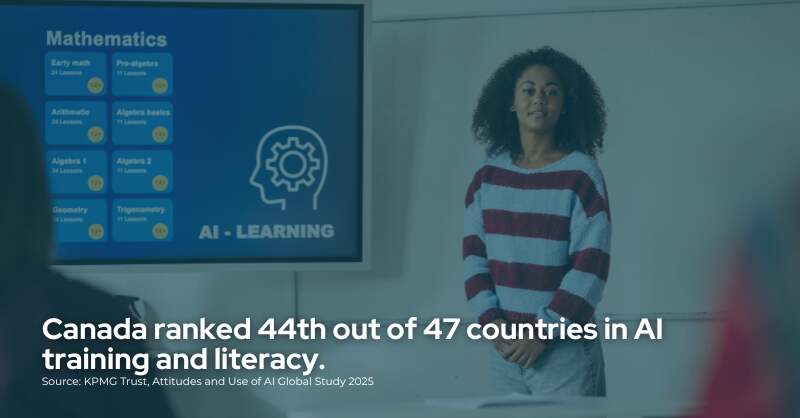
“The Prime Minister’s 2025 mandate letter calls AI skills an “urgent priority.” Yet in classrooms across the country, there’s no coordinated plan to bring AI literacy into the curriculum.”
Canada’s national AI strategy focuses on responsible use in government and public sector capacity. It’s a strong foundation—but it doesn’t address the skills students will need to thrive in an AI-powered world. Education is a provincial responsibility, but federal leadership still matters. Implementing a national AI literacy framework could guide consistent, age-appropriate integration across provinces and territories. The Prime Minister’s 2025 mandate letter calls AI skills an “urgent priority.” Yet in classrooms across the country, there’s no coordinated plan to bring AI literacy into the curriculum.
If we wait until post-secondary to introduce these concepts, we risk leaving many students behind, especially those without access to enrichment or extracurricular tech programs.
Teachers Are Experimenting, but They Need Support

“Teachers are not being set up for success. Most haven’t received training in AI concepts, and there’s little guidance on how to integrate them meaningfully into existing curricula.”
Educators are beginning to explore how AI can be used in the classroom. Some are testing generative tools to support lesson planning or student writing. Others are introducing basic concepts through digital literacy units. But these efforts are fragmented and often unsupported.
Teachers are not being set up for success. Most haven’t received training in AI concepts, and there’s little guidance on how to integrate them meaningfully into existing curricula. Without a national framework, we risk leaving it up to individual schools or individual teachers to figure it out on their own.
Who Bears the Responsibility?
Teaching AI and ethics in schools isn’t just a technical challenge—it’s a societal one. Responsibility must be shared across multiple levels: governments to set policy and funding priorities, school boards to guide curriculum integration, educators to deliver content with care and context, and families to reinforce values at home. Without clear leadership and coordination, we risk placing the burden solely on teachers—many of whom are navigating these complex topics without training or support.
Why Early Exposure Matters
“While upskilling adults is necessary, it’s often slow, expensive, and reactive. If we want to build a future-ready workforce, we need to start much earlier—ideally in kindergarten.”
AI is already shaping the world our children are growing up in—from the videos they watch to the tools they’ll use in future jobs. But most students don’t understand how these systems work, or how to think critically about them.
While upskilling adults is necessary, it’s often slow, expensive, and reactive. If we want to build a future-ready workforce, we need to start much earlier—ideally in kindergarten.
And it’s not just about jobs. Starting early helps close digital divides before they widen. Without early access, tech literacy becomes a privilege.
What AI Literacy Actually Looks Like
“By Grade 12, students should be able to analyze how algorithms influence things like hiring or media recommendations, debate ethical questions around surveillance and bias, and use generative tools to support creative work—with a clear understanding of their limitations.”
This isn’t about teaching five-year-olds to code. It’s about helping them understand the systems shaping their world. The OECD’s AI Literacy Framework is one useful reference. It outlines age-appropriate ways to help students understand how machines learn, how to interact with digital tools, and how to evaluate their impact on society.
In junior kindergarten, students might play sorting games that mimic pattern recognition, explore how machines “see” shapes and colours, or read storybooks that introduce decision-making. These activities build early awareness of how technology interacts with data.
By Grade 12, students should be able to analyze how algorithms influence things like hiring or media recommendations, debate ethical questions around surveillance and bias, and use generative tools to support creative work—with a clear understanding of their limitations.
This progression is why Canada needs a pan-Canadian AI competency framework—to ensure consistency, equity, and clarity across provinces and grade levels.
A Vision Within Reach
“Whether taught by educators or reinforced by parents, one principle must guide AI literacy: teach agency, not just awareness. “
Imagine a classroom where students are encouraged to ask questions about the technology they use, where they learn how apps decide what videos or news stories to show them, and where they explore fairness in facial recognition or build simple models to understand how machines make decisions.
This kind of learning also responds to what many parents are already asking for: guidance. Families want their kids to be safe, thoughtful, and informed online. Teaching AI literacy early helps children understand—not fear—the tools they’re already using.
Whether taught by educators or reinforced by parents, one principle must guide AI literacy: teach agency, not just awareness. Students should learn that they can shape technology—not just use it. This means encouraging curiosity, critical thinking, and ethical reflection from the earliest years.
This isn’t a distant vision. The tools, knowledge, and global examples are already here. Canada has the research strength, policy momentum, and a dedicated minister to lead this work. What’s missing is coordination and the political commitment to bring it all together.
Let’s Build the Foundation Now
Let’s build a national AI-in-education strategy that starts in kindergarten and grows with students through high school. That means creating a pan-Canadian AI literacy framework, embedding it in curriculum guidelines, and investing in teacher training and classroom-ready tools. This is not just a vision—it’s a call to action. Policymakers, educators, and school boards must work together now to ensure every child in Canada—not just those with access to enrichment—can understand, question, and shape the technologies that will define their future.
AI literacy is not optional. It’s foundational.
About the Expert
-

Jessica Rizk is a Senior Research Associate on the Education and Skills team at the Conference Board of Canada. She leads national research on how Canada’s education systems can adapt to emerging technologies and evolving labor market needs to prepare learners for the future economy.
See more
-
 Canada’s Insurance Industry Has A Productivity Crisis. AI Can Cure It.
 Jackson Fregeau
CEO & Co-Founder
Quandri
Jackson Fregeau
CEO & Co-Founder
Quandri
-
 Can AI Help Canada Build the Future of Life Sciences?
 Handol Kim
Co-Founder & CEO
Variational AI
Handol Kim
Co-Founder & CEO
Variational AI
 Martin Enault
Chief Entrepreneur in Residence
Centech
Martin Enault
Chief Entrepreneur in Residence
Centech
 David D. Jones
Managing Director
Merck Canada
David D. Jones
Managing Director
Merck Canada
-
 Adoption Is Not Adaptation: The Reskilling Wave Canada’s AI Strategy Leaves Out
 Tracey Taylor-O’Reilly
Founder
Promentus
Tracey Taylor-O’Reilly
Founder
Promentus