
Career Literacy in the Age of AI: Empowering Youth to Navigate the Future of Work
Lisa Taylor argues that Canada’s youth don’t just need more skills to survive the AI economy—they need career literacy to navigate it with purpose, agency, and long-term success.

Headlines today paint a bleak picture for youth: disappearing entry-level jobs, stagnant wages, and graduates lacking the skills employers seek. Fear is a powerful motivator, and today’s algorithms feed on it, but these narratives risk becoming a self-fulfilling prophecy.
Canada’s response has largely focused on skills training. Challenge Factory is often asked: Which skills or occupations will survive AI disruption, and what will employers need most? It’s easy to find research and opinions alike that, at the same time, pick which skills or jobs will be “winners” while somehow still making individual job seekers feel like the game is rigged.
“Canadians at all career stages lack a basic literacy for understanding how they fit into a shifting economy and cyclical labour markets.”
Labour market attachment, career engagement, and overall well-being depend on far more than workplace skills. Despite being highly skilled, many newcomers face insurmountable career barriers. Canadians at all career stages lack a basic literacy for understanding how they fit into a shifting economy and cyclical labour markets. The last few decades have provided plenty of examples of where skills training policy has led to trained Canadians who still struggle to find work.
We believe there is a more empowering future where today’s youth thrive as tomorrow’s leaders. To achieve it, we must address Canada’s low levels of career literacy, understand when youth-targeted initiatives help or harm, and build intergenerational solutions to strengthen agency, resilience, and economic mobility.
The Economic Imperative
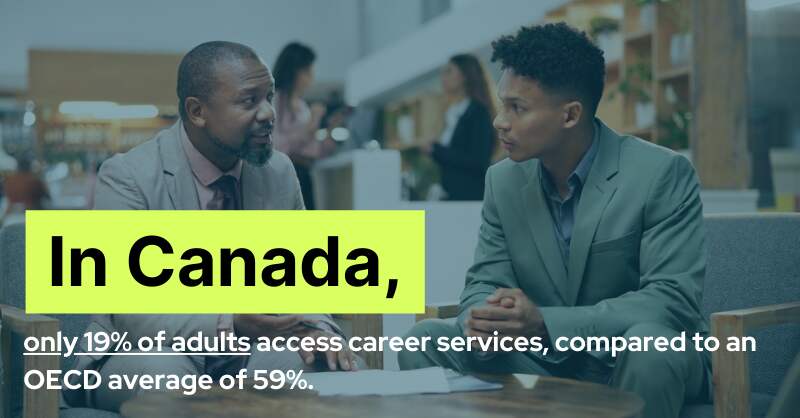
Career development is not just a social good; it is an economic strategy. Countries with high career literacy enjoy stronger labour market participation, productivity, and wage growth. Yet in Canada, only 19% of adults access career services, compared to an OECD average of 59%.
Career development enables youth to identify training aligned with personal goals and market demand, reducing dropout rates, underemployment, and mismatched qualifications that cost the economy billions in lost productivity annually.
“Without strong career literacy, short-term skilling may not translate into sustained employment or economic advancement.”
Canadians have demonstrated that they will initiate skills-related learning. During COVID-19, Coursera saw a 65% increase in Canadian registrations in 2020 alone. However, without strong career literacy, short-term skilling may not translate into sustained employment or economic advancement.
The Business Case for Organizational Leaders
For employers, investing in youth career literacy is not charity – it is a talent pipeline strategy. Young workers with strong career agency adapt faster to AI-driven change, integrate learning with work, and bring greater engagement, innovation, and retention.
Imagine a workplace where youth interns and new graduates understand not just how to code an app or simplify a process with AI but how their work and what they can offer fit the organization’s mission, competitive positioning, and shifting industry trajectory. These are future employees who will grow your business and stay ahead of skill gap needs, not just complete assigned tasks.
The Youth Perspective
If you are a young person reading this, you already know the landscape feels uncertain. You see headlines about AI taking jobs, hear mixed advice from family and friends, and feel pressure to keep up with new skills while paying bills.
Career literacy is your tool to cut through the noise. It empowers you to answer:
- What problems do I want to solve, and where are opportunities to be part of the solution?
- Which skills or experiences do I need to gain, and how can I build a plan that balances these needs with financial, life, and other pressures?
- How does this align with who I am and what I value?
Learning how to answer these questions now will establish a lifelong career competence to re-evaluate your work as circumstances change in an unpredictable environment.
Intergenerational Context
Today’s labour market challenges are shared across generations navigating technological and social change. Yet our programs often isolate youth, separating them from older peers who are also struggling in an economy that feels precarious. Imagine the potential for peer mentorship across generations to foster stronger social cohesion.
“Our programs often isolate youth, separating them from older peers who are also struggling in an economy that feels precarious.”
Breaking down age silos will better equip youth to thrive in an AI economy. Research shows that friendships and mentoring relationships with those at least 10 to 15 years older or younger foster greater resilience, well-being, and adaptability across the lifespan.
Policy Recommendations: Build Career Literacy for Economic Growth and Youth Empowerment
1. Integrate Career Literacy with AI and Digital Skills Programs
Fund and design initiatives that offer technical training combined with guided career exploration. These initiatives should draw on quality career development methods to expand opportunities beyond the obvious or one-size-fits-all solutions.
2. Make Career Development Education a Core Competency
Embed career literacy into K-12 and postsecondary curricula as a valued skill set, on par with digital literacy, to foster lifelong adaptability, agency, and higher economic productivity. Provide formal curriculum, integrated career development training, and tools to all educators.
“Embed career literacy into K-12 and postsecondary curricula as a valued skill set, on par with digital literacy, to foster lifelong adaptability, agency, and higher economic productivity.”
3. Foster Intergenerational Learning and Career Transition Opportunities
Design policies and programs that break down age silos, enabling youth to engage with mid-career and older workers to build resilience and innovation as workers of all ages shape a different future of work for themselves and their communities.
4. Establish a National Career Development Strategy
Develop a coordinated, consistent career development system as part of current national efforts to bring down accreditation barriers across provinces and territories. When Challenge Factory was commissioned to map the Canadian career development sector, we uncovered that Canada has as many career professionals as we do pharmacists – and every Canadian knows how to find a pharmacist. In an era of rapidly changing job landscapes, this often-overlooked sector is crucial to enhancing labour market efficiency, productivity, and competitiveness.
5. Mobilize Employers as Partners
Create incentives and frameworks for businesses to integrate quality career literacy into workplace learning, co-op placements, and onboarding programs, ensuring talent pipelines remain agile and future-ready.
Youth Are Ready. Are We?
Today’s youth are creative, ambitious, and deeply aware of the social and environmental contexts they inhabit. They are not looking for shortcuts. They seek clarity, agency, and tools to shape a future worth inhabiting.
Empowering youth with both AI skills and career literacy will give them the capacity not just to survive, but to shape the future of work. This is an economic strategy, a social imperative, and a business opportunity.
Let’s rise to meet them.
About the Expert
-

Lisa Taylor is the founder and CEO of Challenge Factory. She is an author, entrepreneur, consultant, futurist, and community leader focused on making sense of the changing world of work. Lisa has published five employer-focused books, including The Talent Revolution: Longevity and the Future of Work. She is one of WXN’s 2022 Top 100 Most Powerful Canadian Women and an associate fellow for the National Institute on Ageing.
See more
-
 Bridging the Digital Divide: Empowering Youth Through Digital Skills Training
 Julia Blackburn
CEO
NPower Canada
Julia Blackburn
CEO
NPower Canada
-
 Stop Telling Young People to Adapt: We Need to Meet Them Halfway
 Valentina Castillo Cifuentes
Associate Director Youth & Innovation Project
University of Waterloo
Valentina Castillo Cifuentes
Associate Director Youth & Innovation Project
University of Waterloo
 Sana Khaliq
Equity, Diversity, and Inclusion Specialist
Canada’s 2SLGBTQI+ Chamber of Commerce
Sana Khaliq
Equity, Diversity, and Inclusion Specialist
Canada’s 2SLGBTQI+ Chamber of Commerce
 Marina Melanidis
Founder
Youth4Nature
Marina Melanidis
Founder
Youth4Nature
-
 Canada’s Future Lies With Our Youth: Ensuring Access to Post-Secondary Education
 Nimmi Kanji
Executive Director
TELUS Friendly Future Foundation
Nimmi Kanji
Executive Director
TELUS Friendly Future Foundation