
Canada Must Heed the Message of Brain Drain in Engineering
Canada must confront its engineering brain drain by reigniting national ambition, investing in advanced industries, and building a stronger technology ecosystem to retain and empower top talent.

There is plenty of evidence that economies of the future will be increasingly reliant on science, technology, engineering, and math (STEM) talent. In Canada, we are doing a reasonable job of producing STEM talent, although this is in jeopardy due to chronic underfunding of universities; however, retention is a major problem. Canada should be concerned with losing STEM talent, AKA a brain drain, not only as a problem in itself, but also as a symptom of a larger problem that has existed for longer than many realize.
Perhaps it started with the Avro Arrow. In the 1950s, Canada had the chutzpah and ambition to develop a supersonic interceptor jet aircraft that was the most advanced of its type in the world. Although by all accounts a complete success, the program was cancelled in 1959, with many of the Avro engineers eventually contributing to the Apollo program in the US. This provides a striking example of the connection between scaled-down national ambition and brain drain.
Canada also had a world-class rocketry program in the 1950s—the Black Brant rocket, still used by NASA today, came out of that effort. Canada was also the fourth country in the world to operate a satellite, with the Alouette 1 launched from the US in 1962. Although many Canadian aerospace companies currently compete successfully internationally, such as Bombardier, MDA Space, Pratt & Whitney Canada, and CAE, their success results more from the technical excellence of their engineers than from any national technology strategy or ambition.
“It is striking that Sweden, a much smaller country than Canada, produced two major automakers, Volvo and Saab, and makes its own fighter jets. Clearly, Canada should be aiming higher.”
Limited National Ambition and Its Consequences
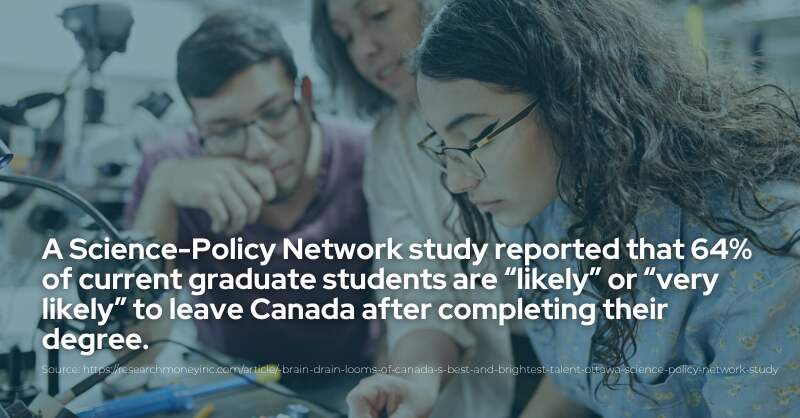
Canada’s current limited ambitions in technology development are partially caused by our proximity to the US. Global capitalism and associated offshoring also contributed to the decline of manufacturing in Canada. Another factor is our abundance of natural resources, which enables the country to remain prosperous despite its weak industrial performance. Canada’s largest companies reflect this, as they are dominated by services and natural resources.
It is striking that Sweden, a much smaller country than Canada, produced two major automakers, Volvo and Saab, and makes its own fighter jets. Clearly, Canada should be aiming higher.
Decline in Advanced Industries
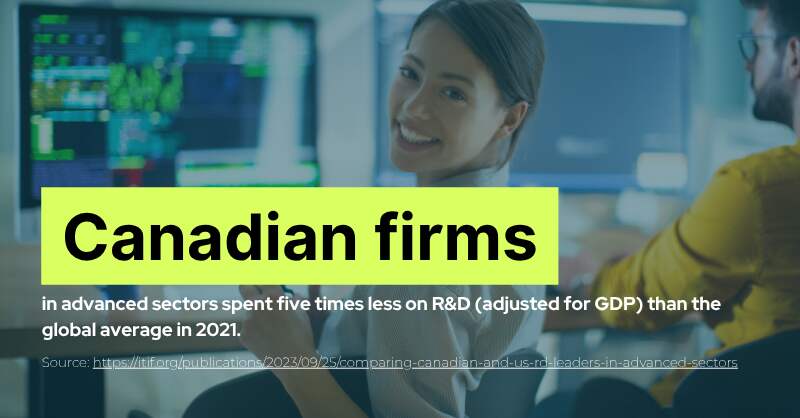
This absence of national vision and ambition impacts many industries in Canada. Based on the Hamilton Index, Canada’s global share of virtually every advanced industry declined substantially from 2006 to 2018. This sort of performance in innovation-driven industries neither inspires Canadians to choose a STEM field nor provides the capacity to retain them.
“Canada’s global share of virtually every advanced industry declined substantially from 2006 to 2018.”
Our enthusiasm for supporting start-ups and small and medium-sized enterprises has led to a decided lack of focus on the larger companies that are the key players in many advanced industries. This is exacerbated by the enthusiasm of various levels of government for new and shiny things like AI and urban air mobility, which are already flush with venture capital, at the expense of more established industries and ignoring the fact that we still rely heavily on less trendy products like ships and aircraft.
Investment in innovation is vital to ensure that such industries meet their environmental targets and remain competitive. Unlike venture capital, government investment should not focus on future profits and scalability and instead should emphasize societal and economic needs.
The Personal Cost of Brain Drain
Returning to brain drain, of the past 26 PhD graduates from my research group at the University of Toronto Institute for Aerospace Studies, ten left Canada immediately after graduation to take up excellent positions at places like NASA, Amazon, and the GE Aerospace Research Center. Nine of the ten were born in Canada. Three are now professors contributing to the development of STEM talent outside of Canada.
“The key difference is the lack of positions in Canada for fresh PhD graduates primarily interested in research, including research positions at government laboratories and postdoctoral positions at universities.”
Those who stayed in Canada also have excellent positions at companies such as Bombardier, Pratt & Whitney Canada, and Ansys. The key difference is the lack of positions in Canada for fresh PhD graduates primarily interested in research, including research positions at government laboratories and postdoctoral positions at universities. The vicious cycle of brain drain leading to weak innovation leading to further brain drain must be reversed.
A National Vision for Technology and Defence
The current geopolitical shift provides Canada with an opportunity to create an ambitious national vision. In order to buy Canadian, we must manufacture Canadian. It is now clearer than ever that a degree of economic self-reliance is essential.
In particular, we should seek opportunities where increased defence spending can also improve Canada’s manufacturing capabilities for civilian applications. This works well in aerospace, where companies such as Airbus, Boeing, and Embraer develop technologies through defence contracts that also end up on their commercial aircraft.
“The increase in defence spending provides an ideal opportunity to finally develop a badly needed national strategy for aerospace.”
How many Canadians could be inspired to become aerospace engineers in Canada if Bombardier were able to return to manufacturing commercial aircraft, as it did so well for many years? The increase in defence spending provides an ideal opportunity to finally develop a badly needed national strategy for aerospace.
Building a Complete Technology Ecosystem
A national industrial strategy must include the entire technology ecosystem, including universities and government laboratories, as well as the full range of companies from large to small. Universities and government laboratories are critical for talent retention and also conduct research that is crucial for innovation.
However, with its current budget, the National Research Council’s Aerospace Research Centre, for example, cannot fulfil its potential as a key player in Canada’s aerospace ecosystem and a magnet for talented young Canadians. Moreover, there are some disturbing trends with respect to support for research from the Natural Sciences and Engineering Research Council (NSERC).
“A substantial fraction of Canadian professors, who were hired via highly competitive search processes and are expected to spend a substantial portion of their time on research, are not provided with the most basic funding to conduct their research.”
For example, the success rate for Discovery Grants, which are essential for professors, over the past five years is 62%. This means that a substantial fraction of Canadian professors, who were hired via highly competitive search processes and are expected to spend a substantial portion of their time on research, are not provided with the most basic funding to conduct their research.
While a success rate of 100% is not to be expected, the idea that 38% of Canadian professors are deemed unworthy of the most basic level of research support seems counterproductive and prevents these professors from contributing to Canada’s research mission. The success rate for NSERC grants that support university-industry collaboration is even lower and has declined each of the past two years.
Reclaiming Canada’s Ambition
Current events, which have put into stark focus the need for a more self-reliant economy and have caused a surge in defence spending, provide Canada with a huge opportunity. A well-thought-out investment in the entire technology development ecosystem, from universities through NRC to industry, can be transformative.
This can be achieved with appropriate consultation with all stakeholders, especially the research community, which is often excluded, but has crucial knowledge of next-generation technologies. The aerospace sector, due to its importance in defence, is a prime candidate for this approach.
Let us challenge ourselves to return to the level of national aerospace ambition we had in the 1950s, when we were able to develop the most advanced supersonic interceptor in the world. This will attract young Canadians to STEM fields and put an end to brain drain.
About the Expert
-

David Zingg is the Distinguished Professor of Computational Aerodynamics and Sustainable Aviation at the University of Toronto Institute for Aerospace Studies. He serves on several national and international panels and boards related to aerospace and sustainable aviation and has worked for many years with several Canadian companies, most notably Bombardier.
See more
-
 The Next Big Thing: The Moon and Canada
 Alex Ellery
Professor of Mechanical and Aerospace Engineering
Carleton University
Alex Ellery
Professor of Mechanical and Aerospace Engineering
Carleton University
-
 Science and Governance: Dual Opportunities for Canadian Leadership in Space
 Dr. Sarah Gallagher
Director of the Institute for Earth and Space Exploration
Western University
Dr. Sarah Gallagher
Director of the Institute for Earth and Space Exploration
Western University
 Dr. Valerie Oosterveld
Professor and Western Research Chair at the Faculty of Law
Western University
Dr. Valerie Oosterveld
Professor and Western Research Chair at the Faculty of Law
Western University
 Dr. Pauline Barmby
Professor and Chair of Physics & Astronomy
Western University
Dr. Pauline Barmby
Professor and Chair of Physics & Astronomy
Western University
-
 Designing Ontario’s Future Workforce: Innovation Starts with Talent
 Tara J. Remedios
Director of Talent
Ontario Vehicle Innovation Network
Tara J. Remedios
Director of Talent
Ontario Vehicle Innovation Network