
Science and Governance: Dual Opportunities for Canadian Leadership in Space
Canada has a dual opportunity to lead globally by advancing groundbreaking space science missions like CASTOR while shaping international governance to address the growing risks of satellite constellations and space debris.



Canadian science has an impressive record of being at the forefront in space. Canada was only the third country, after the United States and the Soviet Union, to build a satellite—Alouette 1, to monitor the ionosphere—launched in 1962. In 1992, Canadian astronaut Roberta Bondar was the first neurologist in space and an early contributor to the discipline of space medicine.
Currently, the Fine Guidance Sensor instrument contributed by the Canadian Space Agency to the James Webb Space Telescope enables its breathtaking images by keeping the telescope stable during long exposure times, while the NIRISS instrument looks for signatures of life around other worlds. Looking ahead, Canada will be the fifth nation in the world to have pristine material from other bodies in the Solar System when the OSIRIS-REx samples from the asteroid Bennu come to the John H. Chapman Space Centre in 2026. These are but a few examples of Canada’s outstanding legacy of space science leadership.
Science, Security, and Technology Development
In the present landscape of conflict and international uncertainty, science missions might seem like a distraction from operational and defensive space needs. However, this view ignores the relationship between space security and the development of new technologies that make this security possible. Our legacy of leadership in space science creates the environment needed for developing those capabilities.
“Science missions might seem like a distraction from operational and defensive space needs. However, this view ignores the relationship between space security and the development of new technologies that make this security possible.”
As an example, by some measures, the James Webb Space Telescope (JWST) is a million times more sensitive than Hubble. This giant leap in capability was possible because of the combined efforts of thousands of astronomers and engineers, as well as the willingness of NASA, CSA, and ESA to take on the risk of extending the boundaries of technology far beyond the existing state of the art.
Scientists plan to use JWST to seek answers to big questions like “What was the early universe like?” and “Is there life outside of our Solar System?” Clearly, the specifications for JWST’s science instruments were incredibly demanding; these requirements pushed industry to level up significantly. The expertise developed by Canadian industry in fine guidance pointing for astronomy has been leveraged for the laser communication required for the Quantum Encryption and Science Satellite (QEYSSAT) to demonstrate secure communication protocols necessary for privacy and defence.
CASTOR: The Next Canadian Space Mission
The success of Canadian universities and companies in meeting the challenges posed by JWST has generated a new opportunity for Canada to lead in space science. The Cosmological Advanced Survey Telescope for Optical and UV Research (CASTOR) is a proposed CSA-led space astronomy mission which would image the skies in ultraviolet and blue light, providing image sharpness comparable to the Hubble Space Telescope with a mapping speed a hundred times faster.
Ultraviolet observations cannot be made with ground-based telescopes or with JWST and are key to investigating the nature of dark energy and the atmospheres of planets outside the Solar System. The 35-year-old Hubble is the only general-purpose ultraviolet telescope, and its remaining lifetime is limited. CASTOR would fill a critical gap in space astronomy internationally, providing a superb complement to JWST.
“Developing the technologies required to realize CASTOR’s science goals would allow Canadian companies to showcase their capabilities to the world and build their human capital.”
The mission concept is mature, with substantial interest and involvement from Canadian industry and enthusiastic international partners. Developing the technologies required to realize CASTOR’s science goals would allow Canadian companies to showcase their capabilities to the world and build their human capital. In addition, Canada would demonstrate capacity in optical communications and large-format, high-resolution detectors that could be used for monitoring the Northwest Passage.
Advancing the development of CASTOR and committing to its launch will show the world that Canada is ready to lead its first large-scale international space science mission, inspire the next generation of Canadian space explorers, and supply the world with first-rate space technologies.
Governance of Satellite Constellations
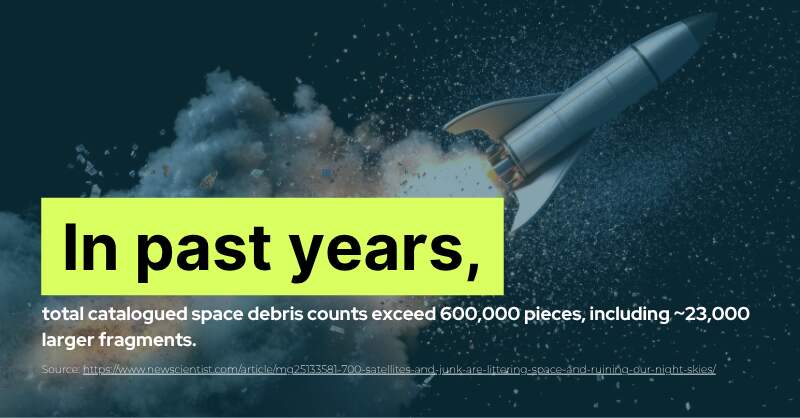
The massive steps forward in space science, illustrated by JWST and CASTOR, came about because of interagency and international collaboration. This cooperation, however, is missing in low Earth orbit, which is rapidly becoming filled with tens of thousands of small, disposable satellites with bright reflections that hide the night sky and interrupt astronomical observations.
“Canada’s geography magnifies both the benefits of these satellite constellations.”
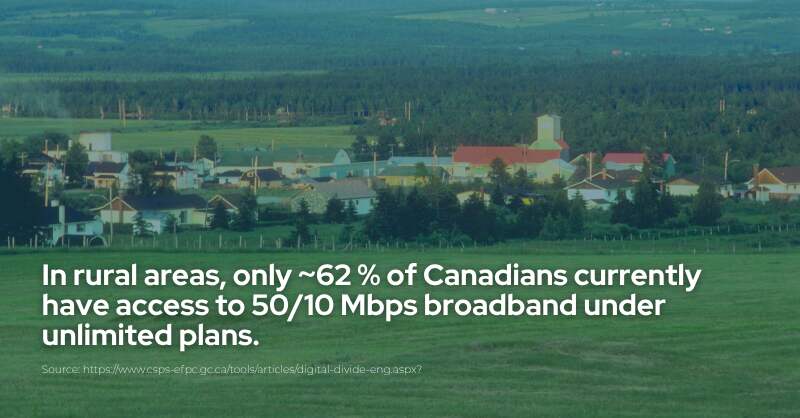
The mega-constellations pose a risk of generating a runaway cascade of space debris and are dumping an alarming amount of aluminum and lithium into our upper atmosphere on re-entry. Canada’s geography magnifies both the benefits of these satellite constellations—for example, in providing internet to remote locations—and the harms: satellite reflections are worst at the latitudes where most Canadians live. The lack of coordinated international governance in this domain offers another opportunity for Canadian leadership in space.
Canada’s Role in International Space Policy
As a trusted partner in international space cooperation, Canada is well-positioned to broker international discussions on policies relating to satellite constellations. Existing guidelines for space debris mitigation provide a model for proposing a set of clear standards for the scope of and limits on satellite constellations, by accounting for environmentally and culturally sensitive assessments of their impact.
Such guidelines could be negotiated within the United Nations Committee for the Peaceful Uses of Outer Space, stemming from discussions in its Scientific and Technical Subcommittee on emerging issues and challenges posed by large constellations on the dark and quiet skies so necessary for astronomy. The International Telecommunication Union is another relevant partner in this domain.
“Canada’s vast land mass provides an ideal platform for monitoring and reporting on satellite constellation orbits and brightness, enabling leadership in providing the data required for decision-making.”
These guidelines would go beyond consideration of orbital slots and radio frequency assignments to address the space environment, including the production of space debris and light reflections. Canada can also leverage its success in international environmental advocacy, as with the Montreal Protocol, designed to protect the ozone layer, to advocate for recognition of the potential atmospheric impacts of rocket launches and satellite re-entry.
Finally, Canada’s vast land mass provides an ideal platform for monitoring and reporting on satellite constellation orbits and brightness, enabling leadership in providing the data required for decision-making.
The Future of Canada’s Space Industry
We live in a rapidly changing world, with old partnerships fraying and new ones forming. Space science and space policy are directly connected to Canada’s high-tech capacity and international alliances. The time is now for Canada to take leadership on both fronts, to build a more prosperous future for Canada and for the world.
About the Experts
-

Dr. Sarah Gallagher is the Director of the Institute for Earth and Space Exploration at Western University, former Science Advisor to the Canadian Space Agency and past President of the Canadian Astronomical Society. She studies the environments around supermassive black holes and champions national research priorities, open science and STEM capacity-building.
See more -

Dr. Valerie Oosterveld is a Professor and Western Research Chair at the Faculty of Law, Western University, and a faculty member of the Institute for Earth and Space Exploration. Her research focuses on various aspects of public international law, including international space law related to space resource extraction and utilization.
See more -

Dr. Pauline Barmby is Professor and Chair of Physics & Astronomy at Western University and chairs the Board of the Association of Canadian Universities for Research in Astronomy. She develops computational tools to analyze large astronomy datasets in order to study stars, star clusters, and their formation in nearby galaxies.
See more
-
 The Next Big Thing: The Moon and Canada
 Alex Ellery
Professor of Mechanical and Aerospace Engineering
Carleton University
Alex Ellery
Professor of Mechanical and Aerospace Engineering
Carleton University
-
 Canada Must Heed the Message of Brain Drain in Engineering
 David Zingg
Distinguished Professor of Computational Aerodynamics and Sustainable Aviation
University of Toronto Institute for Aerospace Studies
David Zingg
Distinguished Professor of Computational Aerodynamics and Sustainable Aviation
University of Toronto Institute for Aerospace Studies
-
 Why Canada Must Build Sovereign Launch Capability to Lead the Space Economy
 Melissa Quinn
VP, Spaceport Operations
MDA Space & Maritime Launch
Melissa Quinn
VP, Spaceport Operations
MDA Space & Maritime Launch