
From Forests to Cities: Building Canada’s Housing Future with a Homegrown Supply Chain
What if the solution to the housing crisis is already growing in our forests? Discover how integrating advanced manufacturing with sustainable wood products can build neighborhoods faster, slash emissions, and modernize the Canadian economy.

Canada stands at a crossroads. We are facing a housing crisis, a forestry crisis, and a construction-labour crisis, all at the same time. Yet within this convergence lies an extraordinary opportunity: to build an all-Canadian housing supply chain that stretches from our forests to our cities, powered by innovation, sustainability, and modern manufacturing.
A Triple Crisis in the Making
Across the country, the dream of owning or even renting a home has slipped further out of reach. The causes are complex, but the main drivers have been a combination of overspeculation, lengthy approval processes, conflicting municipal rules, and soaring construction costs. However, the outcome is simple: too few homes at prices too high for most Canadians.
“Conventional construction simply cannot meet the scale of need. The sector is already facing critical labour shortages, and higher demand would only drive costs further upward.”
Increasing supply would be the natural response, but it’s not easy to do. Conventional construction simply cannot meet the scale of need. The sector is already facing critical labour shortages, and higher demand would only drive costs further upward. In other words, the old ways of building will not get us out of this crisis.
Meanwhile, Canada’s forestry sector—one of our oldest and most important industries—is itself under severe strain. Export tariffs, mill closures, and declining competitiveness are putting thousands of jobs and entire communities at risk. This is an economic emergency hiding in plain sight.
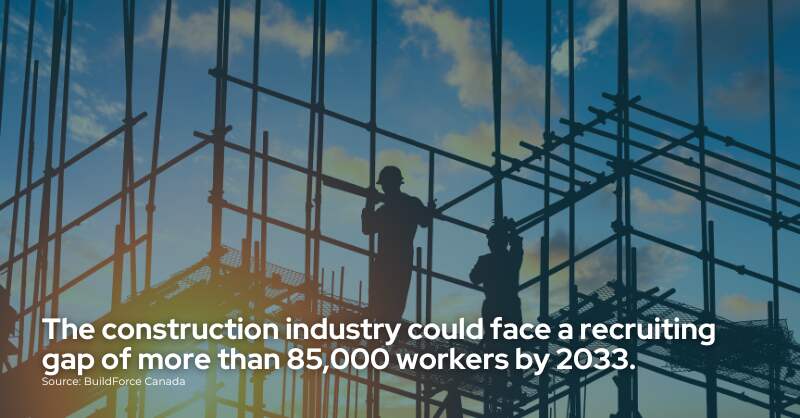
At the same time, our construction labour force is shrinking. The average age of a construction worker in Canada is rising rapidly, and fewer young people are entering the trades. According to BuildForce Canada, “the industry could face a recruiting gap of more than 85,000 workers by 2033.”
These three challenges—housing, forestry, and labour—might seem unrelated. But together, they offer a powerful opportunity for transformation.
The All-Canadian Opportunity
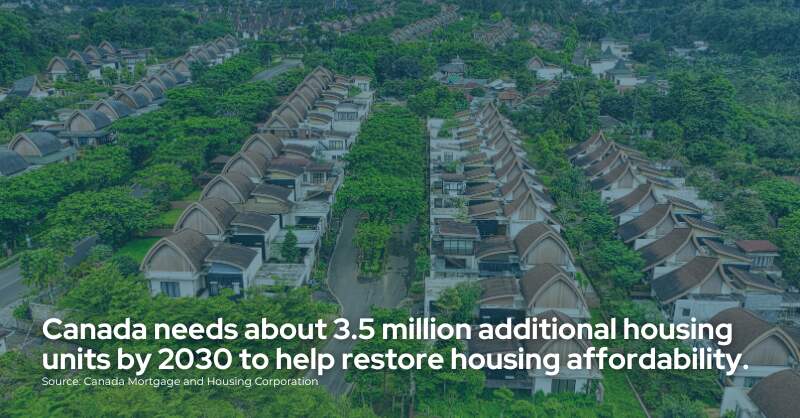
The solution lies in connecting our natural resource economy to our built environment—literally, from forests to cities. Canada has an abundant, renewable forest resource (if managed sustainably), a strong base of advanced manufacturing talent, and a growing ecosystem of innovators working in robotics, AI, and prefabrication. What we need now is coordinated national investment to bring these pieces together.
By focusing on value-added wood products such as engineered mass timber and integrating them into an industrialized construction process, Canada can tackle two crises at once: housing affordability and forest-sector decline. This is not a distant dream—it’s a model already proven in countries like Germany, Austria, and Sweden, where prefabricated building systems deliver high-quality, energy-efficient homes faster, with fewer workers and less waste.
Industrialized, or “off-site,” construction moves much of the building process into controlled factory environments, where automation, precision engineering, and digital design streamline production. When combined with mass timber—a lightweight, low-carbon, and high-strength material suitable for mid- and high-rise buildings—it becomes possible to build entire neighbourhoods in a fraction of the time of conventional construction, while slashing emissions and costs.
Canada has every ingredient needed to lead this global shift. What’s missing is the scale of investment and coordination that only public policy and private capital can provide. Together, investments can create both supply and demand and modernize our industry.
Building Supply: Investing in the Value Chain
“A national upskilling program focused on digital design, automation, robotics, and modern manufacturing could attract a new generation of workers.”
To unlock industrialized construction, Canada must first build the foundation: the manufacturing and supply capacity to deliver it.
That starts with modernizing the lumber industry. Decades of underinvestment and reliance on raw exports have left many mills outdated and uncompetitive. Government incentives should focus on helping producers upgrade to high-value, engineered timber products, turning low-value fibre into high-margin construction materials.
Most importantly, new investment vehicles are needed to finance prefabricated construction and technological innovation. Canada’s federal agencies—including BDC, EDC, PSP Investments, and the Canada Growth Fund—could play catalytic roles by supporting companies that scale industrialized manufacturing and mass timber construction. These investments would not only reduce reliance on imports but also create new export markets for Canadian-made building systems.
At the same time, workforce development must be reimagined. A national upskilling program focused on digital design, automation, robotics, and modern manufacturing could attract a new generation of workers. Partnerships with Indigenous communities and post-secondary institutions would ensure that the benefits of this transition are shared widely and sustainably.
Creating Demand: The Role of Government and Capital
“Canada needs faster, clearer, and more consistent building approvals. Digital permitting, standardized codes across jurisdictions, and incentives for density can remove the bottlenecks that delay projects and add cost.”
Even with manufacturing capacity in place, industrialized construction will not flourish without predictable demand. This is where government and institutional investors can have the greatest impact.
Public procurement is the most direct tool available. By committing to use Canadian-made, prefabricated building systems for federal and provincial projects—from affordable housing to schools and public buildings—the government can provide the long-term certainty manufacturers need to invest and expand. Programs such as the Greener Federal Buildings strategy or Canada Lands Company developments are ideal vehicles to lead this shift.
Financial innovation can also help de-risk early projects. Low-interest modular manufacturing loans, performance-bond guarantees, or even “Contracts for Difference” similar to those used in renewable energy markets could stabilize returns for developers adopting new construction methods. Including mass-timber buildings in the Investment Tax Credit framework would further signal federal commitment to this growing sector.
On the regulatory front, Canada needs faster, clearer, and more consistent building approvals. Digital permitting, standardized codes across jurisdictions, and incentives for density can remove the bottlenecks that delay projects and add cost.
A National Housing-and-Industry Strategy
The housing crisis is not just about homes; it’s about productivity, sustainability, and national resilience. A coordinated strategy to build housing through Canadian materials, Canadian technology, and Canadian labour can redefine how we think about economic growth.
Industrialized construction is a manufacturing industry at heart. It transforms the act of building—once artisanal and site-bound—into a scalable, exportable process that drives innovation in robotics, design, and clean technology. It strengthens domestic supply chains, reduces carbon emissions, and positions Canada as a world leader in sustainable construction.
Intelligent City and a handful of other innovators have already demonstrated that prefabricated mass timber can be used for high-rise multi-family housing. But to achieve national impact, we need a whole-of-government and whole-of-industry effort to scale this approach. The goal is not just to build homes faster, but to build an entire industrial ecosystem around them.
Time to Build
Prime Minister Mark Carney recently said, “You are the future of housing construction in this country. This is exactly the type of innovation that we need to tackle the housing crisis.” He’s right—not just about any one company, but about the broader opportunity that Canada faces.
By aligning our natural resource economy with advanced manufacturing and digital innovation, we can build homes that are affordable, sustainable, and proudly made in Canada. The challenge before us is not whether we can do it, but whether we have the vision and urgency to start.
About the Expert
-

Oliver David Krieg is President of Intelligent City and an expert in mass timber and industrialized manufacturing. Under his leadership, Intelligent City is scaling its prefabricated mass timber product platform for high-rise multi-family housing across Canada. With a PhD in robotics for timber construction, Oliver joined Intelligent City originally in 2018 as CTO. Prior to that, he was a research associate and group leader at the Institute for Computational Design and Construction (ICD) at the University of Stuttgart, Germany.
See more
-
 How to Combat Canada’s Housing Crisis by Making Home-Building Affordable
 Kevin Lee
CEO
Canadian Home Builders’ Association
Kevin Lee
CEO
Canadian Home Builders’ Association
-
 How Technology is Unlocking a New Era for Canadian Homeowners
 Justin Herlick
CEO
Pine
Justin Herlick
CEO
Pine
-
 A Pathway to Prosperity Starts With Social Innovation
 Andrea Nemtin
CEO
Social Innovation Canada
Andrea Nemtin
CEO
Social Innovation Canada