
How to Combat Canada’s Housing Crisis by Making Home-Building Affordable
Canada’s housing crisis is reaching a breaking point. Bold, coordinated action is needed now to remove policy barriers, ease costs, and tackle labour shortages so the country can finally build the homes it needs.

Canada’s chronic supply shortages and housing affordability challenges persist across the country. While the federal government has set an ambitious goal of building 500,000 new homes per year, the path to achieving this target is strewn with policy barriers, mounting costs and regulations, excessive taxation, labour shortages, and economic uncertainty that continue to negatively impact home-building efforts.
The most recent Canadian Home Builders’ Association (CHBA) Housing Market Index (HMI)—a proven indicator of future housing starts six months and beyond—paints a sobering picture of industry sentiment on future construction activity. Builder confidence has remained at near-record lows for almost two years. These indicators don’t just reflect pessimism; they predict a continued decline in housing starts (especially for homeownership), worker layoffs, and even closing businesses at a time when new housing supply is desperately needed.
Closing the housing supply gap requires bold and immediate action from all levels of government, and policymakers must take an all-hands-on-deck approach to remove the many unnecessary roadblocks that are stifling home-building efforts. As the association representing those who build the homes Canada needs—from single-detached to high-rise and everything in between, for ownership or for rent—CHBA has clear and achievable recommendations for governments to support the creation of more housing and help restore affordability for Canadians. The following are some of them.
Fast-Track the GST Rebate
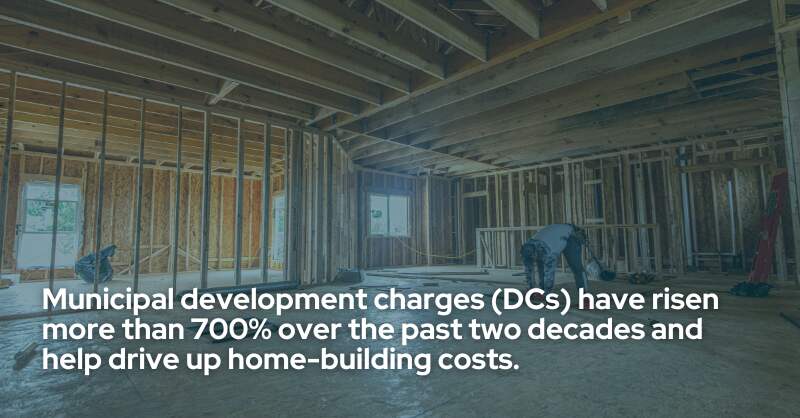
The GST Rebate, announced earlier this year, is an important measure to support buyers and stimulate the construction of new homes, but its eligibility needs to be expanded from first-time buyers to all buyers to have the necessary effect. Further, the implementation of the legislation on this has been delayed in the parliamentary approval process, and has kept prospective buyers on the sidelines for months, hindering home sales and delaying new projects at a time when they need to significantly ramp up. up. CHBA’s Housing Market Index Survey for Q3 2025 shows that nationally, some 41% of builder respondents are laying off workers, while in Ontario, that number is 64%. It is imperative that the First-Time Home Buyers’ GST Rebate be the federal government’s top priority.
Further enhancements are also needed to truly drive the amount of new housing supply required. Beyond expanding it to include all buyers of new homes, it should apply to renovations that add an additional unit of housing, like secondary suites and accessory dwelling units.
Find Alternatives to Development Charges
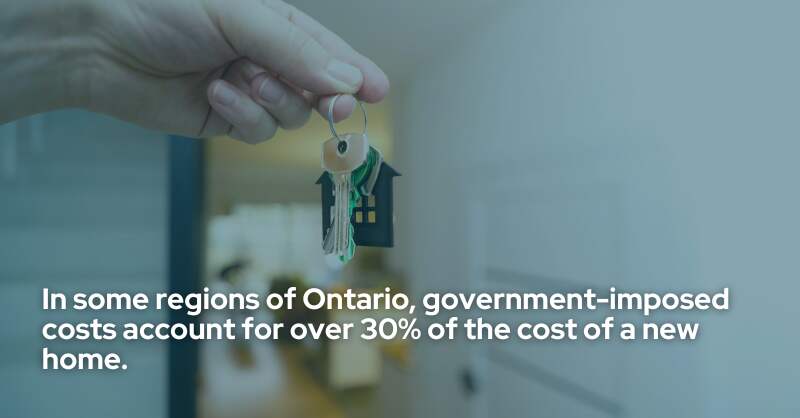
Municipal development charges (DCs) have risen more than 700% over the past two decades and have been an underrecognized major driver of skyrocketing home building costs. In some regions of Ontario, government-imposed costs account for over 30% of the cost of a new home. With the average selling price of a new home in Ontario at about $900,000, that means around $300,000 is taxes and charges.
While DCs can make sense in principle—new housing growth pays for its fair share of new infrastructure growth—they have evolved to pay for much more than just the infrastructure costs related to new growth. In many cases, municipalities have leaned on DCs to offset the cost of infrastructure upgrades and avoid property tax increases for existing homeowners (i.e. voters). But soaring DCs unfairly burden buyers of new construction homes (especially first-time buyers) as they often end up paying for infrastructure that the entire tax base benefits from, paying DCs much higher than those in the past. In fact, many current homeowners who bought their homes decades ago didn’t have to pay any DCs at all when they purchased their homes.
The federal government’s three-year freeze on DCs as a stipulation for municipalities to receive funding through the Canada Housing Infrastructure Fund is a step in the right direction. But a deeper, systemic fix is needed to actually lower unsustainably high DCs.
“It’s time for alternative funding models for DCs that spread infrastructure costs across the broader tax base, as has been done historically.”
The Mark Carney government has also committed to working with the provinces to subsidize 50% of DCs on multi-family housing for five years. This is good for the short term, but needs to be expanded to all homes. Either way, simply subsidizing out-of-control DCs is not sustainable in the longer term. CHBA recommends that it’s time for alternative funding models for DCs that spread infrastructure costs across the broader tax base, as has been done historically. This would relieve pressure on buyers of new homes, help spur housing starts, and reflect the reality that infrastructure benefits all residents, not just those buying homes in new developments.
Avoid Unnecessary Red Tape and Added Costs Through Codes
“CHBA recommends that every policy be reviewed through a housing supply and affordability lens, and as such, urges that affordability be adopted as a core objective of the National Building Code.”
Red tape and added costs through regulation have become a growing problem for home-building efforts. Many municipal, provincial, and federal policies (often made without proper industry consultation) have added needless complexity and cost to the home-building process.
For example, new policy directions driving more stringent codes and regulations can be important but expensive, and in some cases are duplicative or unnecessary, and almost all are increasing home building costs. To prevent a further drag on affordability, CHBA recommends that every policy be reviewed through a housing supply and affordability lens, and as such, urges that affordability be adopted as a core objective of the National Building Code, and that changes that drive up construction costs not be regulated until cost-effective solutions are found.
Fix the Mortgage Stress Test and Expand Access to Longer-Term Mortgages
“The federal government—which has previously pledged to review Canada’s mortgage market—should adjust the Interest Act to facilitate longer-term (seven- or 10-year) mortgages and remove the stress test on them.”
The mortgage stress test has been locking well-qualified buyers out of homeownership for over a decade, without change based on interest rate escalation or historically low delinquency rates, which has resulted in declining homeownership rates since 2011 and put undue pressure on the rental market and affordable (social) housing system. It’s time to recalibrate to an approach that better balances risk and housing supply needs. The federal government has already pledged to review the stress test for insured mortgages, and OSFI is intimating that the stress test may be removed for uninsured mortgages. CHBA recommends that these changes be acted upon with urgency to ensure fairness for well-qualified buyers and help restore access to the market to support new construction.
Additionally, the federal government—which has previously pledged to review Canada’s mortgage market—should adjust the Interest Act to facilitate longer-term (seven- or 10-year) mortgages and remove the stress test on them. This would provide more stability for buyers and reduce the risk of mortgage renewal shock as interest rates fluctuate.
Address Labour Shortages and Invest in Innovation
“The factory-built sector, not unlike site-built construction, needs much more sustained demand to ramp up. “
Labour shortages have plagued the residential construction industry for years, and current immigration and workforce training policies are misaligned with the sector’s needs, often conflating the needs of residential construction with construction in general (i.e. industrial, commercial, and institutional (ICI) construction).
To truly support the home building workforce, the federal government must look to adjust the immigration system to bring in newcomers with the skills and affinity for home building. This includes broadening the Express Entry system to include trades that actually build homes like framers and labourers—roles that are essential to ramp up home building, including factory-built methods like modular construction.
As the federal government looks to support the widespread adoption of factory-built housing, which will help increase productivity to both speed production and address the labour shortage, it is important to note that all the other barriers preventing more housing supply in general must be overcome first through holistic financial, regulatory, and policy support. In simple terms, the factory-built sector, not unlike site-built construction, needs much more sustained demand to ramp up. CHBA’s Sector Transition Strategy, released early last year, outlines a multitude of actions governments can take to do so, and to de-risk investments in factory-built methods and remove barriers to their use.
Closing the Canada housing supply gap and restoring housing affordability will not happen overnight. All levels of government have a role to play in removing the barriers to getting the homes Canada needs built. Some policy change has started, but it’s time for all policymakers to clear the path. Through initiatives like Build Canada Homes, there has been much emphasis by the current federal government on non-market affordable/social housing, which is important, but the government also needs to focus on increasing policy support for market-rate housing so that average middle-class Canadians can find homes they can afford to rent or buy. CHBA looks forward to the November budget to see if such changes are forthcoming.
About the Expert
-

Kevin Lee is CEO of the Canadian Home Builders’ Association (CHBA). A professional engineer with a Master’s in Architecture, Kevin has worked in the housing industry for over 35 years. With experience in both the public and private sectors, Kevin brings a wealth of knowledge in housing policy, home building technology, and business.
See more
-
 From Forests to Cities: Building Canada’s Housing Future with a Homegrown Supply Chain
 Oliver D. Krieg
President
Intelligent City
Oliver D. Krieg
President
Intelligent City
-
 How Technology is Unlocking a New Era for Canadian Homeowners
 Justin Herlick
CEO
Pine
Justin Herlick
CEO
Pine
-
 Canada’s Ageing Population: Why Federal Leadership Is Needed Now
 Alyssa Brierley
Executive Director
National Institute of Ageing
Alyssa Brierley
Executive Director
National Institute of Ageing
 Talia Bronstein
Director of Policy
National Institute of Ageing
Talia Bronstein
Director of Policy
National Institute of Ageing