
Why Nonprofits Are the Unsung Drivers of Canada’s Economic Growth
The non-profit sector, which accounts for 8.3% of Canada’s GDP and is the nation’s largest employer, is an underfunded yet critical pillar of economic resilience and must be treated as an essential partner in building a productive workforce.

Canadians know how to celebrate team effort. In sports, our strong fan loyalty is recognized across the world, as we proudly—and loudly—rally behind our teams. We don’t just celebrate who scores the goals, but every player who makes a win possible. Like sports teams, a successful economy relies on teamwork, but we’ve been leaving key players on the bench.
This year, the Canadian economy has continued to face persistent challenges, including sluggish growth and productivity, and ongoing trade uncertainty with the United States. Amid growing concerns about Canada’s economic trajectory, the non-profit sector remains a critical yet under-recognized pillar of our economic resilience.
The Economic Impact of Nonprofits
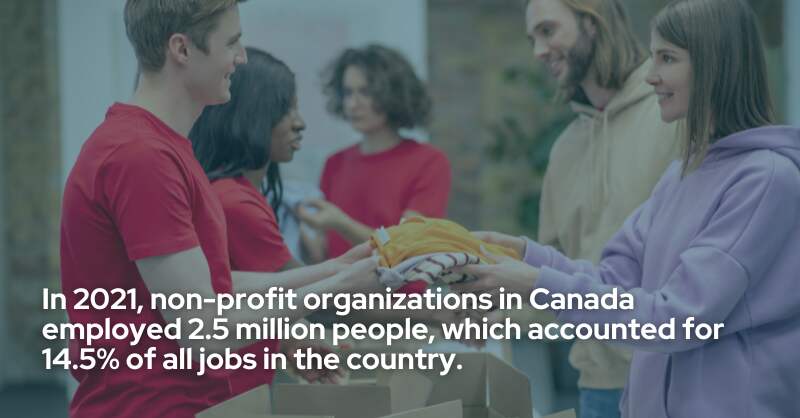
In 2021, non-profit organizations in Canada employed 2.5 million people, which accounted for 14.5% of all jobs in the country. Even today, in 2025, the non-profit sector remains the largest employer in Canada. It is 70% larger than construction, and 60% larger than manufacturing, according to an Imagine Canada report using Statistics Canada data. Volunteers also added nearly $56 billion to Canada’s GDP in 2017, accounting for approximately 2.6% of economic activity.
According to 2023 data from Statistics Canada, non-profit organizations accounted for 8.3% of Canada’s total GDP, equivalent to approximately $182 billion in economic activity. Demand for non-profits has grown alongside economic strain on the greater population, with real GDP from non-profits serving households rising 1.1% as more Canadians depend on their services to offset growing financial pressures.
The Care Economy Connection
This pattern mirrors what Canadian economist Armine Yalnizyan calls the “care economy,” which is a network of paid and unpaid work that sustains families, children, and older adults. Care work alone already makes up over 13% of Canada’s GDP, a sector larger than manufacturing and nearly twice the size of construction or finance. As the population ages and more workers retire than enter the labour force, Canada’s economy simply cannot grow without it.
Like the care economy, the non-profit sector has often been overlooked as a driver of Canada’s economic growth, even though its impact is all around us. Non-profits form the infrastructure that enables people to fully participate in society and the workforce. They train and re-train workers, provide care for children and seniors, assist with food security, and help build affordable housing.
Reducing Pressure on Public Systems
“Non-profits expanded at 1.9% annually, outpacing the total economy’s growth of 1.5% over the same period.”
By filling critical gaps in housing, healthcare, education, and social services, charities reduce pressure on public resources while strengthening communities. For example, addiction and mental health programs offered by social service organizations not only support individual recovery but also allow participants to re-engage in work and community life, boosting the local economy.
Non-profits also provide stability and continuity, even when other sectors face slower growth. Statistics Canada data show that between 2010 and 2020, the real GDP of non-profit institutions grew faster than the overall Canadian economy in nearly half of those years. On average, non-profits expanded at 1.9% annually, outpacing the total economy’s growth of 1.5% over the same period.
Funding Gaps and Inequities
“Small non-profit organizations receive the least government funding, relying the most on individual donations to deliver goods and services.”
Despite delivering these essential services, the non-profit sector remains underfunded and undervalued in economic planning, leaving its full potential as an engine of growth largely untapped.
In 2023, provincial and territorial government funding provided a small portion of Canadian non-profits’ total revenue at 10.5% , notes Statistics Canada. For comparison, individual donations and membership fees were the largest combined source of revenue, at 40%.
Small non-profit organizations receive the least government funding, relying the most on individual donations to deliver goods and services. However, they typically work closest with the communities they serve and are often at the forefront of identifying and meeting emergency community needs. The support is needed, but it’s not there.
Concentration of Government Support
“The majority of government funding is directed at two causes: health and education. Together, these categories receive 87.1% of all government dollars allocated to charities.”
There are over 170,000 charitable and non-profit organizations in Canada. Of those, 85,000 are registered charities, which are recognized by the Canada Revenue Agency (CRA) as public or private organizations that operate exclusively for purposes of public benefit to Canadians. Despite a common perception that charities depend largely on government support, most operate primarily on individual donations and other self-generated revenue.
CanadaHelps data from 2018 highlights that the majority of government funding is directed at two causes: health and education. Together, these categories receive 87.1% of all government dollars allocated to charities. Looking at it another way, this means that the majority of all government funding goes to the 1% of charities that reported more than 200 employees.
While their significance is undeniable and deserving of substantial support, this concentration leaves tens of thousands of other Canadian charities – many doing vital work within their communities, with very limited access to government funding. For example, while nearly one in four charities operate in the Social Services and Environment sectors, they collectively receive only 9.5 percent of available government funds.
CanadaHelps’ Giving Report also shows that 22% of Canadians said they relied on charitable services to meet essential needs in 2023, with 69% of them indicating it was their first time doing so. However, over half (57%) of charities are unable to meet current demand levels, highlighting a significant gap between need and available resources. While the total amount donated has increased, the number of donors has declined by 18% since 2020.
Investing in Nonprofits as Economic Partners
“Strengthening the non-profit ecosystem means a more stable workforce, fewer productivity losses, and a nation better equipped to adapt to change, especially in the challenging economic landscape we face today.”
Investing in people-centred services isn’t just a matter of moral due diligence; it’s essential to the economy. We need to start treating the non-profit sector as an equal team member when it comes to building resilient communities and a productive workforce. Without strategic support from policymakers, businesses, and individual Canadians, non-profits lack the resources to meet growing demand, limiting their ability to sustain communities and strengthen the economy.
Strengthening the non-profit ecosystem means a more stable workforce, fewer productivity losses, and a nation better equipped to adapt to change, especially in the challenging economic landscape we face today. In sports like hockey, the best teams don’t just invest in the goal scorers, but also in those who assist in their success. If we are to play as one Team Canada, we need to include all the players on the team who contribute to our shared economic success.
About the Expert
-

Duke Chang is President and Chief Executive Officer of CanadaHelps, Canada’s largest online donation and fundraising platform. He joined in 2023, bringing over 25 years of leadership in financial services and technology. He holds an MBA from Duke University and a BS from Georgetown University, and lives in North York, Ontario.
See more
-
 Indigenous Youth Are Key Partners in Strengthening Canada’s Security
 Jennifer Brennan
Senior Director
Mastercard Foundation
Jennifer Brennan
Senior Director
Mastercard Foundation
-
 Canada’s Philanthropic Moment: Five Policy Shifts to Unlock Impact
 Jean-Marc Mangin
CEO
Philanthropic Foundations Canada
Jean-Marc Mangin
CEO
Philanthropic Foundations Canada
-
 A Pathway to Prosperity Starts With Social Innovation
 Andrea Nemtin
CEO
Social Innovation Canada
Andrea Nemtin
CEO
Social Innovation Canada