
Why Canada Should Back Employee Ownership Trusts for the Long Term
A simple shift in ownership can shield Canadian businesses from foreign buyouts while turning everyday workers into wealthy stakeholders.

Canada is getting used to standing more proudly on its own two feet since our longest-standing ally launched an economic war against us. At this trying moment, Canadians are asking how we protect our sovereignty, make life more affordable for workers and families and build a stronger, more resilient economy for the long term.
One practical answer is already on the books: the Employee Ownership Trust.
Right now is the right moment for Canada to rethink who owns and benefits from our country’s most productive assets. Because if we don’t, we will continue to see viable Canadian companies sold to foreign buyers looking to control our resources—like a conveyor belt moving local success stories out of Canadian hands.
Employee Ownership Trusts, or EOTs, offer a different business succession option that keeps companies rooted in the communities in which they were built. Established in 2024, the EOT allows business owners to sell to a trust that holds shares on behalf of employees. Owners receive full market value paid out of future profits, while workers become employee-owners, without having to invest their own savings.
Keeping Canadian Companies in Canadian Hands
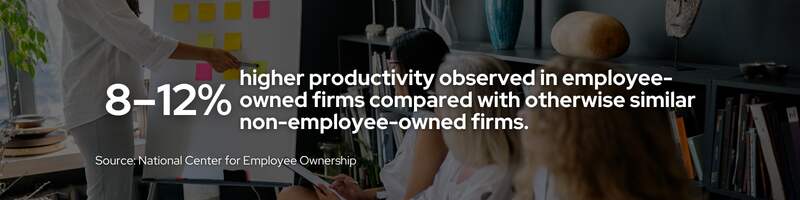
This model protects Canadian sovereignty by anchoring firms at home. Every EOT sale keeps ownership rooted in Canada, with that firm’s long-term success becoming directly tied to the well-being of its workforce and the community where it operates. It makes life more affordable for workers by helping them build real wealth—in some cases, the first meaningful ownership stake they’ve ever had. And it strengthens the broader economy: research shows employee-owned firms deliver an 8-12% productivity boost, are more likely to survive economic downturns and less likely to lay off workers during recessions.
“The US now has more than 6,000 employee-owned companies generating over $2 billion in worker wealth.”
These outcomes have been proven over decades in the United States and the United Kingdom. Both countries encourage employee ownership with all-party political support and substantial government incentives that spur on their success.
The US now has more than 6,000 employee-owned companies generating over $2 billion in worker wealth, while the UK’s EOT has created new income streams for more than 335,000 workers across nearly 2,500 firms. While it will take some time for Canada to get to that level of adoption, economist Brett House has projected that Canada could eventually see more than 100 new EOTs per year, if the right policy conditions are in place.
Momentum is Growing in Canada

Encouragingly, Canadians across the country can see the potential. From business leaders, including CEOs of some of our largest banks and institutions, to the new worker-owners sharing financially in their company’s success, support for employee ownership is growing rapidly.
In February 2025, Toronto-based Grantbook, a philanthropy-focused consultancy, became the first company in the country to be sold to an EOT, and since then, Brightspot Climate, Taproot Community Support Services and Paradigm Transportation have followed suit. About 1,000 Canadians are now employee-owners as a result of the policy. A countrywide array of expert advisors has sprung up to support them, and dozens more companies across the country are actively exploring transitions as word spreads.
Policy Certainty is Essential
“Without clarity about whether the incentive will remain in place, many owners will default to traditional sales rather than risk pursuing a structure that could lose its tax treatment midway through the process.”
But for this policy to truly deliver, the market needs certainty.
Canada introduced a temporary capital gains tax exemption—up to $10 million—for owners who sell to EOTs. That incentive, described as a “no-brainer” by advocates, makes employee ownership a viable succession option by offsetting the complexity of selling to employees rather than a conventional buyer. Yet it is set to expire at the end of 2026, after being in effect for less than three years.
Business succession planning takes years, not months. Without clarity about whether the incentive will remain in place, many owners will default to traditional sales rather than risk pursuing a structure that could lose its tax treatment midway through the process. Letting the exemption expire before employee ownership has even had a proper chance to take off would stall momentum before Canada has even had an opportunity to see what’s truly possible. In the U.S. and the U.K., the success of employee ownership has been underpinned by permanent capital gains tax incentives.
A Generational Transfer of Business
As baby boomer entrepreneurs make plans to retire, owners of thousands of businesses, which are the backbones of our small towns and many Canadian industries, will be searching for an exit strategy. The EOT can be a great option in two main cases.
First, for successful businesses in small communities or niche industries where there may not be a viable buyer, selling to an EOT can help preserve important local businesses throughout the country.
Second, for the many Canadian business owners who are deeply worried about selling to an outsider who may not respect their life’s work, employee ownership is a way to protect their legacy and reward the people who helped them succeed.
These are both big markets, which is why our counterparts in the U.K. are now seeing almost 10% of all business sales going to EOTs.
A Lever Canada Can Pull
To protect Canadian sovereignty, make wealth-building more accessible for workers and build a stronger, more productive economy, the federal government must act quickly to make the EOT incentive permanent. Permanence in the tax code would provide a clear path forward, giving business owners confidence, financial lenders predictability and workers a real opportunity to share in the success they help create.
At a moment when so much feels beyond our control, this is a lever Canada can pull.
About the Expert
-

Jon Shell is an entrepreneur and advocate for a fairer and more balanced economy. He is Chair of Social Capital Partners, a policy nonprofit focused on broadening access to wealth, ownership and economic security.
Social Capital Partners is a Canadian nonprofit organization.
See more
It develops policy solutions and partnerships aimed at improving economic mobility and expanding opportunity for working people.
-
 You Can’t Champion Canadian SMEs While Maintaining the Status Quo
 Kevin Kliman
Co-Founder
Humi
Kevin Kliman
Co-Founder
Humi
-
 Boosting Canada’s Innovation Performance Will Fuel Our Economic Future
 Ferhan Bulca
Director
Maple Leaf Angels
Ferhan Bulca
Director
Maple Leaf Angels
-
 Have We Been Looking for Economic Growth in All the Wrong Places?
 Dawn Desjardins
Chief Economist
Deloitte Canada
Dawn Desjardins
Chief Economist
Deloitte Canada
 Stephen Tapp
Chief Economist
Canadian Chamber of Commerce
Stephen Tapp
Chief Economist
Canadian Chamber of Commerce