
The Future of Gender Equality in Corporate Canada
Gender parity isn’t just a values issue, it’s a strategic necessity for Canada’s global competitiveness and economic resilience. Discover how to shift from “good intentions” to intentional design, unlocking untapped corporate advantage.

Gender Equality: Canada’s Untapped Competitive Advantage
Canada has long been recognized as a country that values fairness, inclusion, and social progress. Yet when it comes to gender equality in corporate leadership, progress has stalled. Despite decades of awareness, women remain underrepresented in executive positions, boardrooms, and decision-making circles.
“Companies with gender-balanced leadership outperform their peers in profitability, innovation, and long-term resilience. “
This is not only a social issue, but it is also an economic and governance imperative. Numerous studies have shown that companies with gender-balanced leadership outperform their peers in profitability, innovation, and long-term resilience. Advancing women is not just the right thing to do; it is a strategic necessity for Canada’s global competitiveness.
Today, as we face growing volatility with our largest trading partner, the United States, Canada must look inward and outward to strengthen its own economic resilience. Uncertainty south of the border has already led to hiring freezes, budget cuts, and program reductions across many sectors. But before cutting equity initiatives or downsizing female talent pipelines, leaders must ask themselves: how can we diversify our markets if we don’t have diverse teams driving innovation, creating new products and services, and opening new frontiers? A diverse workforce is not a luxury; it’s the engine of competitiveness and market diversification.
If we want to remain a world leader in business and innovation, we must accelerate our efforts to achieve parity across all levels of corporate Canada.
Closing the Parity Gap in Leadership

Parity Certification™, a rigorous assessment conducted by Women in Governance, measures organizations’ commitment to parity and inclusion, from recruitment to compensation, promotion, and retention.
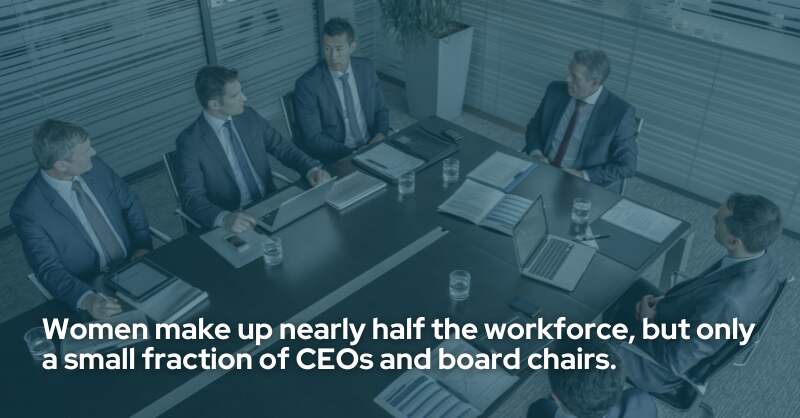
Our data shows encouraging progress: more companies are setting diversity goals, implementing inclusive hiring practices, and closing pay gaps. Yet the numbers remain far from where they need to be. Women make up nearly half the workforce, but only a small fraction of CEOs and board chairs.
“Leadership parity will not happen by chance; it must be designed, measured, and driven from the top.”
For Canada to lead, we must demand accountability at the top. This means embedding measurable gender objectives in corporate scorecards, tying executive bonuses to inclusion outcomes, and ensuring that boards themselves reflect the diversity they champion. Leadership parity will not happen by chance; it must be designed, measured, and driven from the top.
Embedding Accountability in Corporate Governance
“Policymakers can accelerate progress by mandating disclosure on gender representation, incentivizing companies that meet equity targets, and rewarding inclusive governance practices.”
True progress requires more than good intentions. It requires systems of accountability that make equity part of the DNA of our governance models.
Organizations that achieve real change are those that treat gender parity as a business metric, just like financial performance or risk management. Transparency in pay, promotion, and representation is essential.
Government and regulatory bodies also have a key role to play. Policymakers can accelerate progress by mandating disclosure on gender representation, incentivizing companies that meet equity targets, and rewarding inclusive governance practices. Canada should aspire to be the benchmark country for gender parity in corporate governance, setting global standards that others will follow.
Investing in the Pipeline: From Education to Executive Roles
“It is our collective responsibility to ensure that girls and women not only aspire to lead but have every tool and support to get there.”
Parity at the top begins long before the boardroom. It starts in classrooms, universities, and entry-level jobs where aspirations are formed, and opportunities are either created or constrained.
We need to strengthen the pipeline of female talent through targeted investment in education, mentorship, and sponsorship. Programs that help women transition into leadership roles, especially in STEM (Science, Technology, Engineering & Mathematics), finance, and technology, are critical.
Equally important is ensuring that career advancement does not come at the cost of personal well-being. Flexible work policies, accessible childcare, and equitable parental leave must become standard in every organization. These are not “women’s issues”; they are productivity issues that benefit everyone.
Canada’s future leaders will be shaped by how well we nurture talent today. It is our collective responsibility to ensure that girls and women not only aspire to lead but have every tool and support to get there.
Building Inclusive Workplaces for All
Gender equality cannot exist in isolation. To achieve lasting progress, we must embrace intersectionality, recognizing that women’s experiences differ across race, ethnicity, sexual orientation, disability, and other dimensions of identity.
Corporate inclusion strategies must be holistic, creating environments where every employee feels valued, heard, and empowered to contribute. Belonging is not a slogan; it is a measurable outcome that drives retention, engagement, and innovation.
When women and all underrepresented groups can thrive authentically in the workplace, organizations become stronger, more creative, and better equipped to serve diverse markets.
Canada’s Call to Action: Leading by Example
“True resilience will come not from retrenchment, but from reinvention driven by diverse teams capable of creating new ideas, products, and markets. “
The path forward is clear. Gender equality in corporate Canada is not a distant goal; it is an urgent priority that demands bold leadership and coordinated action.
To policymakers: Adopt stronger mechanisms for transparency, disclosure, and accountability on gender metrics.
To business leaders: Integrate parity into your strategy, governance, and culture because what gets measured gets done.
To educators and mentors: Empower the next generation of women to lead without limits.
As Canada navigates increasing uncertainty with its largest trading partner, we must strengthen our own foundation for growth and innovation. True resilience will come not from retrenchment, but from reinvention driven by diverse teams capable of creating new ideas, products, and markets.
Canada has the talent, the values and the infrastructure to be a world leader in gender equality. What we need now is resolve.
Parity is not a women’s issue; it is a collective mission for the prosperity of our organizations, our economy, and our society.
The future of gender equality in corporate Canada depends on the choices we make today. Let us choose to lead.
About the Expert
-

Caroline Codsi is the Founder & CEO of Women in Governance, whose Parity Certification™ helps hundreds of leading organizations close the gender gap. An internationally recognized speaker, she has been named one of Canada’s Top 100 Most Powerful Women and one of the Top 100 Entrepreneurs Changing the World. Caroline has been honored by UN Women and received the King Charles III Coronation Medal for her outstanding contributions to Canadian society.
See more
-
 Canada’s Growth Strategy Must Support Women-Led Businesses
 Sonia Prashar
President & Founder
spPR Inc
Sonia Prashar
President & Founder
spPR Inc
-
 A Strengthened Care Economy is the Future of Gender Equality in Canada
 Sarah Kaplan
Distinguished Professor
Rotman School of Management
Sarah Kaplan
Distinguished Professor
Rotman School of Management
 Susan Prentice
Professor of Sociology
University of Manitoba
Susan Prentice
Professor of Sociology
University of Manitoba
-
 Mind the Gap: The Motherhood Penalty and the Future of DEI in Canada
 Harmy Mendoza
Executive Director
WomanACT
Harmy Mendoza
Executive Director
WomanACT