
Stop Telling Young People to Adapt: We Need to Meet Them Halfway
Canada’s most educated generation is facing record-high youth unemployment—not because they lack skills, but because our systems aren’t built to meet them halfway.



Imagine this: A 23-year-old with a university degree, multiple co-op placements, freelance experience, and a strong social media presence. They have done everything right, from upskilling to networking, and yet, after hundreds of applications filtered by artificial intelligence, they still can’t land a full-time job.
This is not unusual. Canada’s most educated generation is struggling to find meaningful employment in an economy that demands more education, more experience, and more skills but offers few guarantees in return.
This is not just a youth issue. When young people can’t secure stable employment, the consequences ripple across society. Productivity starts to slow down, tax revenue declines, and social services become more strained. Employers lose access to fresh talent, causing innovation to stall and future leadership pipelines to dry up.
Canada’s economic future depends on how we support young people today. And that future must be built through intergenerational collaboration, instead of putting all the pressure on youth to adapt, hustle and wait their turn.
Youth Employment in Canada
Youth employment has always looked different compared to adult employment. Young people are more likely to hold temporary, part-time, or entry-level jobs, which leaves them vulnerable during difficult economic times.
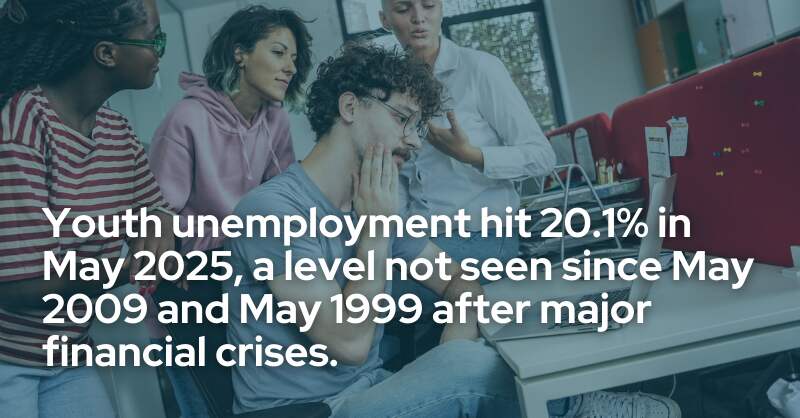
A pandemic-driven inflation, global trade tensions, and population growth that outpace job creation have created the perfect storm. In May 2025, touth unemployment hit 20.1%, a level not seen since the aftermaths of major financial crises in May 2009 and May 1999.
“Young people are more likely to hold temporary, part-time, or entry-level jobs, which leaves them vulnerable during difficult economic times.”
And the burden is not shared equally. Equity-deserving groups, including newcomer youth and those in smaller communities, face more barriers but have access to fewer resources.
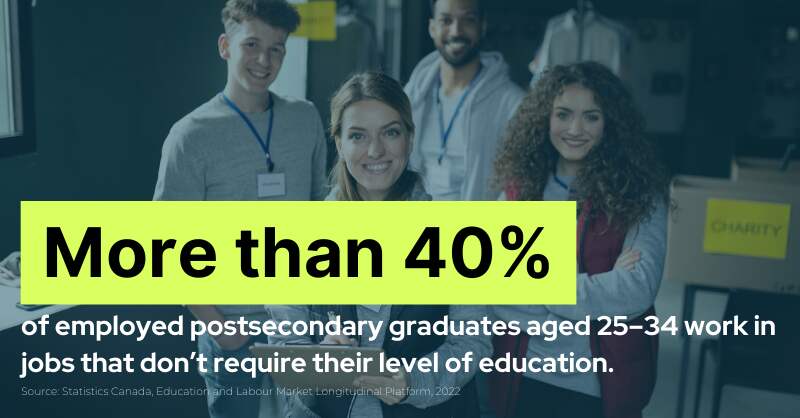
Young people often bring essential skills, from digital fluency to civic engagement and cross-cultural collaboration. Yet, many still can’t find work that matches their qualifications, in particular, immigrant youth whose credentials and talents remain undervalued or unrecognized.
A disconnect remains between the skills young people obtain in higher education and the needs of the labour market. Post-secondary institutions also have a role to play here, not just in credentials but also in preparing young people for the real-world economy.
Typically, the dominant narrative has been centred around young people needing to be the ones to become more adaptable, qualified, and job-ready. But this individualist framing isolates those who have done everything “right” yet still can’t secure jobs reflective of their qualifications. What we need now is a collective, system-wide action across generations and sectors to address the deeper structural barriers keeping young people out of meaningful employment.
“We need a system that evolves, puts youth and equity at the center, expands access, and creates lasting opportunities for meaningful youth employment.”
We don’t need more short-term programs or siloed “youth initiatives”. We need a system that evolves, puts youth and equity at the center, expands access, and creates lasting opportunities for meaningful work. We need a system where intergenerational partnership sits at the heart of Canada’s economic strategy.
One place to start meeting youth halfway is by addressing economic barriers to youth unemployment.
Addressing the Challenges Around Unemployment
While government programs like Canada Summer Jobs are essential, Employment and Social Development Canada must do more. That means expanding incentive programs for employers who hire youth, especially equity-deserving youth, in full-time and long-term roles, not just short-term placements, especially equity-deserving youth.
And it’s not about any jobs. Youth are already showing leadership in calling for work that tackles major challenges, like climate change. The recent youth-led campaign for a federal Youth Climate Corps is one example. Let’s invest in jobs that help young people build a better future for all of us.
“Today’s systems rely heavily on automation, where resumes that don’t match narrowly defined keywords may never even be seen by a person.”
Meanwhile, employers need to rethink workplaces and the recruitment process that value and recognize diverse forms of experiences. Too often, today’s systems rely heavily on automation, where resumes that don’t match narrowly defined keywords may never even be seen by a person. The solution is about designing fairer processes that don’t unintentionally filter out diverse talent.
Young people need to be more involved in decisions that affect their future. Decision makers need to recognize youth as crucial economic contributors; therefore, they need a seat at the table to be involved in matters that affect them.
Building a Future With Youth
The question is not whether young people have the skills or are ready to face the future of work. They are. The question is whether employers, policy makers, educators, and community leaders are ready to meet them in the middle and co-create a system that works for everyone.
Intergenerational collaboration is not optional. It is the only way forward for a resilient, innovative, and inclusive economy.
About the Experts
-

Valentina Castillo Cifuentes is the Associate Director at the Youth & Innovation Project at the University of Waterloo. She has extensive research experience in social impact measuring and youth program evaluation.
See more -

Sana Khaliq is the Equity, Diversity, and Inclusion Specialist at Canada’s 2SLGBTQI+ Chamber of Commerce. With almost a decade of knowledge and experience within the social justice space, she envisions a future where everyone can thrive.
See more -

Marina Melanidis is a PhD student and Cambridge Trust scholar in Geography at the University of Cambridge. She is also the Founder of Youth4Nature, an international youth-led non-profit organization that educates, equips, and establishes youth as leaders on system-wide solutions for the nature and climate crises.
See more
-
 Bridging the Digital Divide: Empowering Youth Through Digital Skills Training
 Julia Blackburn
CEO
NPower Canada
Julia Blackburn
CEO
NPower Canada
-
 Career Literacy in the Age of AI: Empowering Youth to Navigate the Future of Work
 Lisa Taylor
Founder and CEO
Challenge Factory
Lisa Taylor
Founder and CEO
Challenge Factory
-
 Canada’s Future Lies With Our Youth: Ensuring Access to Post-Secondary Education
 Nimmi Kanji
Executive Director
TELUS Friendly Future Foundation
Nimmi Kanji
Executive Director
TELUS Friendly Future Foundation