
Beyond Productivity: The Social Dividend of Canada’s Homegrown AI

Canada is at a crossroads. For years, a persistent and troubling narrative has dominated our economic discourse: the productivity gap. Labour productivity has declined in six of the last seven quarters, placing us consistently behind most of our G7 peers in a race we cannot afford to lose. The Bank of Canada’s Deputy Governor has rightly declared this a national “emergency,” a challenge to our standard of living and future prosperity.
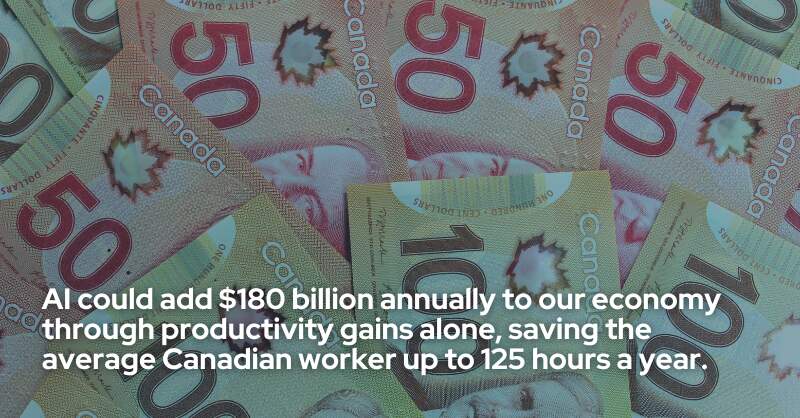
In this environment, the arrival of generative AI has been heralded as a silver bullet. Projections estimate it could add $180 billion annually to our economy through productivity gains alone, saving the average Canadian worker up to 125 hours a year. This is a powerful and necessary goal.
But to focus solely on efficiency is to miss the true, transformative potential of this technology. The next chapter of Canada’s AI story cannot just be about doing things faster; it must be about doing things better, more inclusively, and for the benefit of all Canadians. The real promise of AI lies not just in boosting our GDP, but in delivering a profound social dividend by democratizing access to essential services for our most vulnerable populations.
AI as a Force for Inclusion
Nowhere is this opportunity clearer than in sectors like insurance. For decades, the industry has operated on a high-cost, labour-intensive model. The result is a paradox: the very people who could most benefit from the financial safeguard of insurance—lower-income families, new Canadians, and those in underserved communities—are often the ones who find it least accessible. Complex products, high premiums driven by operational overhead, and communication barriers create a system that inadvertently excludes.
This is precisely the kind of systemic challenge that made-in-Canada AI is perfectly positioned to solve. Consider the work of JasperVOCAL, a Winnipeg-based SME developing a powerful AI voice synthesis platform. Their technology, the Agent Autodialer, isn’t designed to replace human insurance agents but to empower them. By automating the initial, time-consuming work of outreach and pre-qualifying leads, the AI streamlines the front end of the process. This dramatically reduces labour costs and operational friction, allowing human agents to focus their time on the most critical part of their job: providing nuanced advice and building relationships with clients who are genuinely interested and in need of their services.
The Social Dividend of AI
The immediate business benefit is a sharp increase in productivity and efficiency. But the downstream social impact is far more significant. By fundamentally disrupting the cost structure of customer acquisition, this technology creates the economic space to make insurance products more affordable and accessible. It helps lower the barrier to entry for millions of Canadians, offering a pathway to financial literacy and security that could safeguard a family from severe hardship in the face of an unexpected crisis.
This is AI with a purpose beyond the balance sheet. It is technology designed to reduce systemic barriers for those who may face linguistic, technological, or educational challenges when navigating traditional systems. It promotes social inclusion and individual empowerment, demonstrating that the goal of AI adoption should not simply be cost-cutting, but amplifying our capacity to serve all Canadians more effectively.
Homegrown Innovation and National Ambition
“For Canada to truly capitalize on its AI moment, we must shift from being a world-class incubator of AI research to a world-class implementer of AI solutions.”
This vision of a more inclusive economy, powered by homegrown innovation, is the story of Canada at its best. JasperVOCAL itself is a testament to this. Led by Marco Soares, a 20-year-old immigrant entrepreneur, the company embodies the ambition and diversity that will define our nation’s success. By building their company in Winnipeg, they are creating and retaining highly skilled technical and operational roles outside of Canada’s traditional tech hubs, proving that world-class innovation can and must flourish across the country.
This is the blueprint we must follow. For Canada to truly capitalize on its AI moment, we must shift from being a world-class incubator of AI research to a world-class implementer of AI solutions. This requires a radical change in mindset. We must champion a “buy local” approach to our AI strategy, one that prioritizes and nurtures the domestic development of these critical technologies. It is disheartening to see our top talent and valuable intellectual property migrate to other countries because they cannot find the resources and scale needed to grow at home.
Building a Sovereign AI Strategy
“By embracing a “customer model” through grants, incentives, and procurement, we can anchor our IP in Canada, ensuring that the commercial success of our innovation directly contributes to our national priorities.”
Government has a crucial role to play. The federal government’s recent $2.4 billion investment in AI is a commendable start, but we must ensure this capital is strategically deployed to catalyze our domestic ecosystem. Programs like the AI Compute Access Fund are vital, providing the computational resources that allow Canadian SMEs to compete with global giants.
By embracing a “customer model” through grants, incentives, and procurement, we can anchor our IP in Canada, ensuring that the commercial success of our innovation directly contributes to our national priorities. This is the essence of a Sovereign AI Strategy—building a secure and globally competitive innovation ecosystem where Canadian firms are equipped to thrive in the global AI race.
Restoring Trust and Building the Future
“We must prove that AI can be a supportive partner to human judgment, enabling our workforce to dedicate more time to tasks where empathy, creativity, and nuanced decision-making are essential.”
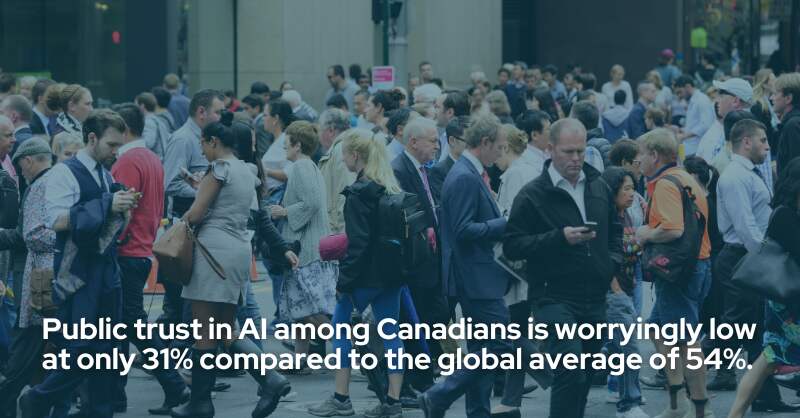
Ultimately, building this future requires trust. Public trust in AI among Canadians is worryingly low at only 31% compared to the global average of 54%. The only way to bridge this gap is by showcasing responsible, human-centric applications of AI that deliver tangible benefits. We must prove that AI can be a supportive partner to human judgment, enabling our workforce to dedicate more time to tasks where empathy, creativity, and nuanced decision-making are essential.
The path forward is clear. Canada has a generational opportunity to not only solve its productivity puzzle but also to build a more equitable and resilient future economy. The solution lies in our own backyard, in the innovative, ambitious, and diverse SMEs that are already building the future. By investing in homegrown, purpose-driven AI, we can ensure that the next wave of technological advancement lifts everyone, creating a stronger economy that truly works for all.
About the Expert
-

Romel Dhalla is a Corporate Director of JasperVOCAL Inc., Managing Partner of Blumont Business Acquisition Partners LP, and Governor of the Montreal Economic Institute. With a strong background in strategic leadership and governance, he guides JasperVOCAL’s growth and impact while overseeing investments in next-generation technology.
See more
-
 Canada’s Insurance Industry Has A Productivity Crisis. AI Can Cure It.
 Jackson Fregeau
CEO & Co-Founder
Quandri
Jackson Fregeau
CEO & Co-Founder
Quandri
-
 Can AI Help Canada Build the Future of Life Sciences?
 Handol Kim
Co-Founder & CEO
Variational AI
Handol Kim
Co-Founder & CEO
Variational AI
 Martin Enault
Chief Entrepreneur in Residence
Centech
Martin Enault
Chief Entrepreneur in Residence
Centech
 David D. Jones
Managing Director
Merck Canada
David D. Jones
Managing Director
Merck Canada
-
 Adoption Is Not Adaptation: The Reskilling Wave Canada’s AI Strategy Leaves Out
 Tracey Taylor-O’Reilly
Founder
Promentus
Tracey Taylor-O’Reilly
Founder
Promentus