
Powering the Future: Sustainable AI Infrastructure as Canada’s Catalyst for Prosperity
To seize global AI opportunities, Canada must treat data centers as critical infrastructure and immediately establish a coordinated national strategy for predictable, low-carbon power access and digital sovereignty. The race isn’t about algorithms alone-it’s about the ability to power them sustainably.

AI’s Energy Reckoning and Opportunity for Smarter Infrastructure

The 2025 G7 Leaders’ Statement on AI for Prosperity recognized a critical duality: artificial intelligence (AI) presents immense opportunities to drive innovation and prosperity, but its rapid adoption also threatens to overwhelm global energy systems.
For Canada, this challenge is especially urgent. Without investing in scalable, sustainable digital infrastructure, the country risks missing out on AI-enabled productivity gains and economic growth.
Let’s be clear: without data centres—and the power to support them—there is no AI, no digital economy, and no modern way of life. No data centres would mean no online transactions, no remote work, no secure health data transfers, no digital public services. These are not just tech conveniences—they are the bedrock of national competitiveness, public trust, and day-to-day functionality in a digital society.
The conversation around AI must now expand beyond algorithms and ethics to include the physical systems that enable the technology: data centres, power grids, and cooling systems. As we move further into the Intelligent Age, the question isn’t just whether Canada will lead in AI—it’s whether we can power that leadership responsibly and sustainably.
AI’s Growing Energy Appetite: A Call for Smarter Infrastructure
The surge in demand for generative AI technologies has brought with it a corresponding surge in energy use. A single ChatGPT query, for example, consumes up to 10 times the electricity of a traditional web search. These workloads are housed in data centres—the industrial backbone of the digital world. AI models require vast amounts of computing power, often supported by dense clusters of GPUs running 24/7.
With nearly 95% of Canadians online and more than 100% mobile penetration, Canada is one of the most digitally connected nations in the world. That creates enormous opportunities for AI applications in healthcare, cybersecurity, financial services, and public sector efficiency. But it also raises the stakes for infrastructure that can support those use cases responsibly.
Canada’s long-term investment in AI, including the Pan-Canadian AI Strategy and the launches of Vector Institute, Amii and Mila, laid the foundation for this opportunity. More recently, the federal government committed $2.5 billion through the Canadian Sovereign AI Compute Strategy. That includes $1 billion for public supercomputing infrastructure, $700 million for commercial AI data centre expansion, and $300 million to support affordable compute access for SMBs. These investments directly address Canada’s historical infrastructure gap and signal a shift toward a more balanced model of growth and governance.
Canada’s Power Paradox: Constraints in an Electrified Economy
“Canada must scale domestic AI capabilities by supporting data infrastructure and attracting investment—but “sovereignty does not mean solitude.””
Canada is both rich in renewable resources and constrained by legacy infrastructure. The push for AI and electrification across industries is accelerating faster than utility upgrades. Grid congestion, fragmented regulatory environments, and limited regional transmission capacity threaten to throttle growth. Delays in utility interconnection and power permitting can stall data centre deployments for years—precisely when Canadian innovators need them most.
Data centres currently consume less than 1.5% of Canada’s total electricity, while in the US the figure is closer to 4%, and forecasted to surpass 10% within the next decade. This illustrates a substantial gap in energy distribution readiness that must be addressed if Canada is to compete globally.
As AI Minister Evan Solomon recently told The Globe and Mail, Canada must scale domestic AI capabilities by supporting data infrastructure and attracting investment—but “sovereignty does not mean solitude.” Canada will need international partnerships to co-develop infrastructure and secure capital, especially when a single hyperscale AI data centre can cost billions of dollars.
Provincial Contrasts: Missed Alignment and Missed Opportunity
“Without a coordinated national strategy to expand and modernize critical infrastructure, Canada risks falling behind the US, EU, and China in the global AI race.”
Provincial disparities further complicate progress. Alberta has earmarked more than 10 GW of electricity specifically for data centres as a cornerstone of a broader strategy to attract over $100 billion in digital infrastructure investment. By contrast, Quebec’s electricity allocation model remains heavily regulated—any load above 5 MW requires government approval. The approval process is long, complex, and now includes a tariff on unused allocated electricity, which adds operational risk for providers.
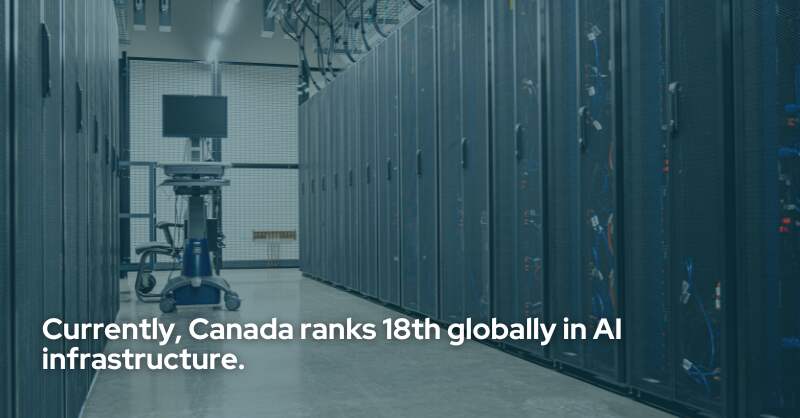
Without a coordinated national strategy to expand and modernize critical infrastructure, Canada risks falling behind the US, EU, and China in the global AI race. Currently, Canada ranks 18th globally in AI infrastructure. Closing this gap will require consistent energy access, investment predictability, and harmonized national frameworks.
Innovations Leading the Way: From Heat Reuse to AI Cooling
“From technicians and engineers to systems architects and energy analysts, our ability to scale AI infrastructure sustainably will depend on a diverse, skilled workforce.”
Around the world, infrastructure providers are innovating to square the AI-energy challenge with climate responsibility. In Sweden, Stockholm Data Parks is pioneering a closed-loop system that captures heat from data centres to warm nearby homes. In the Netherlands, new facilities are being built with full liquid immersion cooling systems to minimize water and electricity use.
Canada is also seeing meaningful progress. For example, Equinix’s TR5 data centre in Markham, Ontario, recaptures waste heat and channels it into the Markham District Energy network—heating homes and reducing local emissions. New data centre builds in Ontario and British Columbia are incorporating advanced liquid cooling technologies, AI-enabled temperature control systems, and low-carbon backup power sources like hydrogen and fuel cells.
At the same time, we must acknowledge that infrastructure is only as strong as the people who run it. From technicians and engineers to systems architects and energy analysts, our ability to scale AI infrastructure sustainably will depend on a diverse, skilled workforce.
That’s why partnerships like the one between Equinix and the CEE Centre for Young Black Professionals matter. By investing in training and early-career pathways for underrepresented communities, we’re helping to future-proof the digital workforce Canada needs.
Collaboration as a Catalyst: Building Canada’s Digital-AI Backbone
“With mandates for procurement standards, digital resilience pilots, and intergovernmental alignment, Canada can hardwire long-term competitiveness into its AI future.”
If Canada is to compete globally, a robust and future-ready AI infrastructure ecosystem is non-negotiable. And achieving this requires systemic collaboration.
Canada must work with global partners to co-develop infrastructure, attract investment, and scale strategically. The federal government’s recent infrastructure commitments are a start, but we must build on that momentum with more comprehensive national coordination.
To seize this moment, Canada should focus on three imperatives:
- Recognize data centres as critical digital infrastructure: These are not just tech assets—they are foundational to every facet of modern life.
- Shape a national energy strategy for data centres: One that ensures predictable, affordable, and low-carbon power access across provinces.
- Launch a national data centre strategy for data sovereignty: One that prioritizes where Canadian data resides, how it travels, and how it’s governed.
This strategy should be coordinated through a working group of public and private sector leaders, focused on implementation—not just policy design. With mandates for procurement standards, digital resilience pilots, and intergovernmental alignment, Canada can hardwire long-term competitiveness into its AI future.
Canada’s evolution from a regulation-first to a regulation-and-infrastructure parallel model reflects a maturing approach. The lessons from AIDA—particularly around balancing protection with innovation—should now inform how we govern the physical layer of AI: where data is stored, how it’s powered, and who gets access.
Infrastructure Is Innovation
The foundations of AI prosperity are not built in code alone. They are built in physical places—in data centres powered by clean electricity, cooled by smart systems, and supported by skilled people.
If Canada wants to harness AI to boost productivity, improve services, and build economic resilience, it must treat infrastructure as strategic. That means not only investing in capacity, but also rethinking how that capacity is built, regulated, and used. The current federal government’s effort to re-examine legacy regulations is an encouraging first move.
Canada has the talent, the resources, and the global relationships to lead in sustainable AI infrastructure. But the window for action is narrow. To seize the moment, we must think boldly, build smartly, and collaborate relentlessly.
About the Expert
-

Marc Mondésir is Managing Director of Equinix Canada, leading national growth and digital ecosystem expansion. Formerly with Microsoft and Dell, he brings deep expertise in consulting and professional services. A champion for diversity, he mentors emerging leaders and advises tech startups. Marc holds an MBA from Queen’s University.
See more
-
 Canada’s Insurance Industry Has A Productivity Crisis. AI Can Cure It.
 Jackson Fregeau
CEO & Co-Founder
Quandri
Jackson Fregeau
CEO & Co-Founder
Quandri
-
 Can AI Help Canada Build the Future of Life Sciences?
 Handol Kim
Co-Founder & CEO
Variational AI
Handol Kim
Co-Founder & CEO
Variational AI
 Martin Enault
Chief Entrepreneur in Residence
Centech
Martin Enault
Chief Entrepreneur in Residence
Centech
 David D. Jones
Managing Director
Merck Canada
David D. Jones
Managing Director
Merck Canada
-
 Adoption Is Not Adaptation: The Reskilling Wave Canada’s AI Strategy Leaves Out
 Tracey Taylor-O’Reilly
Founder
Promentus
Tracey Taylor-O’Reilly
Founder
Promentus