
We’re Graduating Female Scientists But Not Keeping Them. It’s Self-Sabotage
Graduating female scientists is only half the battle if the workplace is still designed to exclude them.

Picture a lecture hall in 2026, where women make up 60% of life sciences students. Now, picture a lab ten years later, where those same brilliant minds have dwindled to a mere 23% of the workforce. This isn’t attrition. It’s eviction by design. This is not a “leaky” pipeline: it’s a rupture.
Open Doors, Broken Systems

For decades, we’ve congratulated ourselves on opening classroom doors to women in STEM. Canadian universities are more diverse than ever, with women now holding approximately 35% of STEM degrees. In the life and agricultural sciences, women are the trailblazers, often accounting for over 60% of graduates.
But if you think it’s mission accomplished, follow those graduates into their first jobs. Watch them earn less than the man at the next bench doing identical work. Watch them be overlooked for promotion. Watch them forced to choose between motherhood and the microscope.
Then watch them leave.
Canada’s Retention Challenge
That 35% share of degree-holders shrivels to just 23% of actual STEM employees. This drop-off is not accidental. We’re hemorrhaging them through entrenched structural failures—a system that welcomes women into the classroom but abandons them in the field.
For young women starting their first jobs in a lab, on a construction site, or at a tech startup today, the barriers are comprised of cumulative, daily disadvantages at every stage of their careers.
The losses are most acute in the math-heavy disciplines shaping the future of the global economy. In engineering, women make up 25.8% of students but only about 21% of newly licensed engineers. In computer science, women represent roughly 16% to 20% of graduates. In the private sector, they hold only about 1 in 10 senior management roles in STEM. In academia, fewer than 20% of full-time STEM faculty are women.
This is not a lack of interest or talent. It is a systemic failure of retention.
The Motherhood Penalty
The reasons are as practical as they are insidious. STEM careers often require rigid schedules, long hours, or frequent travel, while governments and institutions have failed to modernize caregiver supports.
The result is predictable: women are pushed out during their critical mid-career years—the motherhood penalty in action. When we fail to provide flexibility, we’re not making a neutral choice. Careers designed around a worker with no caregiving responsibilities ensure women pay the steepest price.
Death By A Thousand Cuts
“It’s not always overt discrimination. It’s being the only woman in the room, again and again, until you stop walking into rooms.”
Then there’s the culture. Nearly half of women in STEM cite gender stereotyping and microaggressions as their primary roadblock. This is the “death by a thousand cuts”: being passed over for high-profile fieldwork, having their ideas echoed by male colleagues, or being excluded from informal networks where mentorship and promotions are often decided.
It’s not always overt discrimination. It’s being the only woman in the room, again and again, until you stop walking into rooms.
And sometimes, it’s shockingly physical. A landmark 2025 report from the Professional Institute of the Public Service of Canada (PIPSC) confirmed what many women scientists already knew: fieldwork can be dangerous when nobody planned for your body to be there. No safety gear is designed for female bodies. No employer-provided support in remote areas. No proper washroom facilities. When we force a young scientist to choose between her research and her basic safety, we shouldn’t be surprised when she looks elsewhere.
The Economic Cost of Losing Women in STEM
“New analysis suggests closing the productivity gap by 2035 could yield a massive $500 billion dividend.”
The economic cost of this exit is staggering. For years, policymakers touted a 2017 projection that gender equality could add $150 billion to Canada’s GDP by 2026. We’ve reached that deadline, and progress has stalled —undermined in part by the COVID-19 “she-cession,” which disproportionately pushed women out as childcare closures shifted unpaid care burdens onto mothers, fracturing momentum for mid-career scientists.
Yet the stakes have only grown. The 2025 OECD Economic Survey of Canada identifies “fully utilizing women’s skills” as critical to reversing our lagging productivity. New analysis suggests closing the productivity gap by 2035 could yield a massive $500 billion dividend.
In STEM alone, McKinsey estimates a $100 billion gain by 2030, provided Canada bridges the gender gap in high-growth “future arenas”—Generative AI, green energy, and biotech. These sectors will drive nearly 16% of global GDP by 2040, yet women remain significantly underrepresented in the technical and leadership roles that govern them. Are we really content to let world-changing thinkers and prosperity walk out the door because we couldn’t be bothered to build a culture worth staying for?
The Pay Gap is Starving Innovation
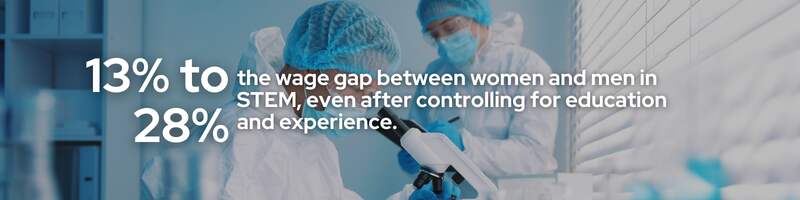
This macroeconomic loss mirrors a microeconomic injustice: women in STEM still earn $9,000 to $15,000 less per year than their male peers, a wage gap of 13% to 28% wage gap, even after controlling for education and experience.
This isn’t just a missing paycheck; it’s lost “risk capital”—the financial cushion needed to launch startups or pursue independent research. From national productivity to household security, Canada’s failure to address parity drags on our collective future.
How Women Are Fighting Inequity
“While policymakers wring their hands over missed GDP targets, young women entering STEM aren’t waiting for the “old guard” to catch up. They’re bypassing the gatekeepers entirely.”
But these numbers only tell part of the story. On the ground, the frustration is turning into defiance—and here’s the shift that should terrify the status quo: this generation is refusing to be the next “leak” in the broken pipeline. While policymakers wring their hands over missed GDP targets, young women entering STEM aren’t waiting for the “old guard” to catch up. They’re bypassing the gatekeepers entirely.
This generation isn’t arriving with the quiet gratitude of the “firsts,” but with the bold expectations of the “many.” More equity-literate than any generation before them, and not content to wait for the system to change, they’re building their own networks—from student-led coding circles to grassroots mentorship programs that bypass traditional gatekeepers.
From McGill’s Women in Tech (WIT) to UWaterloo’s Women in Computer Science (WiCS) initiatives, students are building the mentorship and networks that the ‘traditional’ system failed to provide. They are demanding transparency in promotion, mentorship as a standard practice, and policies that acknowledge people have lives and cares beyond the lab.
From Slogan to Strategy
“You cannot solve the world’s most complex problems—climate change, pandemics, AI ethics—with only half of the available brainpower.”
We are beginning to see the policy ripples. From the 2025 federal budget commitments to inclusive research, to institutional reforms across Canadian campuses, equity is slowly shifting from PR slogan to data-proven strategy. There is a growing recognition that diversity isn’t a checkbox exercise, but a prerequisite for innovation. You cannot solve the world’s most complex problems—climate change, pandemics, AI ethics—with only half of the available brainpower.
The needle is moving, but it’s being pushed by the sheer will of a generation that refuses to accept the pace of change. To support them, government, industry and academia must move faster. We must fix the fieldwork safety standards, enforce pay equity through transparent audits, and dismantle the subtle biases that make brilliant young women feel like trespassers in their own offices. It’s time to bridge the gap between studying science—and staying in it.
About the Expert
-

Senator Farah Mohamed is a Canadian legislator focused on economic policy, workforce development, equity, and youth. She has worked on issues related to labour markets, innovation, and inclusive growth.
See more
-
 From Curiosity to Career: We Must Start Early to Build the Future of Women in STEM
 Cindy Adams
Executive Director
Scientists in School
Cindy Adams
Executive Director
Scientists in School
-
 Budget 2025’s AI Bet: $1 Billion for Infrastructure, Zero for the Women It Will Displace
 Sarah Stockdale
Founder
Growclass
Sarah Stockdale
Founder
Growclass
-
 The War on Diversity, Equity, and Inclusion is a War on Human Rights
 Tamara Thermitus
Distinguished Boulton Senior Fellow
McGill University’s Faculty of Law
Tamara Thermitus
Distinguished Boulton Senior Fellow
McGill University’s Faculty of Law