
From Curiosity to Career: We Must Start Early to Build the Future of Women in STEM
Discover why early, repeated science is the only way to ensure Canada’s future isn’t missing half of its best ideas.

On International Day of Women and Girls in Science, we imagine a better future: One where women are equitably represented in science, technology, engineering, and mathematics, and where innovation reflects the full diversity of our society.
What does that future look like in Canada?
We visualize women equitably leading cutting-edge research in physics and genetic engineering. We imagine them in equal numbers to men designing clean energy systems, advancing crop science, shaping artificial intelligence, and driving breakthroughs that improve lives. We imagine Nobel Prizes awarded to women not as rare exceptions, but as regular occurrences—Donna Strickland joined by many others, no longer standing alone among a long list of men.
Most importantly, we envision a workforce that reflects the full richness of our population: women from diverse cultures, regions, and lived experiences. Indigenous women. Black women. Women from rural, northern, and low-income communities. A future where talent is never lost because opportunity was unevenly distributed.
That is the vision. The reality is very different.
The Reality of Women in STEM
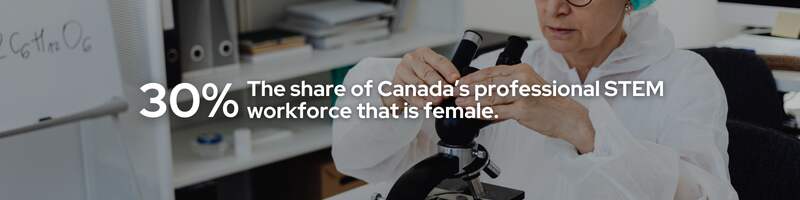
According to Statistics Canada, less than 30% of Canada’s STEM workforce is made up of women. In the skilled trades—one of the fastest growing sectors—women represent less than 10% of post-secondary training programs and the skills trade workforce. And in Canada’s university engineering faculties, while there has been progress over the past decade, women still account for only 25% of undergraduates.
These numbers are not just statistics. They represent lost potential: Ideas not pursued, problems not solved, leadership not realized. And if we are serious about closing this gap, we must stop pretending the problem starts in high school or university.
As the executive director of Scientists in School, a Canadian organization that has brought hands-on STEM experiences to hundreds of thousands of children across the country, I have seen firsthand how early exposure shapes curiosity, confidence, and future participation in science and innovation.
Over more than three decades, we have partnered with schools, teachers, and communities to inspire students—especially girls—to explore STEM in ways that feel accessible and empowering. These experiences and the results of university research via post-workshop surveys of participating classrooms have shown me why investing in girls’ STEM engagement from the earliest years is not just important, but essential for Canada’s future innovation and leadership.
The Status Quo is Not an Option

By Grade 4, many girls have already decided that science and engineering are “not for them”. Somewhere between curiosity and confidence, too many begin to opt out—not because of ability, but because of exposure, messaging, and a lack of belonging.
If we wait until high school to change this, we are already too late. The foundation for women’s participation in science and innovation is built in the Kindergarten to Grade 8 years. This is when identities form. This is when children decide what they are good at, what they enjoy, and what futures feel possible.
That means prioritizing multiple meaningful STEM experiences, not a single workshop or one-off career day, but repeated opportunities in the early formative years allow girls to explore, experiment, fail safely, and succeed visibly.
When girls engage in hands-on, inquiry-based science, something powerful happens. Their confidence grows. Their interest deepens. And their sense of “I belong here” begins to take root, keeping the door open to futures in science and innovation.
Access to STEM Opportunities Must Be Equitable
“When educators collaborate with community-based organizations, including youth groups, cultural centres, Indigenous organizations, and non-profit STEM providers, learning becomes more relevant, trusted, and accessible.”
Too many children and youth in rural, remote, and under-resourced communities do not receive the same quality of STEM enrichment as their peers. Equity means removing barriers—geographic, financial, and systemic—so that every child can experience science as something dynamic, creative, and relevant.
This is where partnerships with local community organizations make a critical difference.
Schools cannot do this work alone. When educators collaborate with community-based organizations, including youth groups, cultural centres, Indigenous organizations, and non-profit STEM providers, learning becomes more relevant, trusted, and accessible. These partnerships help reach families who may not feel connected to formal systems, adapt programming to local contexts, and remove practical barriers like cost, transportation, and awareness. When communities are at the table, STEM becomes something children see not just in textbooks, but in their own lives and neighbourhoods.
Representation Matters Deeply
“Mentorship, storytelling, and visibility play a crucial role in dismantling stereotypes and inspiring persistence in STEM pathways, showing girls that STEM isn’t reserved for just one type of person.”
“You can’t be what you can’t see” remains profoundly true. When girls meet scientists and engineers who look like them, their understanding of what is possible expands.
Role models change trajectories.
Mentorship, storytelling, and visibility play a crucial role in dismantling stereotypes and inspiring persistence in STEM pathways, showing girls that STEM isn’t reserved for just one type of person—it is a space where many identities belong.
This means celebrating female innovators publicly, featuring them in media and outreach, and building mentorship networks that connect students with female professionals in science, technology, engineering and mathematics. This is especially important for girls from communities historically excluded from STEM. For them, seeing women like themselves in STEM roles isn’t just inspiring, it’s transformative.
But inspiration alone is not enough. It must be supported by systems that value data, accountability, and long-term impact.
We need to measure what works, and for whom.
That means tracking not only short-term excitement, but long-term outcomes: confidence, interest, understanding of relevance, and persistence along the STEM pathway. It means paying attention to who is being reached, who is not, and why. And it means continuously improving programs based on evidence, not assumptions.
Teachers play a critical role, too.
When we invest in educators—through resources, partnerships, and professional development—we multiply impact. A single supported teacher can influence hundreds of students over a career. Empowering them with strong tools and experiences strengthens the entire ecosystem of STEM learning.
We Must Broaden How We Define Innovation and Leadership
“When girls see themselves as scientists, engineers, and innovators from a young age, they don’t just change their own futures—they change ours.”
Encouraging women into science isn’t just about filling lab benches or increasing headcounts. It’s about diversifying who drives innovation and solutions across all sectors.
Women bring unique perspectives to health equity, environmental sustainability, ethical technology, sustainable business, and community planning. The challenges we face—from climate change and digital transformation to food security and public health—are complex and require diverse thinkers, creativity, and collaborative problem-solvers.
Canada’s strength lies in leveraging diverse mindsets and fostering collaboration across community organizations, businesses, education, government, and industry.
The future of women in science and innovation will not be built overnight. It will be built classroom by classroom, mentor by mentor, experience by experience.
If we want more women leading discoveries tomorrow, we must nurture their curiosity today.
International Day of Women and Girls in Science is not just a celebration—it is a call to action to start earlier, reach wider, invest smarter, and to believe, collectively, that when girls see themselves as scientists, engineers, and innovators from a young age, they don’t just change their own futures—they change ours.
About the Expert
-

Cindy Adams is the Executive Director of Scientists in School, a Canadian nonprofit dedicated to delivering hands-on STEM education for children across Canada. She leads strategic partnerships and program development to inspire early STEM engagement.
See more
-
 Budget 2025’s AI Bet: $1 Billion for Infrastructure, Zero for the Women It Will Displace
 Sarah Stockdale
Founder
Growclass
Sarah Stockdale
Founder
Growclass
-
 We’re Graduating Female Scientists But Not Keeping Them. It’s Self-Sabotage
 Farah Mohamed
Senator
Senate of Canada
Farah Mohamed
Senator
Senate of Canada
-
 Canada’s Literacy Gap is Not Just an Education Issue; It’s an Economic One
 Carly Shuler
Co-Founder & CEO
Hoot Reading
Carly Shuler
Co-Founder & CEO
Hoot Reading