
Fiduciary-Grade AI: Unlocking Real ROI in Professional Services
Canadian professional services are stuck in an “ROI gap” because general-purpose AI lacks the authoritative data and reasoning required for high-stakes work.

Canadian professional services firms are not afraid of AI. They’re asking a harder question, one I hear from General Counsel, Managing Partners, CFOs, and Heads of Tax and Compliance constantly, in Canada and around the world:
“Where’s the ROI?”
It’s the right question. And the data suggests Canadian professionals have been right to keep asking it.
The Pilot Problem
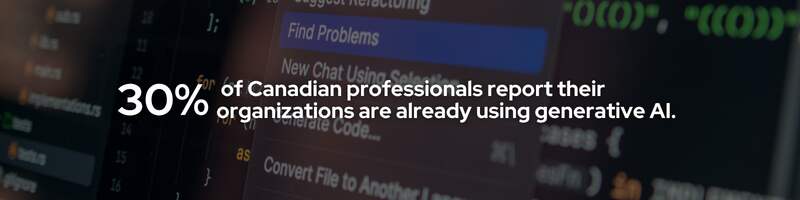
According to the Thomson Reuters Institute’s 2026 AI in Professional Services Report, which surveyed 195 Canadian respondents across legal, tax, accounting, audit, risk, fraud, and government, 30% of Canadian professionals report their organizations are already using generative AI, with another 11% planning to adopt it soon.
The intention is real. 55% of Canadian respondents believe generative AI should be applied to their professional work.
But look closer, and the ROI picture is stark. Only 9% of Canadian organizations are actively measuring the return on their AI tools. 40% are not measuring it at all, and 52% don’t know whether they’re getting a return.
“The ROI gap isn’t an adoption problem. It’s an architecture problem. And until Canadian professional services leaders name it clearly, we’ll keep mistaking pilot programs for progress.”
That is not the profile of an industry confidently deploying AI as core infrastructure. It’s the profile of an industry that has been running pilots, buying licenses, and testing tools—and getting back convenience instead of transformation. Chatbots make work marginally faster, but don’t fundamentally change how work gets done or what a practice can deliver.
Here’s what I’ve come to believe: the ROI gap isn’t an adoption problem. It’s an architecture problem. And until Canadian professional services leaders name it clearly, we’ll keep mistaking pilot programs for progress.
Why Most AI Tools Can’t Deliver Professional ROI

The top barriers Canadian professionals cite for not widely adopting AI are telling: 87% flag the potential for inaccurate responses, 81% cite privacy and confidentiality concerns, and 77% point to data security. Read those numbers carefully. These are not change management problems. They are not training deficits or budget constraints. They are fundamental questions about whether the AI tools being evaluated were built for professional work in the first place.
There is a meaningful and consequential difference between general-purpose AI and fiduciary-grade AI. General-purpose models are remarkable. They can summarize, draft, and reason. But professional work is not a language problem. It is a workflow, verification, and accountability problem. Fiduciary-grade AI is built to the same standard as the professions that rely on it, where being almost right isn’t good enough.
Fiduciary-Grade AI: Building The Four Components That Actually Deliver ROI
To build fiduciary-grade AI that completes professional work and delivers measurable ROI in high-stakes environments, you need four things working together. The scarcity of all four, in combination, is what separates tools that impress in demos from systems that transform practices.
1. Advanced reasoning models
Sophisticated systems capable of multi-step reasoning, logical inference, and contextual understanding within specific professional domains. The cognitive foundation must be built for the complexity of the work.
2. Comprehensive, authoritative content and expertise
Agentic AI systems must access vetted, structured information that professionals can stake their careers on. This isn’t about having large datasets — it’s about having the right data, properly curated and continuously updated. For legal professionals, that means decades of case law, statutes, and regulatory guidance. For tax professionals, it means authoritative code, rulings, and multi-jurisdictional guidance maintained by experts.
3. Subject matter expertise
“If authoritative content is the book smarts, subject matter expertise is the street smarts: the judgment that understands not just what information exists, but how it should be applied in real professional contexts.”
Lawyers, tax professionals, and risk specialists provide the human intelligence that trains, validates, and guides these systems. If authoritative content is the book smarts, subject matter expertise is the street smarts: the judgment that understands not just what information exists, but how it should be applied in real professional contexts, resolving the nuances and edge cases that make professional work genuinely hard.
4. Access to professional tools
You cannot delegate actual tasks because the AI lacks the means to complete work successfully. If you want AI to solve a tax problem, it needs to know how to use a tax engine, not just discuss one.
Closing Architecture Gaps With Fiduciary-Grade AI
This is the architecture problem at the heart of the ROI gap. General-purpose models have brilliant reasoning but lack authoritative content, professional expertise, and tool integration. Vertical startups have focus but lack the infrastructure, scale, and depth of content built over decades. Neither can deliver the complete system professional work demands.
What that complete system looks like in practice: Deep Research on Westlaw Advantage doesn’t just answer legal questions, it autonomously executes multi-step research grounded in authoritative sources, delivering work product a lawyer can actually use. That’s the difference between AI that assists and AI that completes work.
Canada’s Opportunity to Lead in Fiduciary-Grade AI
“50% of Canadian respondents expect generative AI to become a central part of their workflow within two years, and another 28% say three to five years. The window for getting this right is not distant. It is immediate.”
Looking ahead, 50% of Canadian respondents expect generative AI to become a central part of their workflow within two years, and another 28% say three to five years. The window for getting this right is not distant. It is immediate.
Canada has something genuinely valuable to contribute to the global AI conversation: a professional services culture built on precision, accountability, and trust. Those aren’t obstacles to AI adoption. They are exactly the values that should be setting the standard for what AI adoption looks like. The firms and leaders who lean into that—who demand fiduciary-grade AI as the baseline rather than a stretch goal—won’t just protect themselves from the risks keeping 87% of their peers up at night. They’ll build something more durable: AI-enabled practices that clients trust, regulators respect, and competitors cannot easily replicate.
The ROI question Canadian professionals are asking is the right one. But the answer isn’t to wait for general-purpose tools to improve, or to keep piloting solutions that were never built for the full complexity of professional work.
The answer is to demand AI that has all the parts—and has already integrated them.
About the Expert
-

David Wong is Chief Product Officer at Thomson Reuters, a Canadian-headquartered global technology company serving professionals across legal, tax, accounting, compliance, government, and media. He is a University of Toronto engineering graduate and is based in Toronto.
Thomson Reuters is a global provider of information services and technology solutions. It serves professionals across legal, tax, accounting, compliance, government, and media sectors.
See more
-
 Canada’s Insurance Industry Has A Productivity Crisis. AI Can Cure It.
 Jackson Fregeau
CEO & Co-Founder
Quandri
Jackson Fregeau
CEO & Co-Founder
Quandri
-
 Can AI Help Canada Build the Future of Life Sciences?
 Handol Kim
Co-Founder & CEO
Variational AI
Handol Kim
Co-Founder & CEO
Variational AI
 Martin Enault
Chief Entrepreneur in Residence
Centech
Martin Enault
Chief Entrepreneur in Residence
Centech
 David D. Jones
Managing Director
Merck Canada
David D. Jones
Managing Director
Merck Canada
-
 Adoption Is Not Adaptation: The Reskilling Wave Canada’s AI Strategy Leaves Out
 Tracey Taylor-O’Reilly
Founder
Promentus
Tracey Taylor-O’Reilly
Founder
Promentus