
EV Charging Is a Trillion-Dollar Problem. Batteries Themselves Might Be the Solution
Repurposing retired EV batteries into on-site energy storage systems offers a cost-effective, sustainable solution to Canada’s fleet charging challenges while advancing a circular economy.

As the adoption of electric vehicles (EVs) accelerates to meet ambitious national targets, Canada faces a critical transition period in the global trend towards cleaner transport. This transition, however, introduces a significant challenge: supplying power to a rapidly growing EV fleet without overwhelming an already vulnerable electricity grid—an undertaking that would necessitate trillions of dollars in infrastructure upgrades.
As organizations increasingly deploy electric vans, trucks, and buses, they encounter a dual challenge: how to power these extensive fleets reliably and cost-effectively, and what to do with the growing volume of vehicle batteries once they are no longer suitable for automotive use. For many fleet operators, the latter issue—managing end-of-life batteries—is fraught with uncertainty, cost, and liability concerns.
The good news is that a strategic approach, centred on repurposing these fleets’ own retired batteries into on-site Battery Energy Storage Systems (BESS), can tackle both challenges simultaneously, unlocking significant economic and sustainable advantages.
The EV Fleet Operator’s Dilemma: Charging Demands and the Looming “Scrap Tide”
The operational success of an EV fleet hinges on efficient and affordable charging. However, many Canadian fleet depots face constraints. Grid connections may lack the capacity for large-scale, simultaneous charging, leading to costly upgrades or compromised charging schedules. Furthermore, electricity demand charges, which are based on peak usage, can dramatically inflate operational costs for energy-intensive fleet charging operations.
“Many are unaware of viable battery repurposing options, perceiving used batteries as having little to no residual value and/or prematurely recycling batteries in their inventory.”
Alongside this charging conundrum, a wave of end-of-life EV batteries is emerging from maturing fleets. Fleet operators are often confronted with:
- End-of-life disposal: Many are unaware of viable battery repurposing options, perceiving used batteries as having little to no residual value and/or prematurely recycling batteries in their inventory.
- Logistical & Storage Burdens: The practicalities of removing, transporting, and storing these heavy, sizable batteries are complex and can incur significant storage costs.
- Cost of Inaction or Traditional Disposal: Faced with high recycling fees, some operators may resort to storing batteries indefinitely or resorting to disposal, missing out on potential value and sustainable solutions.
These challenges mean that what was once a key asset (the vehicle battery) can become a costly headache and a significant environmental responsibility at the end of its automotive life.
Accelerating a Circular Economy for EV Batteries
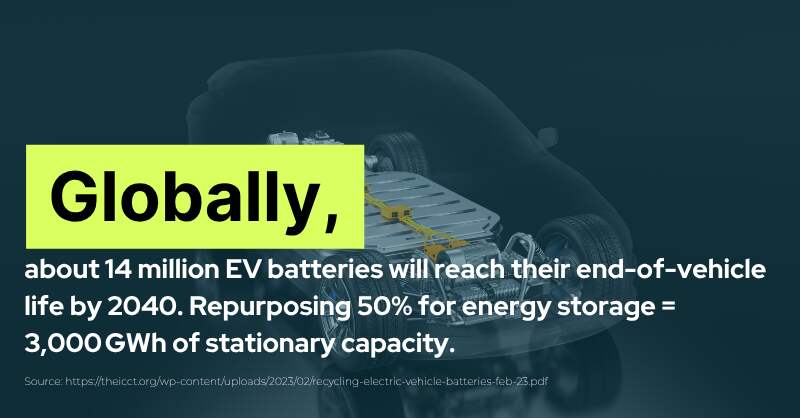
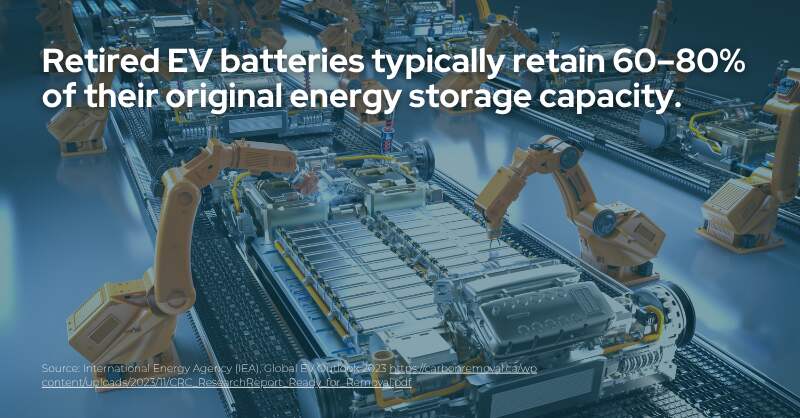
This challenge has incredible potential to be reframed as an opportunity. The batteries retiring from EV fleets, though no longer fit for vehicle applications, often retain substantial energy storage capacity; on average, these batteries can retain up to 80% of their state of health. By partnering with battery repurposing specialists, these batteries can be given a second life and deployed as battery energy storage at these depots.
“The batteries retiring from EV fleets, though no longer fit for vehicle applications, often retain substantial energy storage capacity; on average, these batteries can retain up to 80% of their state of health.”
This closed-loop approach offers compelling benefits:
- Enabling Efficient Charging & Reducing Energy Costs: An on-site BESS can significantly reduce electricity expenses by storing energy during off-peak hours (when rates are lower) and dispatching it for EV charging during peak times. This “peak shaving” mitigates high demand charges and can allow for more vehicles to be charged using existing grid infrastructure, potentially deferring or avoiding costly upgrades.
- Transforming Waste into Value: Instead of paying for storage or disposal, the fleet’s retired batteries become the foundation of an energy asset. This addresses the uncertainty around their monetary value by giving them a tangible, cost-saving second purpose that directly benefits operations. This makes a strong economic case, turning a potential write-off into a working asset.
- Addressing End-of-Life Battery Management: Partnering with a repurposing expert alleviates the burden on fleet operators to manage the “scrap tide.” These specialists can manage the assessment, repurposing, and safe deployment of batteries into BESS, effectively taking on the responsibility for their end-of-life management in a sustainable way.
“Instead of paying for storage or disposal, the fleet’s retired batteries become the foundation of an energy asset. This addresses the uncertainty around their monetary value by giving them a tangible, cost-saving second purpose that directly benefits operations.”
Beyond Charging: Versatile Applications of On-Site BESS
The advantages of deploying BESS built from EV fleets’ repurposed batteries extend beyond just optimizing EV charging. The modularity and versatility of these systems offer stackable applications that can further reduce operational costs and improve energy resilience at these facilities:
- Facility-Wide Demand Charge Reduction: The BESS can be used to manage peak electricity demand for the entire depot or facility, not just the EV chargers, leading to broader energy savings.
- Backup Power: In the event of a grid outage, the BESS can provide critical backup power, ensuring that fleet operations (like dispatch, basic charging, or IT systems) can continue, thereby minimizing downtime and disruption.
- Integration with On-Site Renewables: Facilities with plans to install, or in the process of integrating, renewable energy sources can utilize BESS to alleviate intermittency issues and store surplus generation for later use.
By leveraging these multi-functional capabilities, fleet operators can significantly enhance the return on their investment in BESS technology, viewing it not just as charging infrastructure but as a comprehensive energy management tool.
“In the event of a grid outage, the BESS can provide critical backup power, ensuring that fleet operations (like dispatch, basic charging, or IT systems) can continue, thereby minimizing downtime and disruption.”
The Path Forward for Canadian Fleet Operators
To capitalize on this opportunity, Canadian EV fleet operators can take a proactive step towards this:
- Evaluate Current Battery Management Practices: Understand the true costs and liabilities associated with current end-of-life battery strategies.
- Explore Repurposing Partnerships: Engage with specialists in battery repurposing (such as Moment Energy) to assess the feasibility of using the fleet’s retired batteries for on-site BESS projects.
- Conduct Depot Energy Assessments: Identify how BESS can best be deployed to reduce charging costs, manage overall facility demand, and improve energy resilience.
- Advocate for Supportive Policies: Join industry voices calling for clear regulations and incentives that support battery repurposing and circular economy initiatives within the fleet sector.
Empowering Canada’s Fleets for a Sustainable Future
The transition to electric fleets is a journey with immense potential for Canada. By strategically managing the entire lifecycle of EV batteries, fleet operators can overcome significant operational hurdles and unlock new efficiencies. Repurposing EV fleet’s batteries into on-site BESS is not just an environmentally responsible choice; it’s an economically astute strategy that tackles charging costs, mitigates end-of-life battery liabilities, and enhances energy resilience. This integrated approach empowers Canadian fleet operators to lead the charge towards a more sustainable, cost-effective, and circular transport ecosystem.
“Repurposing EV fleet’s batteries into on-site BESS is not just an environmentally responsible choice; it’s an economically astute strategy that tackles charging costs, mitigates end-of-life battery liabilities, and enhances energy resilience.”
About the Expert
-

Edward Chiang is the co‑founder and CEO of Moment Energy, a Canadian cleantech startup that repurposes retired EV batteries into clean, affordable grid-scale energy storage. A Forbes 30 Under 30 honoree, Edward Chiang leads Moment Energy’s expansion, including a U.S. Department of Energy–backed facility in Texas focused on scaling sustainable power solutions.
See more
-
 Why It’s Time for Small Fleets to Electrify—and How Information Makes All the Difference
 Adam Thorn
Program Director, Transportation Policy
Pembina Institute
Adam Thorn
Program Director, Transportation Policy
Pembina Institute
-
 Unlocking Mass EV Adoption: Why Home Charging is Canada’s Key Solution
 David Corbeil
Co-Founder and CEO
RVE
David Corbeil
Co-Founder and CEO
RVE
 Marie-Pier Corbeil
VP Operations and Co-Founder
RVE
Marie-Pier Corbeil
VP Operations and Co-Founder
RVE
-
 Vehicle-to-Grid Technology Will Boost EV Adoption
 Rob Safrata
CEO
Novex Delivery Solutions
Rob Safrata
CEO
Novex Delivery Solutions