
Closing the Women’s Health Gap: Why Canada Must Invest in Femtech Now
For decades, women have been underrepresented in clinical trials and health data. This has led to serious care gaps and digital tools trained on biased data.

Canada is leaving billions on the table every year because we continue to ignore the economic cost of the gender health gap.
Women’s health is still treated as a niche concern. But the consequences of this neglect are anything but small. Globally, gender-based health inequities contribute to a $1 trillion GDP gap, a figure that likely underestimates the true cost, according to McKinsey & Company. In Canada, the loss is estimated to be $37 billion (by 2040), much of it stemming from conditions that affect women during their prime working years. That’s not just bad policy, it’s a major missed opportunity.
A Critical Gap During Peak Career Years

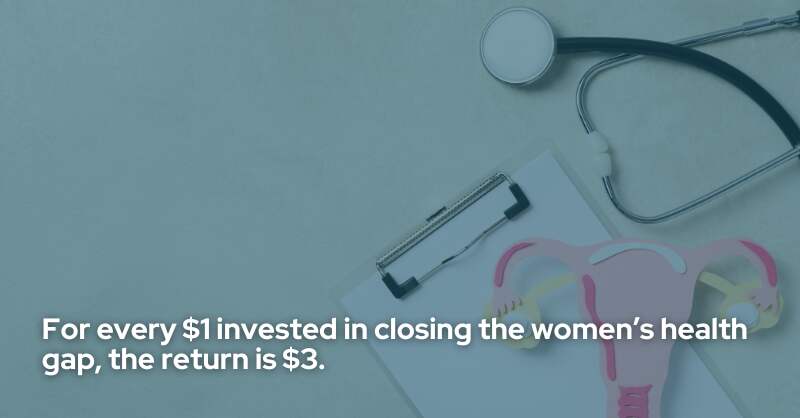
Women’s health investments cut healthcare costs, keep employees in the workforce, and grow the economy. For every $1 invested in closing the women’s health gap, the return is $3. That’s a high-impact investment and one that drives stronger productivity, healthier families, and long-term economic resilience.
Consider this: women with endometriosis lose an average of 10.8 hours of productivity per week, largely due to pain and presenteeism. Those with PCOS also face steep work-related challenges, with over 50% having missed work, 72% say their performance suffers, and more than half feel held back in their careers. These are not just health issues or a matter of fairness; it’s smart economics.
This gap hits hardest during women’s peak career years, undermining their ability to support themselves and their families. Closing it could generate an estimated $4.8 trillion in global economic gains, according to McKinsey’s global report. The market is there. The solutions are emerging. What’s missing is the will to act.
The Rise of Femtech
The femtech sector is already beginning to shift the equation. Femtech, short for female technology, is a fast-growing industry developing health solutions for women, girls, non-binary and trans people, and those assigned female at birth. It tackles everything from pelvic pain and polycystic ovary syndrome (PCOS) to cardiovascular and autoimmune conditions, many of which are misdiagnosed or misunderstood in women.
At a time when women’s health access is being rolled back in the United States, Canada has a real opportunity to lead. We’re already home to the third-largest number of women’s health-focused companies in the world. These innovators aren’t just solving Canadian problems; they’re building scalable, export-ready solutions. But without stronger investment and policy support, we risk falling behind.
A Growing Market With Canadian Strength
“Since 2022, Canada’s femtech sector has created over 1,200 jobs and filed 75 new patents, with far greater potential ahead.”
The business case is undeniable. The global women’s health market, which spans reproductive care, menopause, chronic disease management, and more, is projected to grow from US$43 billion in 2024 to over US$65 billion by 2031, according to Verified Market Research. Within that, the femtech sector alone is expected to exceed US$50 billion by 2025. Canadian companies are well-positioned to lead.
Toronto-based Future Fertility, for example, is using AI to bring greater accuracy and transparency to fertility care, helping patients and clinics make more informed decisions during the IVF process. The company is gaining strong traction and is currently fundraising to scale impact globally.
They’re not alone. Canada’s femtech ecosystem is full of ventures tackling critical gaps in women’s health.
Hyivy Health, based in Kitchener, Ontario, has developed a smart rehabilitation system to help the one in three women living with chronic pelvic conditions. Hamilton-based Afynia has created a non-invasive diagnostic tool for endometriosis, a significant improvement over the costly, invasive scans and surgeries many patients wait years to access. Calgary’s Neuraura has developed a wearable device to help relieve chronic pelvic pain, a common but often overlooked symptom of PCOS, one of the most prevalent women’s health issues.
These are just a few examples of groundbreaking Canadian innovation. Since 2022, Canada’s femtech sector has created over 1,200 jobs and filed 75 new patents, with far greater potential ahead. As a fast-growing segment of the broader women’s health market, the global femtech market is projected to exceed US$50 billion by 2025.
The Barriers Holding Canada Back
“In biotech, five mega deals accounted for 83% of all capital in 2024, a clear sign that investors are retreating from riskier, research-intensive science.”
But to lead globally, Canada must first address the barriers holding our innovators back.
For decades, women have been underrepresented in clinical trials and health data. This has led to serious care gaps and digital tools trained on biased data. While progress is underway, research and development in women’s health remains underfunded, and too many startups are starved of early-stage capital.
While global femtech investment has grown by 300% since 2018, Canadian founders still struggle to access the funding they need to scale. One bright spot is innovations with global potential, but its focus is on later-stage deals. What’s missing is sustained early-stage support.
And this is not just a femtech issue. Across health innovation, capital is drying up. According to the MaRS Vital Signs report and the CVCA data, early-stage investment in Canada has dropped significantly. In biotech, five mega deals accounted for 83% of all capital in 2024, a clear sign that investors are retreating from riskier, research-intensive science. Canada cannot afford to let its world-leading femtech ecosystem stall in the midst of this funding drought.
The Path Forward
To close the gap, governments and investors must act. A dedicated women’s health innovation fund would be a powerful first step. Last year, Femtech Canada called on the federal government to launch such a fund with a one-time $100 million investment, a modest sum with the potential for outsized returns. Private investors must also step up. Backing women-focused health solutions is not only responsible, but it’s also a smart, strategic investment in Canada’s economic future.
We’ve already demonstrated leadership in regenerative medicine and AI for drug discovery. If we apply the same ambition to women’s health, we can fuel the next wave of breakthroughs.
This isn’t a niche. It’s half the population, and the half that makes 80 per cent of household health decisions.
With the right investment, Canada can lead globally in women’s health innovation, strengthening our economy and building a healthier future for everyone.
We have the talent. We have the science. What we need is commitment.
About the Expert
-

Louise Pichette is Director Health Sciences at MaRS Discovery District. Her work focuses on advancing health innovation and supporting commercialization across Canada’s science and technology ecosystem.
See more
-
 Menopause Care in Canada: The Moment Must Become a Movement
 Viktoria Friedrich
Country President & General Manager, Pharmaceuticals
Bayer Canada
Viktoria Friedrich
Country President & General Manager, Pharmaceuticals
Bayer Canada
-
 Rethinking Menopause for the Health of Women and the Future of Our Economy
 Janet Ko
President and Co-Founder
Menopause Foundation of Canada
Janet Ko
President and Co-Founder
Menopause Foundation of Canada
-
 The Economic Impact of Menopause: How Sleep Disruption Affects Canada’s Workforce
 Michelle Jacobson
Co-Founder
Coven Women's Health
Michelle Jacobson
Co-Founder
Coven Women's Health