
Canadian Entrepreneurs Can Build Anything With the Right Start
Canada has the talent and ambition to build world-class companies, but without stronger systems for capital, mentorship, and early support, too many entrepreneurs struggle to turn ideas into lasting success.

Canada is a place where entrepreneurs can soar. Unlike many countries bogged down by stifling regulations, here, the government allows innovation to thrive.
Look at Shopify, Constellation Software, and Rogers Communications. These are just a few of many Canadian success stories, proving that with ambition, you can build the company of your dreams, all while proudly wearing the “Made in Canada” badge.
Make no mistake, though; entrepreneurship is not easy.
Being an entrepreneur is a journey filled with challenges.
“Toronto was named the most expensive city in Canada for international employees for the third consecutive year.”
The high cost of living in Canada’s major cities forces many aspiring founders to make tough choices. Toronto was named the most expensive city in Canada for international employees for the third consecutive year, according to Mercer’s 2024 Cost of Living City Ranking. Vancouver was ranked as the second most expensive city in Canada, and Montreal also saw a significant rise, moving up 17 spots to 118 from 135.
Entrepreneurs need to be well capitalized from day one, and for many families, that financial risk is daunting.
At the same time, consumers today have endless choices. Staying relevant means constantly evolving, differentiating, and delivering value.
Being a successful entrepreneur is a journey filled with motivation.
In Canada, ambition is all around us, and to succeed, founders need to tackle any hurdles they encounter with the relentless optimism our country is known best for.
Facing the Elephant in the Room
I would be remiss not to call out the elephant in the room, which is a major problem for both hopeful and experienced entrepreneurs. Trade tensions and tariffs with the US are casting a shadow on Canadian exports. For entrepreneurs shipping goods south of the border, tariffs of up to 35% are a real threat to competitiveness. Loyal customers may be forced to look elsewhere, and businesses will therefore face uncertainty.
Canada must respond decisively by negotiating fair trade agreements and offering support to businesses navigating this new reality.
Let’s Help Entrepreneurs Start Strong
Still, there is opportunity here at home. Canada is bursting with entrepreneurial talent, and we can do even better by putting stronger systems in place for those just starting out.
“Imagine a centralized, AI-powered platform where you enter your business details and instantly see what funding, subsidies, or programs you qualify for.”
1. Simplify Access to Capital and Resources
Capital is still one of the biggest challenges and warning signs stopping entrepreneurs in their tracks. Grants and subsidies exist, but information is scattered, confusing, and time-consuming to find. Entrepreneurs should not have to dig through countless websites and government portals just to understand what funding is available. Imagine a centralized, AI-powered platform where you enter your business details and instantly see what funding, subsidies, or programs you qualify for. That simple clarity and seamless access to customized information would empower more Canadians to take the leap.
2. Rethink Entrepreneurial Education
Entrepreneurship is not taught enough in formal education. What if universities offered a Bachelor’s degree in Entrepreneurship? Not just theory, but real-world training in finance, negotiation, marketing, branding, and PR; the full toolkit. A program that combines academic knowledge with mentorship would give new entrepreneurs a running start, reducing costly trial and error.
“Not every aspiring entrepreneur has access to experienced mentors or industry connections, and let’s face it, a solid network is now seen as currency in the world of start-ups and scale-ups.”
3. Build a National Mentorship Network
Not every aspiring entrepreneur has access to experienced mentors or industry connections, and let’s face it, a solid network is now seen as currency in the world of start-ups and scale-ups.
What if there were a national agency where established business leaders volunteered their time to mentor emerging entrepreneurs—a “Big Brother” program for business, matching entrepreneurs with seasoned leaders who provide honest feedback, guidance, and support. This network could open doors and accelerate growth for those who otherwise would not have access.
4. Create a Progressive Tax Strategy for Startups
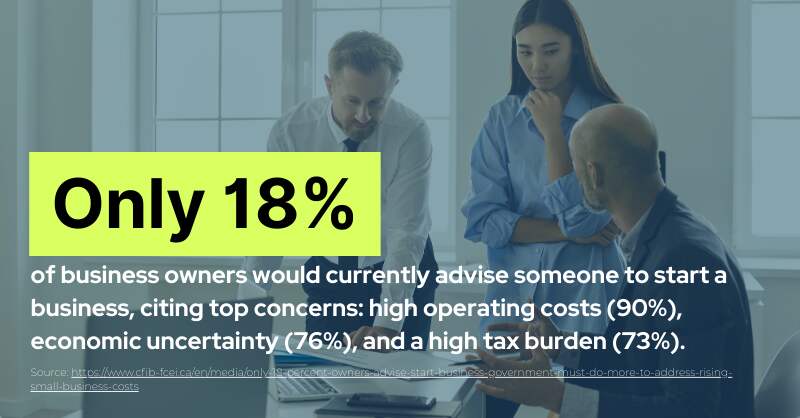
Cash flow is the lifeblood of early-stage businesses, and approaching that first tax season is not only daunting but also one filled with uncertainty of how much cash will need to be dedicated towards it. In fact, many potential founders have debated not starting their own business because of the fear of tax bills that would need to be paid. Even experienced entrepreneurs validate this concern. A survey from the Canadian Federation of Independent Business found that the high tax burden (73%) was among the top reasons business owners would advise against starting a business.
“A progressive tax system that offers generous breaks in the first two years could help entrepreneurs reinvest in growth when it matters most.”
Now, think about if entrepreneurs had a tax break in their first year, or even their first two years, to help with cash flow—a way for the government to show their support for Canadian business. A progressive tax system that offers generous breaks in the first two years could help entrepreneurs reinvest in growth when it matters most. Taxes could gradually increase as companies become profitable, balancing innovation incentives with fiscal responsibility. This approach would keep more capital working in Canadian businesses, fueling jobs and innovation.
5. Provide Free Advertising on Public Platforms
Publicly funded media should allocate free advertising space to early-stage Canadian businesses. Giving startups access to national audiences is not just a boost for entrepreneurs but an investment in our economy. It drives local business growth, encourages homegrown innovation, and promotes Canadian-made solutions to the world.
A Call for Canadians to Dream Big
Despite the many challenges that all entrepreneurs face, no matter where you live in Canada, the entrepreneurial spirit in the country is stronger than ever. We are a nation of innovators, builders, and dreamers. The success stories before us are proof that if you dream it, you can achieve it. Now it is time to move from inspiration to action.
My advice to fellow entrepreneurs is simple: go for it. You will never know what you are capable of unless you try. It will not be easy, but with persistence, the right support, and community, the possibilities are limitless.
To government leaders, prioritize creating a centralized hub for entrepreneurial resources, introduce tax policies that ease early burdens, and fund mentorship initiatives that level the playing field.
“My advice to fellow entrepreneurs is simple: go for it. You will never know what you are capable of unless you try. It will not be easy, but with persistence, the right support, and community, the possibilities are limitless.”
To established business leaders, give back by mentoring emerging entrepreneurs. Just five hours a month can create ripple effects that transform our economy.
Canada is already an incredible place to build a business. Let’s build the systems that ensure it stays that way and open the door to even greater success for generations to come.
About the Expert
-

Shael Weinreb is the CEO and Founder of The Home Equity Partners, a Canadian financial solutions company helping homeowners unlock their home equity without taking on additional debt or monthly payments. Prior to founding The Home Equity Partners, Shael more recently held executive roles with Republic Developments and Starlight Investments. He was the President and Chief Operating Officer at Freed Developments, where he helped manage and oversee various areas of the business, including corporate strategy, acquisitions, dispositions, leasing, sales, reporting, and marketing.
See more
-
 The Future is Founder-Led: Canada’s Path to Global Innovation
 Rachel Rodrigues
Program Director
EY Canada Entrepreneur Of The Year
Rachel Rodrigues
Program Director
EY Canada Entrepreneur Of The Year
-
 Think Like Owners: Why Canada Must Stop Giving Its Future Away
 Allen Lau
Co-Founder and Operating Partner
Two Small Fish Ventures
Allen Lau
Co-Founder and Operating Partner
Two Small Fish Ventures
 Praveen Varshney
Principal
Varshney Capital Corp.
Praveen Varshney
Principal
Varshney Capital Corp.
-
 Closing Canada’s Productivity Gap: Unlocking SME Potential Through Practical AI
 Cinzia Bazzo
Managing Director
Sage Canada
Cinzia Bazzo
Managing Director
Sage Canada