
Canada’s Space Future: How to Lead in the New Space Economy
Philip Ferguson argues that Canada must seize this pivotal moment to lead in the new space economy by investing in homegrown innovation, sustainable space practices, and equitable access for all Canadians.

On a clear California afternoon in 2013, the first-ever commercial launch of a SpaceX Falcon 9 rocket roared to life with the Canadian-made CASSIOPE spacecraft onboard. Since then, we have seen tremendous leaps and bounds when it comes to access to space.
While North America experienced a rather deflating lull in human access to space after the NASA Space Shuttle program ended in 2011, the commercial space industry was hard at work, developing what would become the most prolific access to space we have experienced in the history of the space industry. In 2025, we expect close to 300 rocket launches worldwide, enabling start-ups and seasoned space corporations to execute their visions with relative ease. Now, space commercialization is no longer limited by launch access, but rather space technology maturity and Canada must step up if we want to remain competitive.
A Brief History of Canada in Space

In 1959, three years before Canada’s first satellite was launched, Canada put hardware into space on the first Black Brant sounding rocket out of Churchill, Manitoba. That first launch by Bristol Aerospace from Winnipeg (now Magellan Aerospace) studied the characteristics of Earth’s atmosphere and set the stage for more than 1000 Black Brant sounding rockets (and counting) today.
After Canada’s first orbital spacecraft, Alouette-1, was launched in 1962, Canada quickly became a leader in satellite technology. Perhaps the most notable early successes came from Telesat Canada and the Anik series of communications satellites. However, Canada also made waves in the international space industry with the world-leading Radarsat series of spacecraft, providing unprecedented radar images of the globe at stunning resolutions, particularly with today’s modern Radarsat Constellation Mission, launched in 2019.
“After Canada’s first orbital spacecraft, Alouette-1, was launched in 1962, Canada quickly became a leader in satellite technology.”
While Canada had become known for satellite communications and remote sensing, it wasn’t until the 1970s that Canadian space technology became known in households around the world. Back in the 1970s, NASA tapped Canada for a pivotal role. NASA needed a robot arm for its new Space Transportation System (later named the venerable Space Shuttle), and Canadian company Spar Aerospace—becoming MacDonald Dettwiler and Associates in the late 1990s—keenly took on the challenge. The Canadarm, as it came to be known, was a crowning achievement for Canada in space, with its strategically placed Canadian flag meaning most photographs astronauts took out the back of the Space Shuttle featured the maple leaf emblazoned arm in the foreground.
Since the early success of the Canadarm, Canadian space robotics has continued to dominate space headlines on the International Space Station with Canadarm2, the Mobile Base System, and the two-armed Dextre handling the lion’s share of space station assembly and maintenance. Today, the space station robotics operate almost entirely independently of the resident astronaut crews, thanks to innovative ground control technologies, designed and operated by Canadians.
“The Canadarm, as it came to be known, was a crowning achievement for Canada in space, with its strategically placed Canadian flag meaning most photographs astronauts took out the back of the Space Shuttle featured the maple leaf emblazoned arm in the foreground.”
Despite Canada’s tremendous success in sounding rockets, satellites, and space robots, the new space economy is upon us, and Canada must continue to innovate and lead to stay relevant.
Space-Based Constellations for Broadband
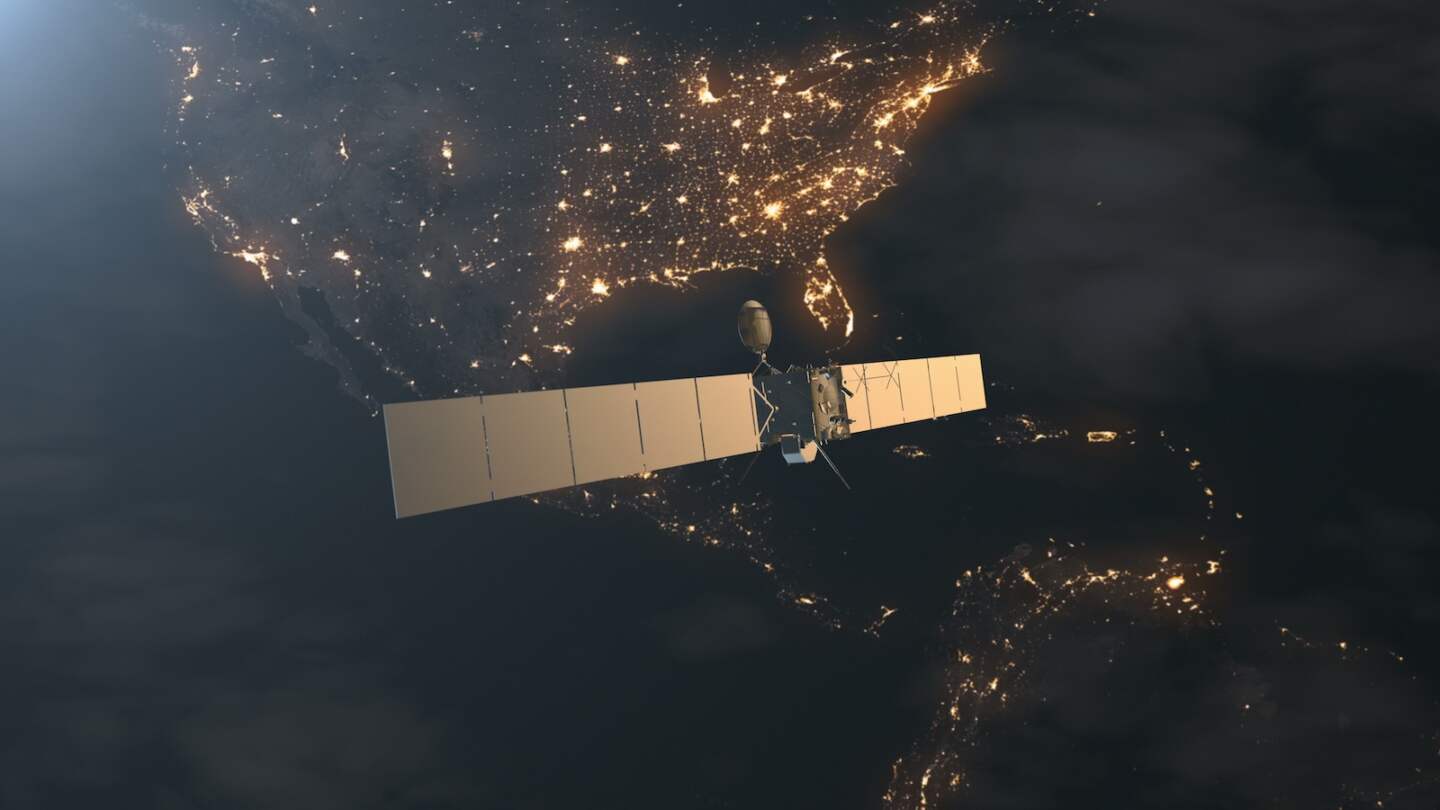
Mega-constellations of spacecraft have become an enabling technology for remote customers seeking high-speed internet. Both Starlink and OneWeb currently offer near-global access to broadband internet, with varying degrees of geographic equity. Starlink’s focus has been on customers living at or below approximately 53 degrees latitude, with satellites in altitudes ranging from 500 km to 600 km. This relatively low altitude compared to OneWeb’s altitude of 1,200 km provides extremely low latency (internet response time), but at the cost of many, many more spacecraft.
Starlink’s sparse coverage in Canada’s Arctic regions and the raging trade war Canada is currently experiencing with the United States make it imperative that Canada develop made-in-Canada solutions for broadband access. Data security and data sovereignty have never been more important for Canadians than it is today. Canada’s historic leadership in satellite communications systems makes us an ideal candidate to provide solutions by Canadians, for Canadians.
“Starlink’s sparse coverage in Canada’s Arctic regions and the raging trade war Canada is currently experiencing with the United States make it imperative that Canada develop made-in-Canada solutions for broadband access.”
Indeed, Telesat Canada has been working on their Lightspeed constellation of approximately 200 spacecraft that will serve the entire world and ALL of Canada. Leveraging MDA’s spacecraft bus technology, these spacecraft will operate at altitudes of approximately 1,400 km and be capable of providing broadband internet to Canadians living anywhere in Canada, including communities in the Arctic.
While the Canadian government has invested heavily in Telesat’s constellation, we need more of this. A single broadband internet constellation is not enough to support the growing data needs for Canada, and competition is a good thing for consumers. Canada must continue to improve satellite communication services for Canadians on Earth and Canadian assets in space. This includes satellite-to-satellite networks, such as what Kepler Communications is rolling out now for space data services, and the kinds of satellite ground station connectivity that organizations like C-CORE and Eagle Flight Network are providing for communities. But these commercial endeavours need government investment to be successful, particularly in the face of intensifying international competition.
Dealing with Space Junk
SpaceX’s Starlink constellation has more than 7,000 active spacecraft in it now, with plans to expand to more than 12,000 or even 34,000 pending regulatory approval. While this may seem like a lot of satellites (and it is), it is only one of the many existing and planned spacecraft constellations that are expected to launch in the coming years. The exponential growth in satellite traffic is driving an international effort to prevent orbital collisions and keep space clean from “space junk”. Canada can and should play a prominent role in these efforts to be good space stewards.
The problem with orbital collisions is twofold. Firstly, given the tremendous relative speeds of objects in space (often well over 10 km/second), even small particles such as fasteners or even paint chips can cause catastrophic damage if they impact another spacecraft. Secondly, if or when collisions do happen, they result in large clouds of fragments that then represent thousands of new pieces of debris, each potentially lasting tens or hundreds of years in space, depending on their orbit. A scenario where a cascading sequence of collisions between spacecraft and debris clouds is known as “Kesler Syndrome”, which can occur if the population density of spacecraft in a certain orbit becomes too high. After Kesler Syndrome takes effect, entire orbit corridors would be rendered useless for decades or even centuries. Some postulate that the spacecraft population density we are approaching now could support a Kesler Syndrome style cascade event, so the international space community must take action.
“The exponential growth in satellite traffic is driving an international effort to prevent orbital collisions and keep space clean from “space junk”. Canada can and should play a prominent role in these efforts to be good space stewards.”
In 2018, and under the direction of Canadian Dr. David Kendall, the United Nations Committee On the Peaceful Use of Outer Space (UNCOPUOS) put out international recommendations that all spacecraft in low Earth orbit remove themselves from orbit (deorbit) within 25 years after the end of their mission. While not easily enforceable on the international stage, this set an important bar and forced countries to consider the space debris they leave behind after a mission. However, the spacecraft orbital population today is several times larger than it was in 2018, prompting more restrictive action. In 2022, the Federal Communications Commission (FCC) in the United States enacted new rules that forced American spacecraft to deorbit within five years of a mission ending. Even though the legality of this rule is being challenged in American courts now, the international community largely agrees that five years is much more sustainable than the 25 years proposed in 2018.
“Without more investment in new technologies to deorbit CubeSats, a five-year deorbit requirement will only serve to stifle the CubeSat market in Canada.”
In 2025, Canada’s Ministry of Industry, Science, and Economic Development (ISED) proposed a similar five-year deorbit rule for Canadian spacecraft, seeking input from the space community. There is no doubt that a five-year deorbit rule will substantially slow the proliferation of space debris to a sustainable level. However, many Canadian companies and universities are relying on small nanosatellites or “CubeSats” (a spacecraft approximately the size of a carton of milk or a shoebox) for scientific research, remote sensing, and communications relay, and these deorbit regulations put stringent limits on orbital altitudes. These limits can only be extended using complex and expensive thrusters or drag sails that many missions cannot afford from a mass, volume, power, or cost perspective. Without more investment in new technologies to deorbit CubeSats, a five-year deorbit requirement will only serve to stifle the CubeSat market in Canada. It would be like instituting a law today that mandated all food packaging breakdown completely within five years of burial in a landfill site. Legislation like this would certainly reduce the environmental impact of waste management systems in Canada, but today’s packaging industry does not yet have the appropriate technology to make this a reality.
Canada can set an example as a good space steward by leading and funding the development of innovative deorbit technologies that enable CubeSats to comply with five-year (and shorter) deorbit rules. New space regulations must be accompanied by commensurate investment in technologies. The Canadian Space Agency’s “Space Technology Development Program” has shown promise in the past for innovative space technologies and could be repurposed for national investments into de-orbit technologies specific to CubeSats.
Spectrum Management
All spacecraft need to communicate with Earth in order to be useful. This communication enables control of the satellite (uplink) and provides data from the satellite (downlink). This wireless communication leverages waves in the electromagnetic spectrum, ranging from extremely low frequency signals all the way up to the visual light frequencies, X-rays, and gamma rays. Generally, the higher the frequency, the more data that can be pushed through the communications link. The most common part of the electromagnetic spectrum used for spacecraft communications is the frequencies which are high enough to prevent the ionosphere from blocking them, but low enough such that clouds, rain, and atmospheric gases do not completely attenuate the signal. Practically speaking, these frequencies range from about 30 MHz to 300 GHz. Much like property on Earth, nobody is making any more electromagnetic spectrum, so spacecraft operators must vie for and often compete for a small sliver of useful spectrum to communicate with their spacecraft. Naturally, as the number of spacecraft increases, this competition for spectrum is getting fiercer and fiercer.
Complicating this spectrum congestion are the land-based cellular networks, which continue to expand their spectral footprint. Recent court cases between satellite operators and cellular carriers have highlighted the overlap we are starting to see between terrestrial and orbital spectrum allocation, and thus, even more competition for this limited resource.
“Canada must take a strong leadership role in spectrum allocation that protects blocks of useful space-to-ground, ground-to-space, and space-to-space frequencies for innovative Canadian research and development.”
As with most competitions, those with the most money to dedicate to their cause tend to rise to the top. Unfortunately, this means that spectrum allocations are increasingly going to the highest bidder, which leaves small and innovative start-ups and cutting-edge research organizations out of luck (precisely the organizations that we want to enable if Canada is to succeed in the new space economy).
Canada must take a strong leadership role in spectrum allocation that protects blocks of useful space-to-ground, ground-to-space, and space-to-space frequencies for innovative Canadian research and development. Currently, ISED acts as Canada’s gatekeeper when it comes to spectrum licensing both on the ground and in space. By working closely with universities, start-ups, and the Canadian Space Agency, blocks of spectrum over Canada can and should be reserved for developmental spacecraft and space devices. Such a system would encourage innovation while reducing or eliminating the financial and sometimes technical barriers of obtaining a frequency license for use in space.
Making Space Technology Accessible
For decades in Canada and around the world, access to space has been limited to wealthy governments and companies with the means to fund space missions costing tens to hundreds of millions of dollars. While certainly impactful, these missions have not served many of the communities in Canada that stand to benefit the most from space-based communications and remote sensing.
“Climate change has also made travel on the sea ice and tundra unpredictable, and at times, dangerous. Better communications systems are needed for lost, stranded, or injured community members.”
Some of the most isolated communities in the world reside in Canada’s Arctic region. There is only limited access to satellite communications, a strong reliance on the land and sea for food and transportation, and a climate that is changing nearly four times faster than the rest of the planet, and that means northern communities in Canada face severe inequity when compared to southern cities. Furthermore, climate change is extending the ice-free season in Hudson’s Bay and the Northwest Passages, enabling increased marine shipping through these regions and altering wildlife migration patterns, making hunting and trapping for community sustenance difficult. Climate change has also made travel on the sea ice and tundra unpredictable, and at times, dangerous. Better communications systems are needed for lost, stranded, or injured community members.
As a leader in space technology, Canada should be able to provide space services to northern communities, but as of today, these services are lacking. Northern communities deserve access to and sovereign ownership of space-based remote sensing data taken from their own communities and the land and sea that surrounds them. Northern communities deserve dedicated and secure broadband internet service. Northern communities deserve knowledge of when marine traffic will pass through their communities, where the traffic is from, how long they will stay, and how to respond to environmental emergencies if spills were to occur.
Canada already has the capability to collect and distribute much of this data. Canada’s three Radarsat Constellation Mission spacecraft collect high-resolution radar imagery of the Arctic several times per week, which can provide ice and snow cover information. Those same spacecraft, along with other Canadian spacecraft, collect ship traffic information daily. Telesat Canada is developing the Lightspeed network, which promises to connect all of Canada with broadband internet service. What’s missing today are the networks, the pathways, the distribution systems, and most importantly, the ownership agreements to get this data into the hands of the communities that need it. Canada must stand up for these isolated communities and provide them with the space-based services that the rest of Canada takes for granted today.
The Future of Canada’s Space Economy
Canada’s humble yet impactful history in space speaks for itself in terms of sounding rockets, space robots, and satellites. The unprecedented access to space provided by commercial launch operators today has opened a golden opportunity for Canada to step up and support Canadians and Canadian-made space technology.
The new space economy that we face today will require investment in space networking constellations, technology to minimize space junk, electromagnetic spectrum to enable innovation and development, and technologies that target equity-seeking northern communities. We are a country of hard-working and proud citizens who pride ourselves on our ability to support each other in times of need. The time is now for Canada to invest in forward-looking space technology that strengthens our independence and sovereignty while simultaneously making space a sustainable place for research, development, innovation, and commercialization by Canadians, for Canadians.
-
 Why Canada Must Build Sovereign Launch Capability to Lead the Space Economy
 Melissa Quinn
VP, Spaceport Operations
MDA Space & Maritime Launch
Melissa Quinn
VP, Spaceport Operations
MDA Space & Maritime Launch
-
 The Next Big Thing: The Moon and Canada
 Alex Ellery
Professor of Mechanical and Aerospace Engineering
Carleton University
Alex Ellery
Professor of Mechanical and Aerospace Engineering
Carleton University
-
 Science and Governance: Dual Opportunities for Canadian Leadership in Space
 Dr. Sarah Gallagher
Director of the Institute for Earth and Space Exploration
Western University
Dr. Sarah Gallagher
Director of the Institute for Earth and Space Exploration
Western University
 Dr. Valerie Oosterveld
Professor and Western Research Chair at the Faculty of Law
Western University
Dr. Valerie Oosterveld
Professor and Western Research Chair at the Faculty of Law
Western University
 Dr. Pauline Barmby
Professor and Chair of Physics & Astronomy
Western University
Dr. Pauline Barmby
Professor and Chair of Physics & Astronomy
Western University