
Canada’s Innovation Moment Is Now. Here’s How We Lead It
Canada may lead the world in AI talent, but without stronger commercialization pathways and IP retention, the country risks losing the economic benefits of its own innovations.

Canada’s future prosperity depends on how we answer a pressing question: Can we turn our innovation potential into economic power, at speed and at scale?
The answer must be yes. But only if we move faster, align smarter, and invest in the full journey of innovation, from world-class research to commercialization, adoption, and export.
We are at a pivotal moment. Across sectors like life sciences, advanced manufacturing, artificial intelligence, quantum computing and clean technology, the world is undergoing seismic shifts. These are not future challenges; they are today’s economic battlegrounds. And while Ontario has the talent, creativity, and research strength to compete, we still face systemic gaps in commercial readiness, early-stage financing, and market deployment.
We must confront this gap head-on.
“Progress doesn’t always translate to outcomes. Too often, we see promising startups struggle to cross the space between early-stage discovery and market traction.”
Where We Are Now
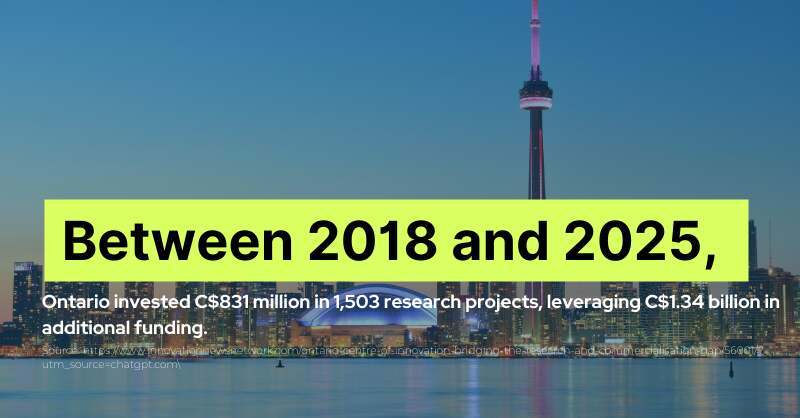
Canada has made meaningful progress in building innovation capacity. But progress doesn’t always translate to outcomes. Too often, we see promising startups struggle to cross the space between early-stage discovery and market traction.
At the Ontario Centre of Innovation (OCI), we work directly with innovators navigating this terrain. Our experience shows that targeted, early-stage support, especially when it’s responsive to sector needs and paired with real-world testing, is essential to helping companies succeed.
Take Juniper Genomics, a homegrown company transforming fertility care by integrating modern genomics and data science to support individuals and couples trying to conceive. Using a proprietary approach that combines cutting-edge whole genome sequencing, advanced bioinformatics, and comprehensive data analysis, Juniper aims to improve the likelihood of success with the first embryo transfer. With support from Ontario’s Life Sciences Innovation Fund (LSIF), Juniper is successfully bridging the gap between the research lab and the marketplace.
Or consider Visual Defence, an artificial intelligence company helping municipalities modernize infrastructure management. Visual Defence has developed a computer vision system that uses cameras mounted on transit vehicles to automatically detect potholes. Supported through Ontario’s Digitalization Competence Centre (DCC), Visual Defence is moving from successful pilots to broader deployment, helping cities modernize infrastructure inspection while reducing costs and improving safety.
And in advanced manufacturing, NordSpace is using AI-powered design tools and large-scale additive manufacturing to build next-generation propulsion systems. With support through Ontario’s Critical Industrial Technologies (CIT) initiative, NordSpace is commercializing the Hadfield rocket engine, an innovation with the potential to boost Canada’s space launch capabilities and help secure the country’s position in the global space economy.
What’s at Stake
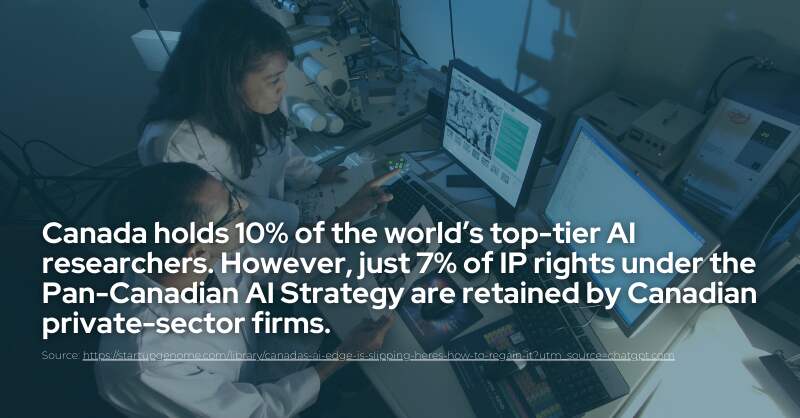
These companies and hundreds like them across Ontario show what’s possible when early-stage innovators have access to capital, connections, and customers. But we need to do more.
“The US, Europe, and Asia are deploying billion-dollar innovation strategies, placing big bets on domestic tech and talent. Canada cannot afford to be cautious in a moment that demands urgency.”
Other countries and regions are moving swiftly to dominate critical sectors. The US, Europe, and Asia are deploying billion-dollar innovation strategies, placing big bets on domestic tech and talent. Canada cannot afford to be cautious in a moment that demands urgency.
If we want to lead, we must create the conditions for innovators to scale from idea to impact without leaving the country or the sector.
Here’s what Canada and Ontario must do now:
1. Scale what works.
Programs like LSIF, CIT, and DCC are delivering real results: attracting private capital, creating high-quality jobs, and helping companies take Ontario-made innovations to global markets. We need to double down on these models, ensuring they’re sustained and scaled across more sectors and communities.
“Ontario’s strength in research is well-known, but we must continue to invest in the infrastructure that connects that research to the real-world demonstration spaces.”
2. Bridge the commercialization gap.
Ontario’s strength in research is well-known, but we must continue to invest in the infrastructure that connects that research to the real-world demonstration spaces, pilot funding, and industry-embedded collaborations that help innovators build, test, and scale faster.
3. Leverage Ontario’s unique advantages.
Ontario has all the ingredients to lead the next era of global innovation: a government that is deeply committed to supporting commercialization and economic growth; world-class colleges, universities, and research hospitals that generate cutting-edge discoveries; and a growing pipeline of ambitious, diverse entrepreneurs ready to scale. What we need now is continued collaboration between public and private sectors, across regions and industries, to turn this potential into global leadership.
Our Window Is Now
Ontario is showing the world what’s possible when bold ideas meet bold investment. Innovation is not a moment; it’s a movement. And if we act with urgency, clarity, and commitment, Ontario won’t just participate in the global innovation economy; we’ll help define it.
At OCI, we are proud to support the companies and people driving this transformation. The opportunity is ours to seize, and the time is now.
About the Expert
-

Claudia Krywiak is the President and CEO at the Ontario Centre of Innovation (OCI), a not-for-profit organization that accelerates the development, commercialization, and adoption of new technologies. Previously, Claudia was the Vice President of Business Development at Mitacs, a national research organization that funds research and training programs. Her career began at Bruker Corporation, enabling scientists to make breakthrough discoveries. She holds a Ph.D. in Chemistry from the University of Toronto. Claudia serves on the Boards of Directors for the Conference Board of Canada and Waterloo’s Accelerator Centre.
See more
-
 Wicked Problems, Wicked Solutions: How to Tackle Canada’s Toughest Challenges
 Chad Park
VP, Sustainability & Citizenship
Co-operators
Chad Park
VP, Sustainability & Citizenship
Co-operators
 Tima Bansal
Founder & Lab Leader
Innovation North
Tima Bansal
Founder & Lab Leader
Innovation North
 David Hughes
President & CEO
Generate Canada
David Hughes
President & CEO
Generate Canada
-
 From Necessity Springs Innovation: Now’s the Time to Reimagine “Prosperity for all Canadians”
 Sasha Krstic
President
Mastercard Canada
Sasha Krstic
President
Mastercard Canada
-
 Building the Future of Insurance in Canada Through Innovation
 Laviva Mazhar
Principal
Luge Capital
Laviva Mazhar
Principal
Luge Capital