
Canada’s Defence Procurement Strategy Must Build More Than Military Capability
As foreign defense giants line up to claim a piece of Canada’s historic military budget, a critical question remains: are we buying our security, or are we building our future?

The ink is barely dry on Canada’s Defence Procurement Strategy, and already, foreign defence giants are lining up to secure a share of Canada’s expanding military budget.
This is a good thing. For the first time in decades, Canada is not the one knocking on doors. Korea is pitching submarines. Sweden is pitching fighter jets. A European consortium is pitching naval systems.
But for Canada’s defence procurement to be successful, the real question is not simply who we will buy from or what items we are buying. It is: What we are going to build here at home, no matter which international partners we take on?
Defence Procurement Should Be an Industrial Strategy

Restructuring the way we buy and maintain our military equipment is a great opportunity to vault Canada’s economy forward. But we have to get it right. If this moment becomes just a search for the best price or the most politically convenient regional job package, we will have missed one of the largest industrial policy opportunities in a generation.
“This is a once-in-a-generation opportunity for us to anchor sovereign capability in Canadian companies, rather than repeating the branch plant model in a new uniform.”
We need to recognize that this is not only about getting shiny new submarines and jets (although that’s crucial too). This is a once-in-a-generation opportunity for us to anchor sovereign capability in Canadian companies, rather than repeating the branch plant model in a new uniform.
Canada Defence Procurement Must Balance Global Partnerships and Sovereignty
We need to be realistic about this opportunity, though. Canada cannot build advanced fighter jets and nuclear submarines alone. Rebuilding a full spectrum of defence manufacturing domestically would take decades, cost multiples of current budgets and risk antagonizing partners and allies who can help us achieve the economic upsides of updating our military.
But if foreign firms control too much of the process, then Canada is not building sovereignty. If foreigners control the platform, the system architecture, the software stack, the maintenance contracts and the upgrade cycles, we are merely leasing our destiny.
“Bringing good jobs to Canadians through defence contracting matters. But control matters more.”
Canada’s Tech Ecosystem and Defence
Modern defence is increasingly software-defined. The real economic leverage sits in artificial intelligence systems, secure communications, cybersecurity architecture, predictive maintenance software, sensor fusion, autonomous navigation and satellite integration.
These are tech areas where Canada already has strength. We don’t have home-grown massive defence conglomerates, but we do have great growth-stage technology firms. Our scale-ups have huge potential.
The Economic Metrics of Canada’s Defence Procurement Strategy
“Instead of asking which bidder promises more jobs, Ottawa should apply a simple Defence Dollar Test.”
It’s a mistake to frame the debate about growing our defence sector as a choice between foreign firms versus Canadian firms. The right way is to determine what generates the highest long-term return for every defence dollar.
Using traditional economic impact models to measure success will fall short, too. They measure near-term jobs and GDP, but they rarely account for intellectual property ownership, export growth, upgrade cycles or profit retention, which are the factors that determine whether value compounds in Canada or leaks away over time.
So instead of asking which bidder promises more jobs, Ottawa should apply a simple Defence Dollar Test.
- How much domestic value added remains beyond assembly?
- Who owns the intellectual property 10 years from now?
- Does the investment create exportable capability for Canadian firms?
- Who captures the upgrade and maintenance revenue over the life cycle?
- Are Canadian suppliers building their own products or simply providing labour?
- Does this spending create a talent flywheel that produces future founders and leaders?
A branch plant model can score well on jobs and short-term GDP, but research by innovation scholars such as Dan Breznitz and David Wolfe shows that economies like Canada’s often struggle to retain the intellectual property and strategic control that underpin long-term prosperity.
A Canadian scale-up may start smaller. But if defence procurement embeds Canadian-owned AI, cybersecurity systems or sensor technologies into global platforms, the value compounds. Headquarters stay here. Profits are reinvested. Export markets open. Talent circulates. New firms emerge.
That is how economies build power.
Canada Defence Procurement Strategy and the Fight for Technological Sovereignty
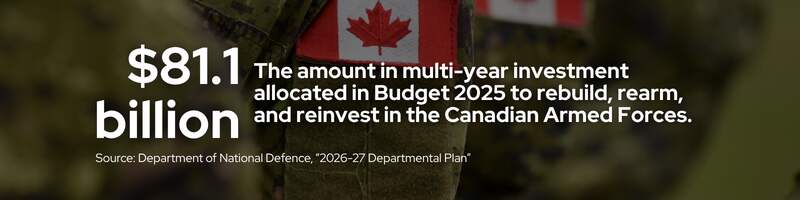
Geopolitical circumstances have given us a once-in-a-generation industrial moment. If we are about to spend tens of billions over the next decade, that money should do more than simply purchase equipment and hope for a few spin-off jobs. It’s time for us to take real control of our own technological sovereignty.
About the Expert
-

Adam Froman is the founder and CEO of Delvinia, and an award-winning entrepreneur and innovator. He was formerly on the Board of Directors for the Council of Canadian Innovators, a business council exclusively focused on helping high-growth Canadian technology firms scale up globally.
Delvinia is a Canadian artificial intelligence and emerging technology company that develops AI-powered solutions for enterprise, government, and industry clients. The company focuses on helping organizations adopt advanced technologies through strategy, implementation, automation, and digital transformation initiatives.
See more
-
 Why the Road to the Boardroom Starts in Girlhood
 Jennifer Flanagan
Co-Founder and CEO
Actua
Jennifer Flanagan
Co-Founder and CEO
Actua
-
 Canada’s Future Is Airborne—Let’s Build It to Last
 Tracy Medve
President & CEO
KF Aerospace
Tracy Medve
President & CEO
KF Aerospace
-
 Low-Code/No-code to Address Canadian Tech Staff Gaps
 Randy Whitcroft
Regional Vice-President Federal & Canada East
Oracle Canada
Randy Whitcroft
Regional Vice-President Federal & Canada East
Oracle Canada