
Canada’s at a Hinge Point in Energy: How to Turn This Moment Into Momentum
Canada stands at a hinge point in energy, where the challenge is not just building projects quickly but earning public trust, respecting Indigenous rights, and aligning policy to turn urgency into lasting momentum.

Canada is at a historic moment in energy. The ongoing trade threats from the United States cast a bright light on the need to diversify Canada’s energy trade and strengthen domestic energy security. Volatile geopolitics are driving global energy security concerns and opening up new opportunities for Canadian energy exports beyond North America. Here at home, the need to boost Canada’s flagging economy and lagging productivity likewise create opportunities for growth from the energy sector.
Against this backdrop, first ministers are meeting regularly about trade diversification, and governments are travelling abroad to promote energy exports to Asian and European markets.
It’s a heady time. Rarely have we seen this level of alignment between governments. It holds the potential to build a stronger, more resilient energy system and economy in a world of increasing volatility and disruption.
Will this potential be realized?
Much depends on Canada’s ability to get energy infrastructure built – the pipelines, transmission lines and export facilities to carry energy within and beyond Canada.
Governments are seized with getting projects built. Many have pushed forward legislation to expedite projects, the federal government has created a Major Projects Office and Prime Minister Carney has released the first set of nation-building projects to receive priority attention for approval.
Will this be enough for Canada to turn this moment into momentum?
Maybe.
Much will depend on execution. Governments are saying many of the right things, but Canada struggles mightily to translate lofty goals into concrete results.
Getting Major Projects Built is About More Than Just Speed
Reorienting energy flows, building big energy projects and forging new market relationships doesn’t happen overnight. It’s crucial that governments don’t let rushing stand in the way of success. Public and investor confidence in energy project approvals is about more than just how fast decisions are taken.
“It’s also about how decisions are taken. Is there opportunity for public input? Have Indigenous rights been respected? Have environmental impacts of projects been scrutinized?”
For the public, it’s also about how decisions are taken. Is there opportunity for public input? Have Indigenous rights been respected? Have environmental impacts of projects been scrutinized?
For investors, it’s also about clarity and predictability of current and future policy and regulatory frameworks. Government expectations for project approvals need to be clear. Policy frameworks need to be stable and incentivize capital deployment.
Moving forward, governments will need to keep laser-focused on five imperatives.
Indigenous Inclusion
Relationships between project proponents and Indigenous communities have transformed in recent years. Indigenous nations are increasingly taking equity stakes in projects, leading projects of their own, undertaking Indigenous-led impact assessments and leading project monitoring.
Canada has learned much over the last decade, but we’re at risk of throwing it away if governments and proponents don’t take the time to build trusted relationships. Time invested at the front end of developing projects and policies is time well spent. It can make the difference between a project or policy ending up in operation or ending up in court.
“Hopefully, there is still time for governments to course correct and make sure that efforts to fast-track don’t become measures that “back-track” on the positive progress made on Indigenous participation in energy projects.”
We’re already seeing the downsides of rushing, notably the opposition from some Indigenous peoples, nations and organizations to so-called “fast-track” legislation by federal and provincial governments. Hopefully, there is still time for governments to course correct and make sure that efforts to fast-track don’t become measures that “back-track” on the positive progress made on Indigenous participation in energy projects.
Keeping the Canadian Public on Energy’s Side
There is strong support from Canadians to use the country’s resources to strengthen domestic and international energy security.
When asked what the priority should be when it comes to building new pipelines, Canadians are most likely to say they want new pipeline projects to both strengthen domestic energy security and to help diversify the country’s energy exports (55%). About one in five Canadians thinks the priority should just be on strengthening domestic energy security (19%), while one in ten thinks the priority should just be on export diversification (10%). Remarkably, only 14% say they don’t support new pipelines.
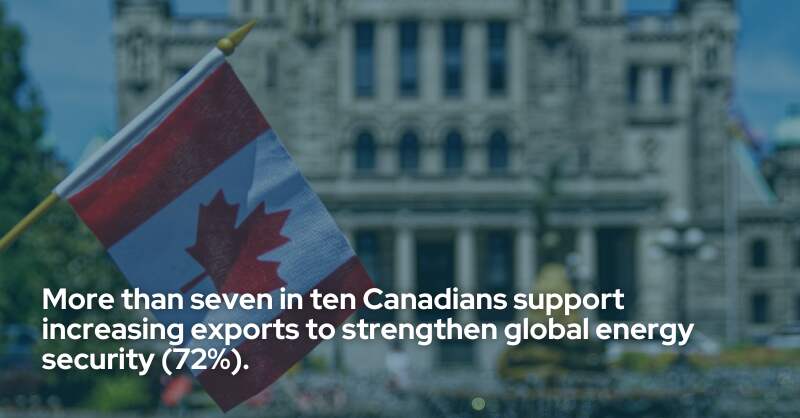
Similarly, support for increasing oil and gas exports to help the world have more secure energy supplies has climbed. More than seven in ten Canadians support increasing exports to strengthen global energy security (72%), up 14 percentage points since 2022 after Russia invaded Ukraine.
“Canadians support energy projects and exports to strengthen domestic and global energy security, but they aren’t writing governments and proponents a blank cheque.”
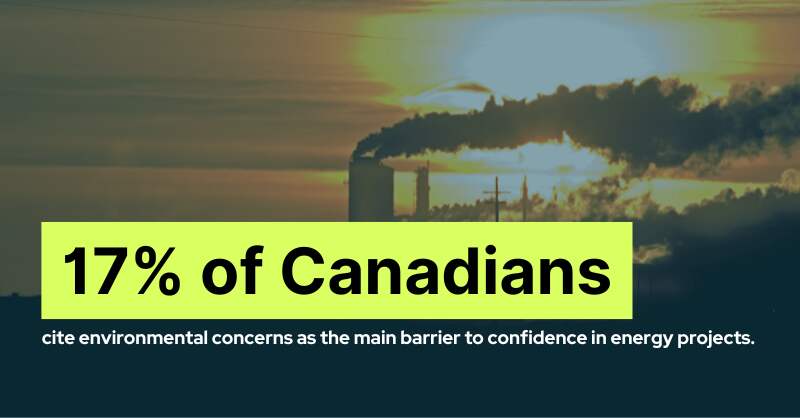
But Canadians are aware of the challenges of getting projects built. When asked what the biggest challenge is to developing energy projects in a way that Canadians can have confidence in, the top responses were environmental concerns and sustainability (17%), balancing conflicting interests (16%), misinformation and lack of public understanding (15%) and obtaining buy in from advocacy groups, Indigenous communities and local communities (10%).
Canadians support energy projects and exports to strengthen domestic and global energy security, but they aren’t writing governments and proponents a blank cheque. They care about the environment and doing right by communities. The path forward cannot ignore either. Governments need to get the balance right.
Informed Reform of Regulatory Approvals
Government attention to improving regulatory systems for project approvals is encouraging, but reforms like the federal government’s One Canadian Economy Act (Bill C-5) to fast-track projects may have made the regulatory system less clear and predictable.
Under C-5, the prime minister, cabinet and individual ministers have much larger roles in project approvals. This politicizes decisions, making the process less predictable and clear – and less likely to garner the confidence of investors and the public.
“Under C-5, the prime minister, cabinet and individual ministers have much larger roles in project approvals. This politicizes decisions, making the process less predictable and clear.”
There are now two classes of projects – those that get “first class” service and those that don’t. The latter are stuck in the existing regulatory system, which has long been critiqued by investors. If governments can fix the regulatory system for some projects, why not do it for all of them?
What’s worse, the “need for speed” has already drawn critique from the public and Indigenous organizations, who worry about weakening environmental protections and a lack of respect for Indigenous rights.
“Governments at all levels need to do a better job of aligning their respective and collective policy frameworks with the overarching objective of diversifying energy trade.”
Aligning Policies With the Goal of Getting Projects Built
It will take more than regulatory reform to get projects built. Lack of clarity and future policy uncertainty over measures like industrial carbon pricing and investment tax credits challenge the calculation of project economics for companies. And policies like the oil and gas emissions cap, the west coast oil tanker ban and some aspects of the clean electricity regulations run counter to the goal of getting projects built.
Governments at all levels need to do a better job of aligning their respective and collective policy frameworks with the overarching objective of diversifying energy trade.
Finding the Right Mix of Public and Private Investment
Building infrastructure takes investment. Lots of it. When the rationale for building a project is purely economic, private investment should lead. But for some projects – including many of the ideas to move energy within Canada and to international markets – the rationale isn’t solely economic. It’s grounded in broader public policy goals like energy security, economic resilience and reducing trade dependence on the United States. Identifying the right mix of public and private dollars for those projects is critical – or project proponents won’t step up.
In addition, given the regulatory risk faced by large infrastructure projects – especially linear projects like pipelines and electricity transmission that cross multiple Indigenous nations, local communities, provinces and ecosystems – governments may need to step in with financing to help projects get over regulatory approval and construction hurdles.
The Future of Major Projects in Canada
Canada is at a historic moment. The time is ripe to build new energy infrastructure for domestic and export markets. There is a remarkable degree of alignment among political leaders and Canadians.
All the lessons that proponents, governments, Indigenous nations and Canadians have learned over the years about how to successfully move a project from inception to in service will need to be put into action.
Governments at all levels play a critical role. They need to keep a sharp focus on Indigenous inclusion, maintain Canadians’ support, improve regulatory systems, align policies with the overarching goal of trade diversification and get the right mix of public and private investment.
“All the lessons that proponents, governments, Indigenous nations and Canadians have learned over the years about how to successfully move a project from inception to in service will need to be put into action.”
That will help Canada turn the urgency of the current moment into ongoing momentum in the years ahead. This is a marathon, not a sprint.
About the Expert
-

Dr. Monica Gattinger is Founding Chair of Positive Energy, Director of the Institute for Science, Society and Policy, and Full Professor at the School of Political Studies at the University of Ottawa. Dr. Gattinger is an award-winning researcher and highly sought-after speaker, strategic adviser and media commentator in the energy sector.
See more
-
 Hydrocarbons Industry: Looking at the full spectrum of options
 Joy Romero
Vice-President, Technology and Innovation
Canadian Natural Resources Ltd.
Joy Romero
Vice-President, Technology and Innovation
Canadian Natural Resources Ltd.
-
 A Decarbonized Petrochemical Future
 Diego Ordonez
President
Dow Canada
Diego Ordonez
President
Dow Canada
 Bob Masterson
President and CEO
Chemistry Industry Association of Canada
Bob Masterson
President and CEO
Chemistry Industry Association of Canada
-
 Spotlight on Decarbonizing Aviation in Canada
 Pierre Ruel
Director of Strategy and Policy
Boeing Canada
Pierre Ruel
Director of Strategy and Policy
Boeing Canada
 Tamara Vrooman
President and CEO
Vancouver International Airport
Tamara Vrooman
President and CEO
Vancouver International Airport
 Benoît Schultz
CEO
Airbus Canada
Benoît Schultz
CEO
Airbus Canada
 Geoff Tauvette
Executive Director
Canadian Council for Sustainable Aviation Fuels (C-SAF)
Geoff Tauvette
Executive Director
Canadian Council for Sustainable Aviation Fuels (C-SAF)