
Canada’s Aging Population: We Had the Forecast for Decades. We Chose to Improvise.
Canada’s aging population was predictable, yet care systems remain unprepared.

Every July 11, World Population Day invites us to consider how today’s decisions shape tomorrow’s world. Too often, the conversation focuses on how many people will inhabit the planet. The more urgent question is whether the systems we build can support the people behind those numbers.
Canada’s aging population is not a surprise. It is one of the most accurately forecast demographic shifts in modern history. Yet we continue to respond as though it were unexpected.
The world’s population surpassed five billion on the first World Population Day in 1987. Today, it exceeds eight billion, projected to peak at approximately 10.3 billion in the mid-2080s before gradually declining. The challenge is no longer population growth alone. It is population aging.
The theme for World Population Day 2026, “Realizing the hopes and aspirations of young people, today and for the future,” is both timely and incomplete. We cannot meaningfully support the ambitions of young Canadians without first confronting what we are asking them to inherit.
Canada’s Aging Population and the Invisible Workforce
As an investor in health technology and a healthcare ecosystem activator for more than two decades, I have an acute awareness of where care solutions exist, where the gaps prove most devastating, and where the opportunities remain.
As we age, the probability of developing a chronic health issue is heightened. Co-morbidities develop, complex care needs grow, and our requirement for healthcare support increases.
In Canada, this shift has quietly created an invisible workforce that has never been formally counted or adequately compensated: the family caregivers balancing careers with the uncompensated labour of caring for aging loved ones. These are facts.
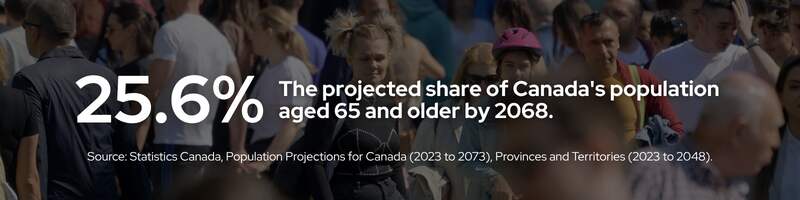
Almost one in five Canadians, approximately 8.1 million people, were aged 65 and older as of July 1, 2025. Behind that statistic is a caregiving economy absorbing millions of unpaid hours annually, disproportionately carried by women, and largely invisible to every economic measure we have.
The fertility rate compounds the challenge. Canada recorded its lowest fertility rate in history in 2024, at approximately 1.25 children per woman. That is not just a demographic signal. That is a shrinking caregiving workforce we have not planned for.
These are not separate problems. They are the same problem seen from different ends of the demographic arc.
A Grade C on Care

Canada’s intention to support aging in place is genuine. The delivery is not.
In my professional and personal experience assessing home care across this country, I assign Canada a solid C: full of good intentions, undermined by alarming variation between and within provinces.
Too often, families resort to hospitals and long-term care facilities not because they are the right fit, but because the void of accessible, coordinated information makes alternatives invisible.
Institutional solutions are not inherently suboptimal. Providence Living in BC demonstrates this with its innovative approaches to caring for residents living with dementia, who are showing meaningfully reduced use of medication.
In my industry, objective measures of unique care outcomes are genuinely difficult to find. This one matters.
Lessons from Japan: A Framework, not a Blueprint
We do not need to design solutions from scratch. Japan arrived at the urgent aging demographic inflection point before any other nation, with approximately 30% of its population over 65 as of 2024, compared to Canada’s 19.5% according to Statistics Canada’s July 2025 estimates.
What Japan offers is not a model to copy, but a proof of intent: that a society can decide to treat elder care as a shared responsibility rather than a family burden.
In 2000, Japan implemented mandatory long-term care insurance under the framing of “from care by family to care by society.” The mechanism matters less than the philosophy: a coordinating framework with a clear mandate, rather than a patchwork of provincial programs.
Japan has not solved the care problem. It has demonstrated that naming the problem explicitly and building institutional architecture around it produces better outcomes than improvisation. Canada is still improvising. Canada is still full of good intentions.
Responding With Urgency to Canada’s Aging Population
“Canada’s aging population health crisis and the crisis of care are co-morbidities with each accelerating the other, and both demand treatment now, not after the next commission reports.”
In my experience, there is no shortage of conversation about policy, opportunity, and demographic change. There is an alarming shortage of activation.
Canada’s aging population health crisis and the crisis of care are co-morbidities with each accelerating the other, and both demand treatment now, not after the next commission reports.
This is why, alongside policy advocacy, I established the Relentless Venture Fund, created specifically to invest in the most common health issues associated with aging.
Policy moves slowly. Capital can move faster. Both are needed.
Why Youth Cannot Wait
I would genuinely love to write a piece focused entirely on the hopes of young Canadians. I cannot do so honestly without demonstrating that we are committed to supporting those affected and not simply asking them to bear the consequences of decisions made on their behalf.
The seniors of 2045 are the working Canadians of today. The caregivers of 2035 are today’s aspirational young people.
World Population Day is not a moment for alarm. It is a recurring invitation to choose deliberately. Canada has the institutions, the innovation capacity, and the demographic data to build for the population it is becoming. What has been missing is a continuity of political execution.
Three Actions to Prepare Canada for an Aging Population
My three calls to action are:
- Canada needs a National Aging Strategy with a cross-ministerial mandate. This is not solved with another commission, but by establishing a framework with named accountabilities and a published timeline. Canada’s most recent coordinating framework on aging is from 1998. A 2021 analysis commissioned by the Canadian Medical Association projected that elder care costs will nearly double, from $29.7 billion annually in 2019 to $58.5 billion by 2031. The same analysis found that proactive investment in home care could divert 37,000 Canadians from institutional care, saving $794 million per year. We are not short of evidence. We are short of action. The federal government, not individual provinces, must lead this.
- Canada needs to formally count and compensate the invisible caregiving workforce. The Canada Caregiver Credit is not compensation. It is a step in the right direction toward acknowledgement. The UK’s Carer’s Leave Act 2023, in force since April 6, 2024, across England, Scotland, and Wales, offers a precedent for a more compelling next step.
- Private and public funders must allocate capital to initiatives prioritizing the health of our aging population.
We need political leaders willing to measure success not by the next election cycle, but by the demographic reality arriving regardless of who wins it.
The clock that started ticking in 1987 has not stopped. Neither should we.
About the Expert
-
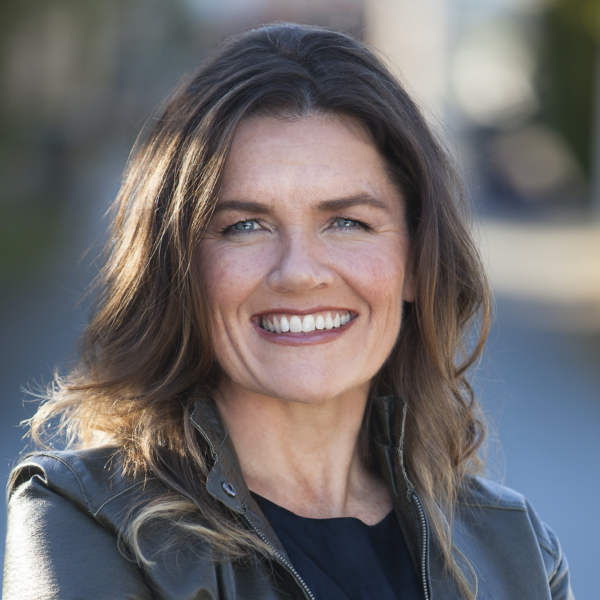
Brenda Irwin is the founder and managing partner of Relentless Venture Fund, a health technology venture capital fund. A healthcare investor for more than two decades, she was previously a life sciences venture capitalist at BDC and has served on more than two dozen private, public and nonprofit boards.
Relentless Venture Fund invests in health technology companies backed by clinical research. The fund focuses on preventive health, chronic-condition management, activity and longevity.
See more
-
 Canada Needs A Population Strategy: Balancing Immigration, Growth and Aging
 Daniel Hiebert
Emeritus Professor of Geography
University of British Columbia
Daniel Hiebert
Emeritus Professor of Geography
University of British Columbia
-
 A Sustainable Framework for Long-Term Care Development: Emphasizing Public Private Partnerships and Risk Allocation
 Melissa Di Marco
Partner and Global Co-Lead
Accuracy Canada
Melissa Di Marco
Partner and Global Co-Lead
Accuracy Canada
-
 A Retirement-Ready Canada is a Competitive Canada
 Derek W. Dobson
CEO
CAAT Pension Plan
Derek W. Dobson
CEO
CAAT Pension Plan