
A Retirement-Ready Canada is a Competitive Canada
Canada’s economic future depends on shifting from inadequate individual savings to large-scale, pooled pension plans that empower retirees, drive consumer spending, and position the country as a global leader in securing lifetime income.

“Financially secure retirees, especially those with predictable lifetime income, are an economic advantage for Canada.”
Canada will soon join the ranks of countries like Japan, Italy, and Finland that have more than 20% of their population over the age of 65. As a “super-aged” society, we will face unique challenges and opportunities as we adapt to the largest age cohort retiring from the workforce. Now is the time to focus on modernizing retirement income to tap into new sources of economic value.
As the CEO of one of Canada’s fastest-growing pension plans, with employers across 20 industries, I’ve been working with leaders on the strong business case to improve retirement security. Increasingly, they’re saying that efficient, risk-managed retirement programs can significantly improve attraction, retention, productivity, and employee engagement. This helps them better achieve their strategic goals, while also benefiting Canada.
Financially secure retirees, especially those with predictable lifetime income, are an economic advantage for Canada. They:
- provide a strong, stable, and predictable tax base;
- strengthen consumer spending; and
- reduce costs and pressure on social programs.
Yet, in Canada, too few workplaces are participating in effective retirement programs, and fewer Canadian employees are reaching retirement with financial security. The challenge here is the lack of utilization of Canada’s modern pension model. This is a missed opportunity for individuals, businesses, and Canada, and it has a significant impact on us all.
Retirement Insecurity Will Cost the Economy
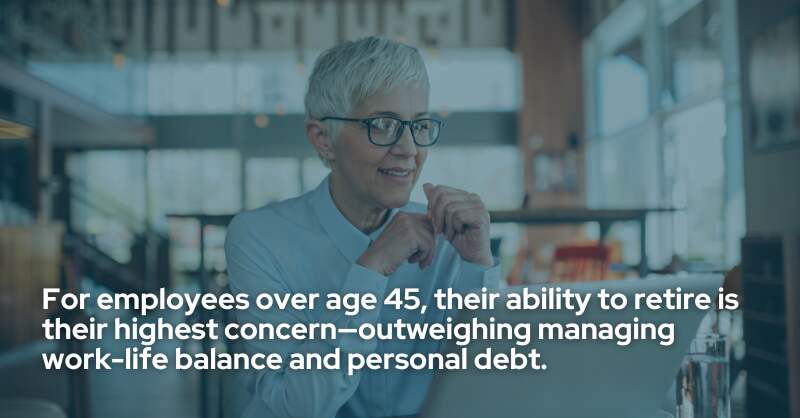
Canadians across generations are worried about retirement. For employees over age 45, their ability to retire is their highest concern—outweighing managing work-life balance and personal debt. Various studies show that all generations fear running out of money in retirement, with some average savings estimates as low as $5,000.
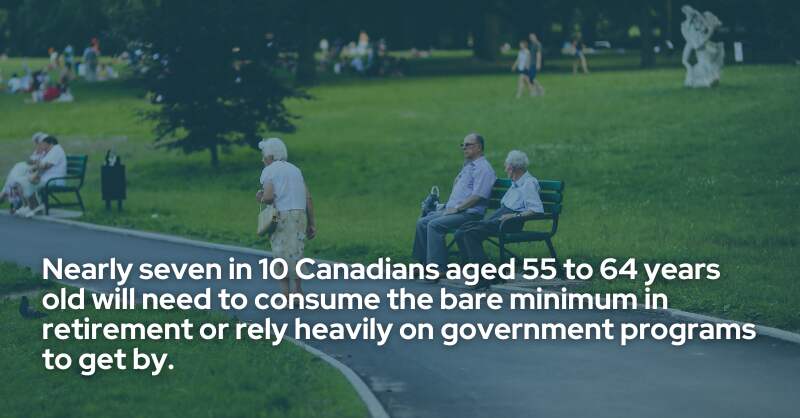
These aren’t just personal finance concerns; they are macroeconomic risks. Deloitte Canada estimates that nearly seven in 10 Canadians now at typical pre-retirement age (55 to 64 years old) will need to consume the bare minimum in retirement or rely heavily on government programs, such as Old Age Security (OAS) and the Canada Pension Plan/Quebec Pension Plan (which barely cover basic living expenses). That’s over two million Canadians in that cohort alone.
“The average public health care cost of a 65-year-old is 400% higher than the cost for those below age 65 and will continue to rise starkly in the mid-to-late retirement years. “
Today, these safety nets come at a higher relative cost than when they were introduced over 50 years ago. OAS is not pre-funded but is paid through general tax revenue from Canada’s shrinking working-age taxpayer base. Health care costs continue to rise as Canadians live longer. Demand for long-term care options far outpaces supply. A report by the Conference Board of Canada shows the average public health care cost of a 65-year-old is 400% higher than the cost for those below age 65 and will continue to rise starkly in the mid-to-late retirement years.
Statistics Canada projects that Canada’s senior population aged 85 and over will grow from 911,900 people in 2024 to between 3.2 and 4.1 million by 2074. Social programs will grapple with added pressure at the same time governments are reckoning with growing debts and the need to invest in long-term economic prosperity.
We can improve the outlook for future retirees by providing better retirement solutions to more employees now. Changes today can pay huge dividends in the future.
We Save Better When We Save Together
“Canadians enrolled in large, well-managed pension plans benefit from pooled resources that lower investment costs, grant access to asset classes that are not readily available in the retail market, and, based on several studies, receive up to twice the income per contribution dollar.”
Too many Canadians are on their own when it comes to funding their retirement, which for most will be between 20 and 30 years. We know Canadian employees want a secure retirement. The good news is that employers that are offering lifetime retirement income plans have shared that effective retirement programs can dramatically improve employee retention and engagement, which in turn drives business success. But many employers believe they can’t afford to offer what their employees want. And they can’t, if they do it alone.
Advancing collective solutions to fund retirements is the next step towards a financially independent retiree class and a healthier economy. Canada has a world-class model that can deliver valuable retirement income efficiently and at scale for the private, non-profit, and broader public sectors.
Canadians enrolled in large, well-managed pension plans benefit from pooled resources that lower investment costs, grant access to asset classes that are not readily available in the retail market, and, based on several studies, receive up to twice the income per contribution dollar compared to other retirement savings plans.
These plans have the expertise and scale to provide valuable pensions for employees with less risk and minimal administration for employers. They are increasingly opening to employers outside their original sectors and jurisdictions. This is broadening access to efficient, pooled retirement income options that share risk and deliver the stability that individuals need.
“Spending from pension payments in 2019 contributed $82 billion to Canada’s Gross Domestic Product and supported over 877,000 jobs.”
Pooling investment and longevity risks also gives average Canadians a secure path to lifetime retirement income without needing to be savvy investors. The retirement industry is working to introduce dynamic pension pools, or Variable Life Benefits, which would allow individual Canadians to turn all or a part of their savings into lifetime retirement income. As the Global Risk Institute notes, “[w]hile protecting a single individual from outliving their savings is often prohibitively expensive, the same protection becomes affordable when spread across a large group.”
The economic benefit of secure lifetime retirement income comes from retirees spending with confidence in their communities. According to the Canadian Centre for Economic Analysis, spending from pension payments in 2019 contributed $82 billion to Canada’s Gross Domestic Product and supported over 877,000 jobs. These figures have surely increased substantially since then. The Canadian Centre for Policy Alternatives found that federal revenues will be $24.5 billion higher in 2025 due to workplace pension income.
Today’s financially secure retirees contribute to the economy as consumers, taxpayers, and volunteers. They tend to be healthier. They provide the government with a secure, predictable tax base for decades into the future. Overall, they positively contribute to the social fabric of Canada. Adding future generations to this equation is essential.
Next Steps: Turning Retirement Income into an Economic Engine
Canadians are living longer and healthier lives, which will reshape how businesses define and serve consumers, and how employers engage employees. Redesigning retirement in Canada is not as complex as many believe. The first step is easy: we must expand access to Canada’s large-scale, world-class pension plans and allow for their continued innovation.
The future of Canada’s economy depends on how we prepare today’s employees for their retirement. Financially secure retirees are a path to economic strength and stability for generations to come.
About the Expert
-

Derek leads one of Canada’s fastest-growing workplace pension plans. With over 30 years of industry experience, he champions innovative solutions that improve retirement security for Canadians and business outcomes for employers. For this work, he received the 2023 Institutional Connect Lifetime Achievement Award and 2019 ACPM Industry Award.
See more
-
 How Board Effectiveness Can Strengthen Canada’s Future Economy
 Ciara Wakita
Partner
Hugessen
Ciara Wakita
Partner
Hugessen
-
 What Canada Must Do Now to Strengthen Productivity: OECD Economic Survey of Canada
 Alvaro Pereira
Chief Economist and G20 Finance Deputy
OECD
Alvaro Pereira
Chief Economist and G20 Finance Deputy
OECD
 Katja Schmidt
Senior Economist and Head of the Canada Desk
OECD’s Economics Department
Katja Schmidt
Senior Economist and Head of the Canada Desk
OECD’s Economics Department
-
 Certainty in Chaos: Canada’s Path to Unshakable Economic Leadership
 Stéphane Paquet
President & CEO
Montréal International
Stéphane Paquet
President & CEO
Montréal International
 Jacquie Griffiths
President
Invest Vancouver
Jacquie Griffiths
President
Invest Vancouver