
Can AI Help Solve the Accounting Skills Gap?
AI can transform accounting from manual number-crunching to strategic, technology-driven work – helping firms close the skills gap, boost productivity, and attract a new generation of talent.

In 2025, AI is no longer just a buzzword; it’s becoming an answer to real workforce challenges, including the accounting skills gap. Across every industry, embracing AI tools has become both a strategic advantage and an operational necessity. What was once considered cutting‑edge or experimental is now integral to how competitive organizations operate day to day.
The pace of AI innovation is unlike anything we have seen, and it only continues to accelerate. It’s an incredible time to be in business because the way work gets done is being redefined before our eyes.
“Canadian firms are trailing their global peers when it comes to implementing AI.”
For example, in July, OpenAI released its ChatGPT Agent, a new underlying model that can control a browser to complete tasks on your behalf. Today’s most advanced AI agents can plan tasks, correct spreadsheet formulas, and interact with complex tools like Excel. It can even manage ordering, inventory and pricing for a vending machine business, or simulate real-world scenarios such as closing the books for a SaaS company. Every single day, models improve, only getting better and faster, and there is no slowing down.
With such fast-paced innovation, it’s encouraging to see Canada’s government placing AI at the core of its economic strategy. The recent appointment of the country’s first AI Minister signals a clear commitment to innovation, alongside policies designed to boost AI adoption across public and private sectors. These initiatives aim to drive productivity, efficiency, and new opportunities for growth, positioning Canada to compete in an increasingly technology‑driven global economy.
However, a recent survey by Georgian Partners found that Canadian firms are trailing their global peers when it comes to implementing AI. Despite strong policy signals, many businesses remain cautious or slow to act. Canadian organizations need to follow the government’s lead and embrace AI. It’s no longer a futuristic concept but a crucial tool for staying relevant, and those who delay risk being left behind in a world that is moving faster every quarter.
The Gap Between Businesses Adopting AI is Widening

Many businesses are falling dangerously behind in AI adoption. Not long ago, forward‑thinking firms were those moving from paper ledgers to spreadsheets. Today, however, the divide lies between companies that persist with outdated desktop software and those that have adopted modern AI‑native systems that can help offset workforce shortages and skills gaps, unlocking immense productivity in the process.
“To maintain an edge, companies must also commit to continuous learning, keeping up with the latest features, updates, and capabilities.”
In the digital world, intelligence is different. The skill is knowing what to use and when, then adapting faster than others. Just as tools enhance AIs, people are also better with tools, and now there are intelligent tools that utilize tools themselves. But make no mistake, the winner won’t be the tools; it will be the people and companies who understand how to use them.
As we know, AI-native tools never remain static; they learn and improve over time, becoming more valuable with every use. In the not-so-distant future, firms that continue to cling to legacy systems will no longer match the speed and service that customers will come to expect.
But adopting the technology is only the first step. To maintain an edge, companies must also commit to continuous learning, keeping up with the latest features, updates, and capabilities. This ongoing evolution is essential in a digital landscape that changes rapidly and rewards those who adapt.
One industry that stands to reap significant benefits from the adoption of AI is accounting, especially as it grapples with a widening talent gap.
The Future of Accounting Depends on a Bold AI Pivot
According to a recent survey by Dext, 29% of Canadian SMBs’ financial management is still manual, while only a third use any form of software to automate the admin.
“The average age of accountants in Canada is now 47, meaning a large portion of the workforce is edging toward retirement, with few replacements learning the required skills to take over.”
Some accounting firms, often smaller and more traditional ones, remain reluctant to use AI. They still rely on time‑consuming manual processes even as the well-documented talent shortage deepens and the next generation shows little interest in pursuing the profession.
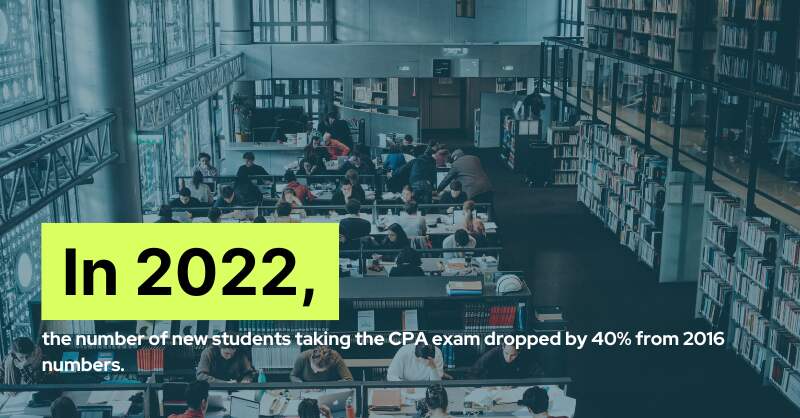
The Association of International Chartered Professional Accountants (AICPA) reports a 40% drop in new students taking the CPA exam between 2016 and 2022. According to CPA Canada, the average age of accountants in Canada is now 47, meaning a large portion of the workforce is edging toward retirement, with few replacements learning the required skills to take over. This demographic shift has far‑reaching implications for firms struggling to meet demand.
There are many reasons younger professionals are choosing not to pursue the accounting field—pay, burnout, and inflexible hours among them. But what if the accounting industry looked at the opportunities for AI in its sector differently? What if, instead of seeing AI as a potential threat, they recognized that it could make the profession more appealing to the younger generation? Younger workers, digital natives, compared to their seasoned counterparts, are comfortable with new tools and automation. They can help lead the way in ensuring firms stay current with new features and capabilities, positioning them to thrive in a faster‑moving digital world.
While accounting has long been stereotyped as boring and monotonous, integrating AI tools can transform the profession. By reducing reliance on outdated processes and easing the strain caused by a shrinking workforce, AI creates a more dynamic, technology‑driven environment, one that aligns with the expectations of younger talent looking for meaningful, future‑ready careers.
“Imagine a fresh generation of accountants who enter the field not to crunch numbers, but to shape business decisions.”
There are generalist AI tools like ChatGPT, and then there are more specialized AI tools created for the accounting space, like our bookkeeping automation platform. We’ve witnessed firsthand how firms using AI-native tools can shift their focus from admin to advisory, even with leaner teams. For example, our AI-powered platform has already processed over 173 million invoices, 8.4 million bank statements, and more than five million line items for our clients in the last six months—all at 99% accuracy and in much less time.
Imagine a fresh generation of accountants who enter the field not to crunch numbers, but to shape business decisions. With AI, that future for the next generation of accountants is possible, and already happening.
AI Brings a Shift From Monotony to Strategic Advisory Work
The future of accounting isn’t just about adopting AI; it’s about using AI to unlock capacity, close skills gaps, and elevate the value accountants deliver. Applied AI (where AI technology is embedded directly into workflows) can automate data processing and reporting, freeing accountants from repetitive manual tasks. For junior accountants, this means working alongside AI by letting it handle routine tasks while they verify results to ensure financial data, such as reconciliations, is complete and accurate. Applying human judgment before acting on AI‑generated recommendations becomes a key task for accountants, as does keeping up on the latest AI features, updates and capabilities.
“Firms that embrace AI and digital tools will operate more efficiently and evolve into trusted strategic partners to their clients, who can anticipate challenges and identify opportunities in real-time.”
For senior accountants, AI opens doors to higher‑value contributions. With less time spent on manual review, they can focus on strategic advisory work: helping businesses with financial management, cash flow, tax planning, and data‑driven insights that guide future decisions—the kind of work that makes the profession truly valuable to clients and attractive to the new generations of accountants. When all the answers are available from AI, the value is in asking the right questions. Firms that embrace AI and digital tools will operate more efficiently and evolve into trusted strategic partners to their clients, who can anticipate challenges and identify opportunities in real-time. They can also devote more time to mentoring and involving junior associates in these higher-value projects, which contribute to the financial success of their clients.
To make this shift successful, firms need to invest not only in the right technology but also in training and change management. Accountants at every level should feel confident using these tools and understand how to balance automation with human oversight. Firms that support this evolution will stand out in a competitive hiring market, attracting talent that wants to be part of an industry that’s moving forward, not stuck in the past.
Businesses Are Only Going to Get Faster
Today’s most successful companies set new expectations for speed, responsiveness, and client experience. Global giants like Amazon and Uber have raised the bar, forcing everyone else to rethink how they deliver value. While these examples might feel distant from accounting, the same pressures apply—clients expect quicker turnaround times, proactive advice, and seamless digital experiences.
“For accountants, this evolution is substantial. Their role shifts from routine data entry to higher‑order tasks like validating insights, applying professional judgment, and advising clients with a deeper, real‑time understanding of their finances.”
AI levels the playing field, giving firms of any size the ability to operate with greater efficiency and agility. By streamlining tasks like quoting, payroll, and invoicing, AI frees up valuable time and resources that can be redirected toward higher‑value client service work, strategic planning, and innovation. Smaller firms in particular can use AI to punch above their weight, offering services and insights that previously only larger organizations could deliver.
For accountants, this evolution is substantial. Their role shifts from routine data entry to higher‑order tasks like validating insights, applying professional judgment, and advising clients with a deeper, real‑time understanding of their finances. It will also make the profession far more appealing to younger generations who want meaningful, tech‑enabled work rather than having to toil at repetitive processes.
Adopting AI doesn’t remove the human element; it amplifies it. Accounting firms that embrace this mindset and leverage the technology will have the “unfair” advantage. They’ll be the ones to navigate the skills gap effectively, attract top-tier talent, and redefine what the future of the profession can offer. At the end of the day, they’ll be the ones that remain in business by providing the speed and strategic advisory work their clients will come to expect and demand.
About the Expert
-

Stephen Edginton, leads the global product and engineering teams at Dext in crafting top-tier, AI-driven solutions empowering businesses, accountants, and bookkeepers to do more. Formerly the Chief Innovation Officer and SVP of Engineering at Epicor Software and co-founded the software development and consultancy company Dot-Net-IT, aiding global clients in digital transformations. With a rich background collaborating with diverse businesses, Stephen advocates AI as the key to unlocking greater potential in the business realm.
See more
-
 Canada’s Insurance Industry Has A Productivity Crisis. AI Can Cure It.
 Jackson Fregeau
CEO & Co-Founder
Quandri
Jackson Fregeau
CEO & Co-Founder
Quandri
-
 Can AI Help Canada Build the Future of Life Sciences?
 Handol Kim
Co-Founder & CEO
Variational AI
Handol Kim
Co-Founder & CEO
Variational AI
 Martin Enault
Chief Entrepreneur in Residence
Centech
Martin Enault
Chief Entrepreneur in Residence
Centech
 David D. Jones
Managing Director
Merck Canada
David D. Jones
Managing Director
Merck Canada
-
 Adoption Is Not Adaptation: The Reskilling Wave Canada’s AI Strategy Leaves Out
 Tracey Taylor-O’Reilly
Founder
Promentus
Tracey Taylor-O’Reilly
Founder
Promentus